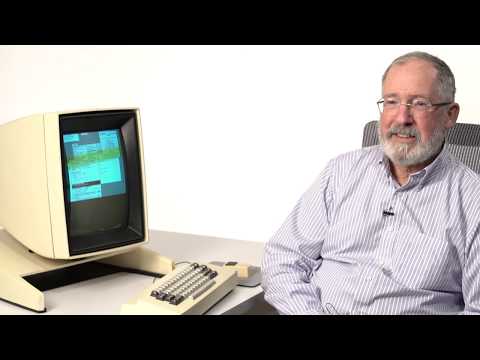
One of several demos of early integrated environments.
Full comment
It is a bit hard to explain in an HN comment something that requires live experience, You can start by having a look at, link "Eric Bier Demonstrates Cedar" link "Alto System Project: Dan Ingalls demonstrates Smalltalk" this video "SYMBOLICS CONCORDIA ONLINE DOCUMENTATION HYPER TEXT MARKUP 1985" link You can see how NeXT builds on many of these concepts on the famous "NeXT vs Sun" marketing piece, link Sun also had some ideas along these lines with NeWS, "NeWS: A Networked and Extensible Window System," link Naturally OS/2, BeOS, Windows, macOS, iOS, and even Android share some of the ideas. Now, before I proceed note that actually modern Linux distributions have all the tooling to make these concepts happen, but it fails short to have everyone agree on a proper stack. So basically, the main idea is to have a proper full stack in place for developing a Workstation computer as one single experience, from bottom all the way to the top. On Xerox's case, they used bytecode with in-CPU execution via programmable microcode loaded on boot, and later on just a thin native glue on top of host OS. The environments had frameworks / modules for the whole OS stack, supported distributed computing, embedded of data structures across applications (OLE can trace its roots back to these ideas), REPLs that not only could interact with the whole OS (commands, modules, running applications), it was also possible to break into the debugger, change the code and redo the failed instructions.