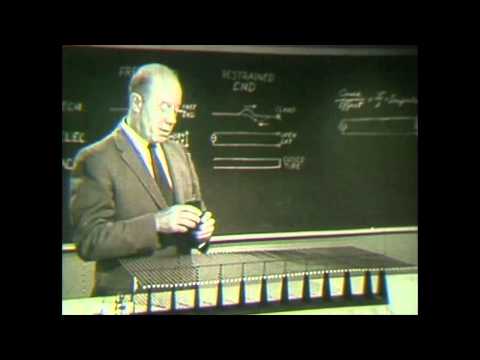
A Bell Labs film in which Dr. J.N. Shive uses a mechanical wave machine to demonstrate reflection, standing waves, resonance and impedance matching. He includes some equations but relies mostly on real-world examples a layperson can follow.
Why Hacker News points people here: HN repeatedly calls it the clearest introduction to waves and transmission-line behavior, better than modern explainers.
“By far the best introduction to the subject of waves of any sort.”HN comment, 2019
Made waves finally understandable through visual demos
Full comment
I'm even jealous of the engineering students that came before me! :P Visualization is such a powerful tool. I didn't really understand waves until I saw "Similarities of Wave Behaviour" this video
Strongly recommendstzsAug 2015
“made standing wave, reflections, energy loss due to impedance mismatch, and impedance matching much clearer than anything else I've seen”
Clear explanation of standing waves and impedance matching
Full comment
I've never understood why these old instructional films so often seem much better at getting things across and making them stick in my mind than more modern material. A couple other examples. 1. A 1959 film from Bell Labs on wave behavior that made standing wave, reflections, energy loss due to impedance mismatch, and impedance matching much clearer than anything else I've seen: [1]. 2. A 1937 explanation of how the differential in a car works: [2]. Here is another upload of that which is lower resolution, but has more from the same source in the sidebar [3]. I suppose it could be something akin to survivorship bias that makes old educational films seem so good--the bad ones don't get remembered 60 years later. [1] this video [2] link [3] link
Strongly recommendsCausality1Aug 2019
“By far the best introduction to the subject of waves of any sort.”
Best introduction to waves
Full comment
Bell Labs' 1959 video "Similarities of Wave Behavior." By far the best introduction to the subject of waves of any sort. this video
Strongly recommendstzsDec 2021
“This outstanding 1959 movie from Bell Labs demonstrates standing waves, impedance matching, and more in a very nice way”
Outstanding demonstration with Shive wave machines
Full comment
This outstanding 1959 movie from Bell Labs demonstrates standing waves, impedance matching, and more in a very nice way using a couple of Shive wave machines, hosted by Dr. Shive himself [1]. [1] this video [2] link
Strongly recommends_trampeltierMay 2022
“This very old video does it all explain better than all todays videos.”
Simple physical models explain better than modern videos
Full comment
This very old video does it all explain better than all todays videos. The models are just so simple, no animations. this video
Strongly recommendsfsocietyNov 2023
“Think of it as a wave, and then watch this video”
Builds a strong wave-based mental model of circuits
Full comment
Thinking of an electron as a thing that travels from the start of the circuit to the end results in a bad mental model. Think of it as a wave, and then watch this video this video . Then you will have a strong mental model.
Strongly recommendsJoel_MckayJan 2025
“John Shive's Wave Machines is where every student should start”
Wave machines as starting point for students
Full comment
Get a ham radio technician license, and you may develop an intuitive perspective on most electrical engineering concepts. i.e. the physics lab derivation of the core EE tool set is unnecessary if you understand what the models are describing. AI is slop in and slop out... and dangerous to students... =3 John Shive's Wave Machines is where every student should start: this video
Strongly recommendsJoel_MckayMar 2025
“John Shive's Wave Machines is where every student should start”
Wave machines as starting point for students
Full comment
It is not "hard" after some practice, but you need to be willing to learn. In general, DFM is a specialized area most EE have zero training in unless they chose to study it as an option. John Shive's Wave Machines is where every student should start: this video Remember to have fun =3
RecommendstopspinMar 2017
“Shive uses a mechanical transverse wave machine to demonstrate the concepts involved in transmission lines, including reflection, standing waves and impedance matching.”
>> Anyone know of more videos like this one? Sure. Similiarities of Wave Behavior (1959) this video The link above skips the modern fluff at the beginning. Shive uses a mechanical transverse wave machine to demonstrate the concepts involved in transmission lines, including reflection, standing waves and impedance matching.
RecommendsnudgeeeAug 2020
“Also check out the excellent video from Bell Labs”
Also check out the excellent video from Bell Labs: “Similarities of Wave Behaviour (1959)” [0], which showcases termination, reflection, resonance and impedance using the Shive Wave Machine. [0] this video
Recommendspeter_d_shermanOct 2020
“this video, at the point I've noted, explains the answer why.”
Explains resonance and coil placement in a Tesla coil
Full comment
Thank you for this link! The part starting here is particularly interesting to me: this video Why is that? Well, because a long time ago, I built an extremely low-power battery operated DC Tesla Coil. It worked, but the one thing I could not figure out was why the coil with the small number of turns, the coil that typically encircles the long coil with the many turns, why this coil with smaller turns -- had to be positioned a slight distance up the many turns coil, and not either directly at its end, nor at its middle. Well, this video, at the point I've noted, explains the answer why. It also explains the relationship between frequency, length of resonator, and ability to create larger amplitude waves via additive superposition, that is, the ability of one wave, travelling in one direction, has the ability to add to the amplitude/crests of another wave travelling in the other direction BUT IF AND ONLY IF THEY ARE IN PROPER ALIGNMENT ! Which, incidentally, is the principle behind how a laser works (in addition to a Tesla Coil!). Also, there's the knowledge here that we can change the frequency to match the resonating coil/cavity/resonator length/etc., OR we can change the resonator length/coil length (in a Tesla Coil this is accomplished by moving the smaller outer coil with less turns on it) to match the frequency. So we can choose one to adjust to match what's needed by the other. Now, if say, a Tesla Coil is storing energy when in operation by additive/constructive interferen
RecommendstzsDec 2020
“covers in a very clear way these topics: reflection of waves from free and clamped ends, superposition, standing waves and resonance”
Clear college-level coverage of reflection, standing waves, impedance matching
Full comment
Another great older film is "Similarities of Wave Behavior" [1] from Bell Labs. It was aimed at college students, and covers in a very clear way these topics: reflection of waves from free and clamped ends, superposition, standing waves and resonance, energy loss by impedance mismatching, and reduction of energy loss by quarter-wave and tapered-section transformers. [1] this video
RecommendssegfaultbuserrApr 2021
“watch this classic tutorial from the mid-50s in the AT&T archive.”
Classic tutorial on reflections from open and short circuits
Full comment
If you want to understand how TDR works, watch this classic tutorial from the mid-50s in the AT&T archive. The first 5 minutes, showing the reflection of an open and short circuit is enough. * AT&T Archives: Similiarities of Wave Behavior this video Many are surprised when they learned that it's possible to detect the location of a break in the mains wiring or an Ethernet cable, just by doing an electrical test from one end of the cable (some Ethernet cards even have builtin TDR support!). There's no closed loop, why is it possible to test anything electrically? Because at high frequency, the circuit becomes an electromagnetic waveguide. Basically like a radar, you send a fast electrical or optical pulse to the electrical cable or the optical fiber, the EM wave travels along the cable until it hits the break and reflects back. You record the time and listen for the echo. All discontinuities (such as damages) on the line will reflect and distort the original pulse. Use the speed of light to pinpoint the location of the fault.
RecommendssuperkuhJul 2023
One of five resources for learning RF
Full comment
There's no all in one stop for understanding radio but these 5 resources helped me a lot. The RF Get Down courses. This is by far the best material online to learn RF and how modulation works: link 3blue1brown's video tutorial on the fourier transform: link AT&T Archives: Similiarities of Wave Behavior this video Quadrature Signals: Complex, But Not Complicated by Richard Lyons, linklink Antenna Theory's website and forums, link I also highly recommend getting a $20 rtl-sdr USB software defined radio dongle. They're great toys for learning RF, what modulation is , and exploring the spectrum.
RecommendstzsJul 2023
“in a way that makes it really easy to understand.”
Covers reflection, standing waves, impedance mismatch in an easy way
Full comment
> And as a bonus, an explanation about transistors from 1953 And here is a 1959 video from the same source about wave behavior [1]. It covers reflection from open and closed ends, superposition, standing waves and resonance, impedance mismatching, and tapered-section transformers all in a way that makes it really easy to understand. [1] this video
RecommendsnudgeeeNov 2023
“one of the classic lectures on wave propagation and reflections”
Classic lecture on wave propagation across mechanical, electrical, acoustic systems
Full comment
In RF electronics, wires end up looking like transmission lines. Here’s one of the classic lectures on wave propagation and reflections, where it looks at similarities in wave behaviour across mechanical, electrical, acoustic and optical systems. AT&T Similarities of Wave Behaviour (1959): this video
RecommendstzsNov 2023
“The whole thing is useful, but those who are just interested in impedance and reflections can skip to chapters 4 and 5.”
Mechanical wave machine makes wave behavior visible
Full comment
This video from Bell Labs showing various behaviors of waves using a nifty mechanical wave machine to make everything visible might be enlightening. The whole thing is useful, but those who are just interested in impedance and reflections can skip to chapters 4 and 5. this video
Recommendsssl-3Jan 2026
“It's an easy thing to watch at any level, with both brilliant practical demonstrations and supporting math provided.”
Practical demonstrations plus supporting math on transmission lines
Full comment
For transmission lines: _Similarities of Wave Behavior_, presented by Dr. J. N. Shier (of Bell Labs fame, and whose team invented the phototransistor): this video It's an easy thing to watch at any level, with both brilliant practical demonstrations and supporting math provided.
Cites itDoxinSep 2020
“a torsion spring makes for a great analogue for waves of all sorts”
Full comment
Nice observation. And indeed with a little work a torsion spring makes for a great analogue for waves of all sorts: this video
Cites itssl-3Feb 2024Full comment
Wifi radios are generally designed for 50 Ohm impedances. But household TV coax in the States (RG-59, RG-6, RG-11, and friends) is 75 Ohm. And impedance matters. How much it matters varies by application, but it can be very important. There's more going on in bit of coax than a shielded conductor[1]. (Relatedly, twisted pair cabling like Cat5e has more going on than a few pairs of wires that happen to be twisted.) But the concept of having a pair of radios connected together with coax does, of course, work fine as long as the I's are crossed and the T's are dotted. I've set up PtP Wifi-ish wireless links on the bench with attenuators and coax jumpers instead of antennas, but I kept the characteristic impedance consistent throughout. (Many-to-many networks are also possible, with similar caveats.) [1]: Similarities of Wave Behavior, as presented by Dr. J.N. Shive, 1959. this video