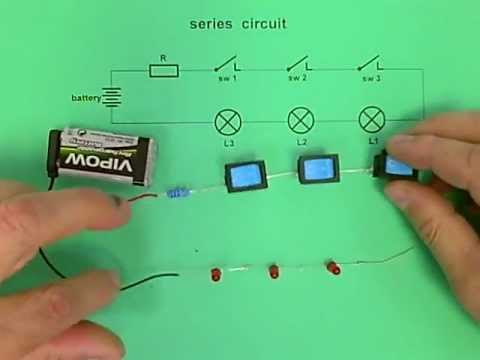
A three-minute demo of a series circuit with three LEDs that behaves in a surprising way, posed as a question of how it works.
Why Hacker News points people here: Cited as an example of how much surprising behavior can hide in seemingly simple circuits, in hardware backdoor discussions.
“don't underestimate what can be hidden in seemingly simple places”HN comment, 2020
“don't underestimate what can be hidden in seemingly simple places”
Shows how much can hide in simple circuits
Full comment
It's not quite a backdoor, but don't underestimate what can be hidden in seemingly simple places: this video Here's how that is doing it: link He's got several more, including this one which doesn't even use switches. You just tap the wire to toggle the LEDs: link I have no idea how that one works.
Cites itgaraetjjteApr 2018
“I have seen fun videos with seemingly simple circuits with LEDs and switches connected in series and they behaved completely differently”
Series LED circuit hiding clever filters
Full comment
Obviously not at SMD scale, but I have seen fun videos with seemingly simple circuits with LEDs and switches connected in series and they behaved completely differently (eg. each switch connected in series controlled other LED). It turned out that switches and LEDs have been modified with clever frequency generators and filter circuits. edit: this video
Cites itwanderingjewJun 2018
“this [1] is probably the best example.”
Best example of disguising components
Full comment
I'm not going to say 'no', but I would highly doubt it. If you're wondering what the 'state of the art' in disguising components to look like other components is, this [1] is probably the best example. It's a guy that turned a LED into an LED and an inductor, and put transistors inside of switches. What you're proposing -- basically putting a USB-capable microcontroller inside something that looks like resistor -- isn't impossible. I can imagine that it could be done, but I would have no idea how. You would probably go with a very small (physically) microcontroller, maybe one of the SOT-23-6 PIC or AVR packages. I don't think it's possible to write a USB stack for those, and you only have 1-2kB to implement a BadUSB [2] sort of thing. It might be possible, but I doubt it. Still, that size of package could be disguised as a (large) SMD resistor, although the PCB would look odd with the addition of extra traces. To be honest, it really wouldn't make sense to disguise a microcontroller as passive components. It's already been demonstrated journalists will gladly plug random USB devices into their computer. If you wanted the device to just pass a cursory investigation, you'd just put a glob of black epoxy over the USB port. Hiding a microcontroller as a pair of resistors might be possible, but it's far more effort than what is really needed. [1] this video [2] link