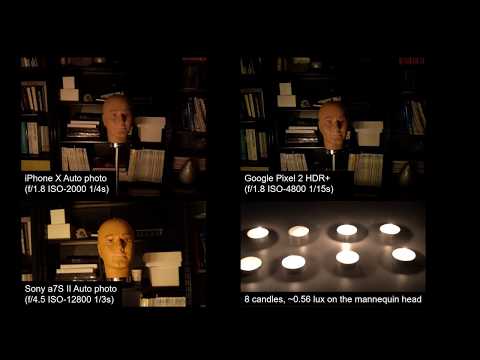
A short video accompanying the CVPR 2018 paper Learning to See in the Dark. It shows a neural network producing sharp images from very low-light raw sensor data, compared against denoising approaches.
Why Hacker News points people here: HN commenters flag it as a remarkable machine-learning result, notably for showing that training on raw images beats JPEG.
“Remarkable machine learning result for "producing astoundingly sharp photos in very low light”HN comment, 2018
“Remarkable machine learning result for "producing astoundingly sharp photos in very low light”
Remarkable low-light image enhancement result.
Full comment
Remarkable machine learning result for "producing astoundingly sharp photos in very low light" (Cory Doctorow - link ) Demo example (one of many examples - drag the middle slider from left-to-right): link GitHub: link Paper: link Video: this video
Cites itlovelearningAug 2018
“they found that training on raw images gives much better enhancement than JPEG”
Cited as example of training on raw images improving enhancement.
Full comment
Public raw image datasets are rare, probably because most cameras, except DSLRs, don't support storing raw images. Also, the nature of the inference may not require high fidelity raw images since they're going to be down-sampled anyway. Unless research suggests that raw images improve inference metrics, nobody's going to invest effort into building a raw image dataset. One notable recent exception to this is the "Learning to see in the dark" paper on low light image enhancement[1] - they found that training on raw images gives much better enhancement than JPEG. The data availability problem may start getting solved in the near future because mobiles (atleast Android) support storing and processing raw images, and on-device learning and inference capabilities are getting better all the time on mobiles. [1]: this video
Cites itperaApr 2020
“The video shows a comparison with some denoising”
Video shows comparison against denoising approaches.
Full comment
To me the results seem vastly superior to those sort of simple DSP algorithms. The video shows a comparison with some denoising: this video