
“Eric Chahi gave a great GDC”
Another World's creator discusses how the game was made.
Full comment
Another World's original author Eric Chahi gave a great GDC "Classic Game Postmortem" talk about creating the game: this video
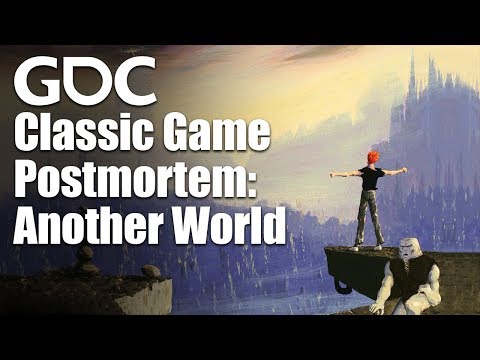
25K views · Nov 30, 2018 · 1:05:45 · 4 HN recommenders · 4 mentions · discussed 2020–2023
Eric Chahi's GDC 2011 postmortem of Another World (Out of This World), describing how he built the game. He shows his polygon art approach, rotoscoping and animation tools.
Why Hacker News points people here: HN points to it whenever Another World comes up, as one of the better GDC talks by the game's creator.
“it's one of the better GDC talks”HN comment, 2023
“Eric Chahi gave a great GDC”
Another World's creator discusses how the game was made.
Another World's original author Eric Chahi gave a great GDC "Classic Game Postmortem" talk about creating the game: this video
“Very cool video, wherein Chahi demonstrates his rotoscoping system”
Chahi explains polygon choice and shows his rotoscoping and animation tools.
Here's Eric Chahi explaining his decision to use polygons - he mistakenly thought that the Amiga version of Dragon's Lair used them! this video Very cool video, wherein Chahi demonstrates his rotoscoping system, where he could use the Amiga's genlock to trace live video in his (extremely impressive) homemade animation/code tool. The polygons in Another World are a bit different from today's games. In a modern game, game models would contain fully 3D representations of each model. Each polygon vertice would have X, Y, and Z coords. The CPU/GPU then render these out. In Another World, the polygons are 2D representations only, like paper cutouts. The animations are precalculated, and then at runtime they basically just need to be blitted out using some of the clever techniques mentioned in the linked article. You wouldn't really be able to alter the animations at runtime or change the perspective, but that was OK - it was a smart compromise to hit Chahi's stated target of about 20fps. This "2D polygon" approach was a brilliant way to overcome the limitations of CPUs at this time. There were fully 3D polygon games at the time, but they run at a fraction of the frame rate as Another World and contain only a fraction of the detail. The 2D polygon world of Another World felt fluid and real (well, relative to the competition at the time) and some convincing pseudo 3D effects could even be faked.
“also the author's GDC talk”
The author's GDC talk on Another World.
Also check out Fabian Sanglard's articles [0] (there's a lot more on his article listings) about Another World if you haven't yet, also the author's GDC talk [1]. [0] link [1] this video
“it's one of the better GDC talks”
Developer shows his tools and steps through animation VM bytecode.
The original developer of Another World did a GDC postmortem, it's one of the better GDC talks: this video IIRC He shows some of his development tools including how he could modify and step through animation directly line by line in VM bytecode.