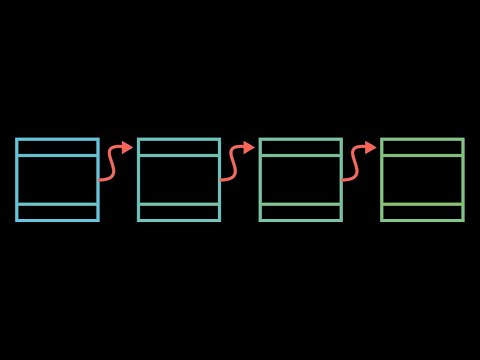
3Blue1Brown explains the math and mechanics behind Bitcoin visually: ledgers, digital signatures, proof of work and the blockchain, building up a decentralized payment system from first principles.
Why Hacker News points people here: The go-to recommended video for newcomers wanting a clear, visual explanation of how Bitcoin and blockchains work.
“this video is the best explanation for how mining and blockchains work IMO”HN comment, 2017
“IMHO the best intro to Bitcoin and cryptocurrencies in general.”
Quick visual intro to Bitcoin
Full comment
For a quick video intro I recommend this video from 3Blue1Brown ("youtube mathematician") this video IMHO the best intro to Bitcoin and cryptocurrencies in general.
Strongly recommendsahussainOct 2017
“Would highly recommend watching this video for anyone who hasn't already.”
Best explanation of blockchain
Full comment
The best explanation of blockchain has to be (unsurprisingly) 3Blue1Brown: this video Would highly recommend watching this video for anyone who hasn't already.
Strongly recommendsgnarbarianNov 2017
“this video is the best explanation for how mining and blockchains work IMO”
Clear, thorough explanation of mining and blockchains
Full comment
this video is the best explanation for how mining and blockchains work IMO: this video It's long but very clear and thorough.
Strongly recommendsRichardCAJun 2024
“I decline to discuss it without mentioning the 3Blue1Brown video”
Go-to video for discussing crypto properly
Full comment
> As someone that works in the crypto industry, I feel this every time I see the news or articles report on it, or comments here talking about it. It was the same way during the 90's Dot-Com era, journalists would explain the World Wide Web with word salad, e.g., the "Graphical portion of the Internet". With regard to Crypto, I decline to discuss it without mentioning the 3Blue1Brown video, sometimes the gambit works and triggers a better discussion: this video And I love the comments in that video about being "Confused, but on a higher level".
RecommendsagreenOct 2017
Included in an intro list for learning blockchain
Full comment
Intro: 1. link 2. link 3. this video 4. link 5. link 6. link Build Your Own Blockchain: 1. link 2. link 3. link Resource List for an Advanced Understanding (Multidisciplinary Approach): 1. link --- Additionally, here is some advice from Balaji Srinivasan (source: link ): 1. First, I'd master database and cryptography fundamentals, with something like Dan Boneh's course for the latter 2. Then, I'd read the Bitcoin.org and Ethereum documentation 3. Then, you should write short Python or Go scripts to do things like printing out the blockchain, formatting and signing a transaction by hand, managing private keys, that type of thing. This will give you a feel for the raw data structures. 4. After doing all this, I'd take a look at application libraries like Ryan Shea and Muneeb Ali's new blockstack.org The reason I'd do it in this order is that you would learn fundamentals first before proceeding to the cutting edge.
RecommendsAdrienCheyOct 2017
“As a quick and visual introduction, I would recommend”
Quick visual introduction to how Bitcoin works
Full comment
As a quick and visual introduction, I would recommend the great "Ever wonder how Bitcoin (and other cryptocurrencies) actually work?" youtube video from 3Blue1Brown this video
RecommendsddebernardyNov 2017
“Here's a short video by 3Blue1Brown on how cryptocurrencies work”
Short explanation of how cryptocurrencies work
Full comment
Mining and facilitating transactions, by which I'm assuming you're meaning certifying that transactions are legit, are the same thing. Here's a short video by 3Blue1Brown on how cryptocurrencies work: this video
RecommendsafarrellNov 2017
“builds from there with great visuals, so it is quite accessible.”
Accessible visual walkthrough of Bitcoin mechanics
Full comment
For a high-level introduction, this article in The Economist is where I'd advise someone to start: link Then, to make things feel more grounded, watch this video of a maths teacher walking you through the mechanics of what actually happens. He starts with "four friends who sometimes spot each other $5 for lunch" and then builds from there with great visuals, so it is quite accessible. this video
Recommendsj_sNov 2017
Recommended starting point on the Bitcoin blockchain
Full comment
Just over a month ago, HN user DennisP answered the question "How did you get into contract ethereum development?". link If you are starting back at the idea of the Bitcoin blockchain, see ahussain's recommendation of 3Blue1Brown a day later: linkthis video
RecommendsdrexlspiveyJun 2018
“This video does a very good job explaining what exact problems you would face if you tried to create a decentralized payment system”
Explains problems of decentralized payments and how Bitcoin solved them
Full comment
This video does a very good job explaining what exact problems you would face if you tried to create a decentralized payment system and how bitcoin solved these problems. this video
RecommendsaxbyNov 2021
“I really liked this video by 3Blue1Brown explaining how blockchain works”
Explains how blockchain and mining work
Full comment
I really liked this video by 3Blue1Brown explaining how blockchain works: this video Things that I didn't realize until I watched the video: * "Mining" bitcoin means processing transactions for other people. Miners do time consuming operations to process transactions. I had never heard of 3Blue1Brown before someone showed me that video, but he has a bunch of other good math videos. I liked the one about pi showing up in weird places.
Recommendsgrog454Jan 2022
“maybe this will help educate you”
Educational explanation of cryptographic ledgers
Full comment
What exactly isn't clear? How cryptography works / benefits people? How applying cryptography to ledgers and ownership databases works? Or how it's all going to be enforced? By the way I'm not pro crypto in that I'm not trying to convince people to put money into it. I think the energy costs of all crypto token systems are prohibitively high right now. That, and the deflation problem I personally think are the biggest unsolved problems in Bitcoin right now.. But somehow I can't even get past what a cryptographic ledger is and how it's beneficial on this forum, of all forums. Yikes. I've been patiently explaining my understanding of the ideas behind crypto. 3Blue1Brown seems to be favorably received on this forum, so maybe this will help educate you: this video NFTs are a natural extension of a cryptographic ledger as it's explained in that video. It's just adding non fungible tokens to the otherwise fungible bitcoin tokens being exchanged on the blockchain, and we'd like those non fungible tokens to represent real world objects, rather than just USD. Aside: I feel like we're in the dark age of cryptocurrencies right now. People are just incredibly unimaginable. I imagine 7,000 years ago there was a guy named Bob who wanted to trade his apples for some oranges. A girl named Alice wanted some apples but didn't have any oranges so instead she offers a piece of gold jewelry. Most of the Bob's on this forum would tell her to ** off. But there was some Bob who accepted the gold jewelr
Recommendsjstx1May 2022
“watch a youtube video or two about it”
Light intro to crypto tech without deep time investment
Full comment
If you're interested, watch a youtube video or two about it (e.g. this video ). You don't need to get super deep or spend too much time on it.
RecommendscowtoolsJul 2022
“I recommend watching 3blue1brown's video”
Explains how hashrate attacks and blocks work
Full comment
>If the majority of miners agree to it then the rest of the network either goes along with it, or they're forced to do a hard fork themselves. The only the hashrate attacks can do is alter the order of transactions (for example allowing them to replace their past transactions and double-spend). They cannot change the way in which users interpret blocks (for example, they cannot spend another user's outputs, change the value of a given output such as a coinbase output, or otherwise alter the tokenomics). I recommend watching 3blue1brown's video: this video >For the end user just trying to make a payment, it's irrelevant whether it's intentional or not, either way he is now faced with the spitting of his coins and the resulting chaos. Any reasonable vendor will wait for X amount of blocks to pass before accepting a transaction. You're describing a well known vector called a "Finney Attack", which becomes exponentially less likely for every block you wait. >What's the actual value of a bitcoin? There just isn't one. Take the number of pizzas that are being sold for bitcoins, and divide that by the number of bitcoins in circulation. I think you may find that the value of BTC/Pizza has not changed much over the last decade. I mean, what is the actual value of a dollar. It is not like we use the gold standard anymore. The dollar is valuable because it is a connected to a useful payment system. You don't mind holding some liquidity in US Dollars because you have an expectation that you
RecommendscowtoolsSep 2022
“Here is a good video that basically explains everything”
Good video that basically explains everything
Full comment
Here is a good video that basically explains everything: this video This is not a very good explanation, but basically, you can have a "currency" using just asymmetric key cryptography: users simply sign "transactions". The problem is that you need a central authority to confirm the order of transactions, otherwise the recipient of a "transaction" will not know if the funds associated with that transaction have already been spent to someone else ("double spending"). You can solve this using hashcash to make the transaction order hard to reverse- creating a "proof-of-work" by doing something that is easy to verify but hard to determine (like reversing a hash function). Another method is "proof-of-stake" wherein transaction order is not signed by a central authority but instead general users that are guided by some internal incentive structure. Cryptocurrency is often expensive to run or use because a cryptocurrency transaction has to be synchronized across the entire network of that cryptocurrency, and there are incentive structures like fees to prevent people from spamming the network. There is also tech like zero-knowlege-proofs, multisig, etc. that can do interesting stuff. But this is the basic concept.
RecommendscowtoolsSep 2022
“If you are new, I recommend this video on bitcoin's design”
Intro to Bitcoin's design for newcomers
Full comment
>transaction fees will prop miners up (though it hasn't happened yet so it's valid to be doubtful this'll happen in practice) No, they won't. This is a common talking point, but it is rarely accompanied by facts. Consider that fees currently amount to about about a percent of the total miner payout. There is some research that indicates that bitcoin is vulnerable to a class of double-spending attacks known as selfish mining: linklink >And also depends what you mean by securing. All clients, miners and not, are capable of checking transaction and discarding "insecure" and invalid chains. I don't need a miner to tell me if your transaction is valid or not. No they aren't. You misunderstand the fundamental design of bitcoin. The problem is not that the non-mining nodes cannot verify signatures or something, the problem is that these non-mining nodes will not be able prove to each other that the signatures to not refer to already spent funds. The non-mining nodes cannot conclusively prevent reorgs that can be used for double-spend attacks. >All clients, miners and not, are capable of checking transaction and discarding "insecure" and invalid chains. They do this by selecting the chain with the highest amount of PoW associated with it. If the network hashrate is low relative to an attacker, then any attacker will be able to easily overpower the network and decide which chains are invalid. If you are new, I recommend this video on bitcoin's design: this video
Recommendsc54Nov 2022
“3Blue1Brown video went a long way”
Helped grasp the basics of Bitcoin and Ethereum
Full comment
It depends on the specific protocol (aka blockchain or token) you're using. For instance, bitcoin is very simply publicly visible, each transaction is broadcast in the clear and you can trace inputs and outputs online [0] Other protocols, such as zcash, specifically obfuscate the inputs and outputs using cryptography, in ways that I'm not specifically sure how to explain, but are supposed to work. In some ways to me this is unsurprising in a way different from the ponzi nature of crypto. I can't explain Ed25519 either, and I'd also get bogged down reading a paper explaining it. I can get my head around the basics of btc and pre-proof-of-stake ethereum though, this[1] 3Blue1Brown video went a long way. Definitely not going to disagree that lots of tokens are ponzis, and lots of the tech and promises are imaginary vaporware. But there are some real pieces of tech in the mix too. [0] link [1] this video
Cites itshpxSep 2017
Cited for confirmations needed on a transaction
Full comment
Although bitcoin aims to generate a block every 10 minutes, in practice it usually takes longer than that. As I'm writing this, the last block[0] took 30 minutes to mine (sometimes it spikes to hours though[1]). Most importantly, a transaction needs[2] to be confirmed 4-6 times[3] meaning it should be 4-6 blocks in the past, so you're looking at a 1-2 hour transaction time. On top of that, if you want to pay less than a certain transaction fee[4] (right now it's $1.62[5]) you probably won't get into the next block, see link . Recall that 1 block = 20 minutes and add that on top of the confirmation time. [0] link look at the Timestamps of this block and the Previous Block [1] link [2] this video [3] link page 8 [4] link [5] link (a satoshi is 0.00000001 BTC, 10,000 satoshi is 40 cents right now) link
Cites itgrog454Dec 2021
Linked as background in a ledger and NFT discussion
Full comment
I thought "the real" NFT is determined by what people decide "the real" one is. This is not actually a problem. NFTs are (or at least can be) a certificate of authenticity within a cryptographic framework. You can forge any physical certificate of authenticity with enough time and effort, but if you manage to forge a cryptographic one in our lifetime then congratulations! You just broke encryption. Tangentially related: It amazes me how poorly people seem to understand anything in this space but especially cryptocurrency. In maybe one out of hundred discussions on cryptocurrency do I see any mention of a ledger, which is the entire point. If you use Venmo or any similar cash exchange app then you automatically stand to benefit from the use of a cryptocurrency. Venmo is a ledger. The only reason you are able to send $1 a thousand times a day to your friend with no transaction fee is because you're not actually sending any money to anyone (as most people would understand it). You're changing values in Venmo's database which is an implementation of a digital ledger. Only when you "square up" with Venmo by transferring money out of Venmo into your own bank account does any money move anywhere (in a way that would cost Venmo a non negligible amount of money themselves). Cryptocurrencies are digital ledgers that, unlike Venmo, are decentralized and cryptographically backed. This means its physically impossible for Venmo (or anyone) to freeze or seize your assets, and impossible for