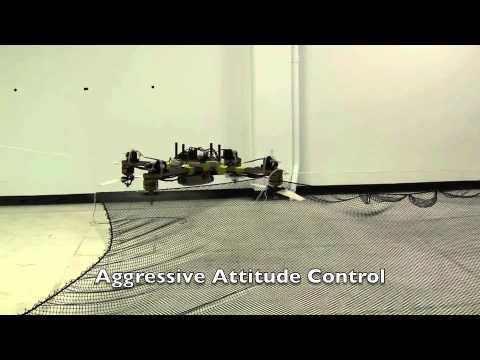
The example you posted has far more things in common with a multirotor than with a helicopter. What amazes me at those little things is how little side-to-side drift they have, considering that's all depending on the CG being well centered. A nice variable pitch quad: this video
Cites itjonmrodriguezDec 2013Full comment
Are there other types of drones other than traditional quadcopters, for example variable-pitch quadcopters [1], that can get more airspeed and thus cover more distance in 15 min? What about using airplane-style drones (like traditional RC planes) + a parachute to land the package? And this way you could use nitro gas fuel to get better energy density (since you can use one big gas engine instead of having to use four tiny motors) [1] this video
Cites itjakemoshenkoAug 2016
“MIT has also demonstrated a variable pitch quadcopter.”
MIT variable pitch quadcopter demonstration
Full comment
Manned multicopters have already happened. [1] MIT has also demonstrated a variable pitch quadcopter. [2] If they can use plasma laminar detachment and reattachment to somehow simulate a variable pitch propeller, while still getting some weight savings over a design with multiple swashplates, then yes I think it should help the quadcopter design scale up to larger propellers. That's a big if though, since to simulate a negative angle of attack I'm guessing your propeller design would have to be pretty inefficient with all plasma turned off. I'm not entirely sure why you want this though, since the single large rotor is more efficient. There was a novel design a few years ago with one large rotor for lift and three smaller ones to counter torque and provide control. [3] [1] link [2] this video [3] link