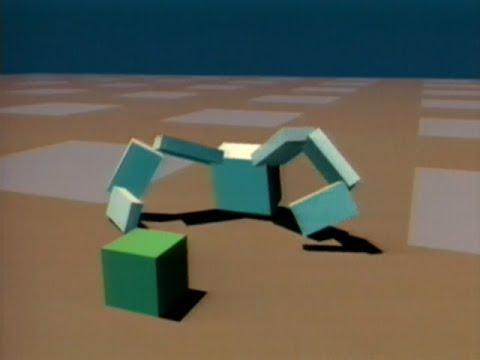
A restored 1994 video of Karl Sims' research on evolved virtual creatures, where simulated block creatures are bred through artificial evolution to swim, walk, follow and compete. It is a landmark demonstration of genetic algorithms in physics simulation.
Why Hacker News points people here: HN brings it up as a classic example of evolutionary algorithms, including how the creatures exploited physics-simulation bugs, which parallels metric gaming in AI.
“they would absolutely exploit any bugs in the physics simulation that they could”HN comment, 2024
Beautiful video. I would love to see this animation technique combined with an evolution simulation similar to Karl Sims' Evolved Virtual Creatures project: this video Previous HN discussion: link
Cites itdahartDec 2024
“they would absolutely exploit any bugs in the physics simulation that they could”
The discussion reminds me of Karl Sims’ Evolved Virtual Creatures. In the Siggraph talk he mentioned that they would absolutely exploit any bugs in the physics simulation that they could. That’s all that’s happening with this article’s LLMs - the metric is dictator, and simply and predictably leads to any and all possible behaviors that achieve higher scores. this video You know what’s really weird though? In a very long and detailed and thoughtful post about how AIs are behaving in surprising ways and doing something other than what they “say”, it is non-stop anthropomorphizing the AI in practically every sentence. The number of silly statements about what Claude “thinks”, or that it “fights”, what it’s “choosing”, how it’s “pretending”… it goes on and on and on speaking as if it’s human. It’s not human. The very problem here is projecting meaning onto a machine. LLMs are statistical token generators and they don’t have values or agenda, and don’t know what faking is. The analogies are specious and hyperbolic; they’re tempting to believe. Sure some humans do fake things sometimes, but not for the same reasons. Everything having to do with thoughts, opinions, values, and alignment, come from the training data, and specifically our interpretation of the training data, which the LLM can only fake because that’s how it was designed. The behavior isn’t the least bit surprising when you think of it as a machine, it’s only surprising when we treat LLMs as if they’re people. And the mo
Cites itpixelpoetMar 2025
“genetic algorithm for optimising black-box locomotion within a physics simulation framework”
Karl Sims' genetic algorithm locomotion work in physics simulation
Full comment
What was shown in the video seems to be something like Karl Sims' work[0], which is completely different (genetic algorithm for optimising black-box locomotion within a physics simulation framework) from AI image generation / what we're currently calling "Ghiblification". [0] this video