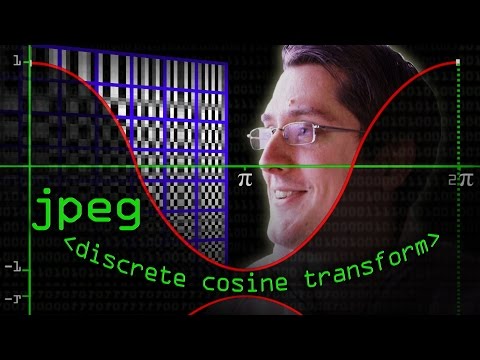
There's a series of videos showing the algorithm: link I finally understood DCT after watching this video And someone created a "JPEG to PNG" tool that "finds the smoothest possible picture that encodes to the given JPEG file": link . I tried it with some very terribly compressed images, and the outputs were a lot better.
RecommendsgreggmanSep 2015
“For example this video explaining jpeg worked for me”
Explains JPEG in a way that worked for commenter.
Full comment
Honestly this presentation didn't work for me. I was amazed at the spectacle and a few things like perfect math world vs pixels and multi-sampler helped explain a few things but over all it was all over the place and didn't seem to get to many points or insights. It seems more like someone was asked to do a presentation, didn't have a solid idea of what to talk about, and so threw together a bunch of stuff until it filed their allotted time. I'm not trying to be discouraging. A great presentation can go a long way to making things understandable. For example this video explaining jpeg worked for me this video My point is only that fancy graphics and animation are not enough. The presentation actually has to get it's points across. Maybe this one worked for everyone but me but it didn't really work for me. I don't really know what to suggest to make it better. Maybe it all made more sense live with more talking. There were a few "bugs" For example slide 22, bi-linear filtering, pixels can't be 2 colors so that slide made no sense. On the positive side I would love to know what software to use to make presentations easy. Yea, I get the author made his own but in general, making animation is hard work. Worse, once I've made them, even if they didn't end up being good for explaining I put so much work into making them that I can't justify starting over for something that works better. So, anything that would make that process not be so much work would be amazingly helpful.
RecommendswalagranAug 2020
“I would add Computerphile's Youtube Video as a watch after this”
Follow-up watch from JPEG series.
Full comment
Pretty cool! I would add Computerphile's Youtube Video as a watch after this: this video . This is a part of their 4-video series on JPEG: link
Recommendsskywal_lDec 2022
“It's a nice ans easy intro to the subject.”
Nice, easy intro to DCT.
Full comment
The Computerphile channel has a nice series of videos on JPEG and one focusing on DCT [0]. It's a nice ans easy intro to the subject. [0]: this video
RecommendsboolemancerDec 2023
“There is a good video[1] from the Computerphile channel describing the concept in the context of JPEG.”
Describes the concept in context of JPEG.
Full comment
There is a good video[1] from the Computerphile channel describing the concept in the context of JPEG. [1] this video
RecommendsitishappyApr 2024
“it's definitely worth looking into the specifics of how this works, as it's quite impressive!”
Worth looking into how this works.
Full comment
It receives information about the spacial frequency content of the image. If you're unfamiliar, it's definitely worth looking into the specifics of how this works, as it's quite impressive! Here's a few relevant Wikipedia articles, and a Computerphile video: linklinkthis video