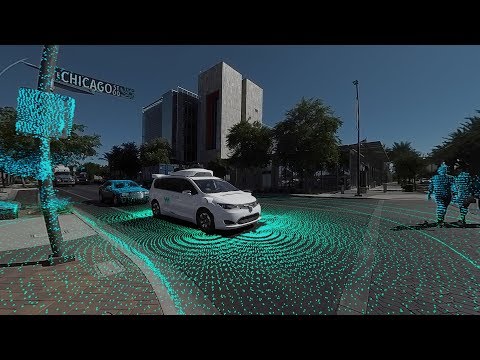
Waymo's 2018 360-degree video lets viewers look around inside a fully driverless ride. It is built from footage and real-time data of an actual trip on city streets.
Why Hacker News points people here: Cited as a reference in self-driving threads for what the car senses, such as sensor range, LIDAR and planning, although some commenters were critical of it.
“Waymo handling city traffic with LIDAR.[2] They show the scan lines and some of the path planning.”HN comment, 2019
Waymo 360 degree ride-along of a driverless journey
Full comment
Waymo cars are all over Chandler and Tempe in Arizona. I see many on a regular basis with a good portion self-driving. It is neat to see all the roads you normally drive in the self-driving videos and it is almost taken for granted that they are here [1][2]. Chandler has always been in early on technology due to many reasons but that lots of programmers/engineers work here due to intel historically, projects like Iridium started here, also one of the first places to get cable/broadband internet in the 90s. With that said, Chandler is very easy to drive, square roads, good weather, clean roads, clearly marked and kept up, minimal freeway needed etc. It is a great place to start but still lots for the cars/algos to learn, however it IS happening and I see it everyday. Many of the videos are around Chandler downtown that is a bit busy and has lots of movement/pedestrians[3], so that is good that it is able to navigate that, it is close to busy urban environments. [1] link [2] this video (360 degree experience) [3] this video
Cites itunityByFreedomApr 2018
“says its car can see up to 3 football fields away”
Waymo says its car sees up to 3 football fields away
Full comment
The latest Waymo video [1] says its car can see up to 3 football fields away. I would guess this would let it operate at higher speeds. I haven't seen any demos of it on the highway. I think they're focused on cities and suburbs. [1] this video
Cites itjppopeOct 2018
“I believe waymo is touting 300 yards-ish”
Waymo touts roughly 300 yards of sensor range
Full comment
What you are talking about is completely plausible with today's technology (thank you Uber for proving it). And I don't think that your comment is unfair by any stretch... ...But there is still no reason why a self driving car cannot avoid everything once we have enough data. There are no surprises with self driving vehicles, for anything that could happen, we have access to that information long before it does happen (I believe waymo is touting 300 yards-ish => this video ). A car doesn't need 300 yards time to stop. it needs less 200 ft (or 274 meters) at full speed. If you see someone that even could create an accident, you just slow down till its not possible to kill someone. (yes I know there are limitations to the current technology) So assuming that we have the sensor data (full coverage, at a distance, real time), and the models are capable of including these edge cases you referenced (e.g. people jumping out in the road). Why would we need to choose who to kill? Why would this decision be necessary?
Cites itAnimatsAug 2019
“Waymo handling city traffic with LIDAR.[2] They show the scan lines and some of the path planning.”
Waymo handling city traffic with LIDAR, showing scan lines and path planning
Full comment
Cruise Automation handling double-parked cars with LIDAR.[1] They show the scan lines and some of the path planning. Busy city streets, lots of obstacles. Waymo handling city traffic with LIDAR.[2] They show the scan lines and some of the path planning. Busy city streets, lots of obstacles. Tesla self-driving demo, April 2019.[3] They show their display which puts pictures of cars and trucks on screen. No difficult obstacles are encountered. Recorded in the Palo Alto hills and on I-280 on a very quiet day. The only time it does anything at all hard is when it has to make a left turn from I-280 south onto Page Mill, where the through traffic does not stop. [3] Look at the display. Where's the cross traffic info? Tesla's 2016 self driving video [5] is now known to have been made by trying over and over until they got a successful run with no human intervention. The 2019 demo looks similar. Although Tesla said they would, they never actually let reporters ride in the cars in full self driving mode. [1] link [2] this video [3] link [4] link [5] link
Cites itasdfasgasdgasdgFeb 2020
“references prediction at the provided timestamp”
Waymo video referencing prediction at a timestamp
Full comment
I don't think there's any implication that the technology is perfect in my comment. But the idea that e.g. Waymo's software is not making some attempt at predicting future states, even implicitly, is absurd. This video[1] was released two years ago and references prediction at the provided timestamp. [1]: this video
CriticalmcguireJun 2019
“What the car is in essence doing is driving by GPS and maps while staring at its feet.”
Full comment
I'm not so sure about that. For one thing, unless they've changed a lot more than I think they have since the last time I got to fool with one myself, the sensors have very limited range. Take a look at the screens displaying "what the car sees" in this self-promotion video from Waymo: this video What the car is in essence doing is driving by GPS and maps while staring at its feet. It is not as bad as driving with your eyes closed, but it's not that much better. Further, some of the infrastructure it is relying on, like lane markings, are very poorly maintained.