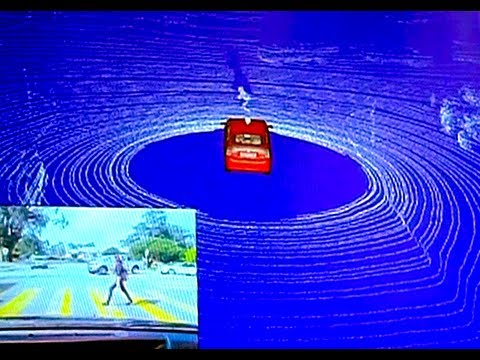
Part 2 of the IROS 2011 keynote by Sebastian Thrun and Chris Urmson on Google's self-driving car. It shows how the car perceives its surroundings with a lidar point cloud and recognizes traffic lights and pedestrians. The audio is poor because it was recorded on a pocket camcorder.
Why Hacker News points people here: HN recommends it as a technical talk aimed at a real engineering audience, with live demos of perception and pre-mapped roads.
“The whole talk is awesome and a presentation for an actual technical audience, too.”HN comment, 2012
“The whole talk is awesome and a presentation for an actual technical audience, too.”
Technical talk with traffic light, pedestrian recognition demos
Full comment
this video 9:00 has a good example, recognizing the state of a traffic light, other cars and pedestrians at an intersection, but lots of cool videos starting around 3:40. The whole talk is awesome and a presentation for an actual technical audience, too.
RecommendsiharrisApr 2013
“There's a great presentation about Google's self-driving car here”
Presentation with real-time telemetry and driver intent behaviors
Full comment
There's a great presentation about Google's self-driving car here (check the second half for video of the real-time telemetry that it gathers): this video One of the things that I found really interesting is how the car inches forward at a stop sign in order to show the "driver's" intent to other drivers. Lots of actions that seem to be second-nature for human drivers have to be carefully emulated here.
Cites itSamuel_MichonMay 2013
Source of the frame in a promo picture
Full comment
The picture Gross shared is a frame from a 1.5 year old promo[1], so he may also have misheard 1Gb for 1GB. [1] link – the bottom image is from this presentation: this video
Cites itohwpJan 2014
“@ 3:30 you can see the generated (and stored) point cloud.”
Shows generated and stored 3D point cloud
Full comment
What about "Haha, Well you're certainly not going to create a 3D point cloud of every street in the world"... Google's self driving cars are just doing that. EDIT: I can't find the post I once read, but this post also makes some clear: link EDIT 2: Here a video of the presentation: this video @ 3:30 you can see the generated (and stored) point cloud.
Cites itRetricMar 2015
“3:52 demos stopping for someone in the road.”
Rebuts FUD with timestamps of pedestrian and light handling
Full comment
That's a load of FUD. Modern Self driving cars track people on sidewalks not just the street. As to driving in the rain, they can do it, but like poeple there less safe at highway speeds in the rain. this video (6:45, 9:00) Also, 3:52 demos stopping for someone in the road. They even read stop lights (8:00). PS: If you actually look at that left turn on @9:00 the car has a much better idea what's around it than people do.
Cites itsorenjanNov 2016
Cited for Google's lidar and 3D map approach
Full comment
Isn't Google's approach dependent on expensive LIDARs and high resolution 3D maps [0], or have they changed that? I don't see that kind of system scale well. [0] this video
Cites itamjaegerDec 2016
“this is the presentation that discusses mapping the roads before autonomous travel.”
Presentation discussing pre-mapping roads
Full comment
If I'm not mistaken, this is the presentation that discusses mapping the roads before autonomous travel. They compare the maps to what the car sees as it drives. this video But there are a number of reasons the need pre-mapping are not a huge issue. A) When autonomous cars start to be introduced people will still know how to drive, and can pilot the car through unmapped areas. By the time everyone has an autonomous car, and no one knows how to drive the world will be mapped. B) Google has already shown with Streetview that they can create detailed, up-to-date maps of most roads. C) This problem will likely be solved in time.