Talks to Watch

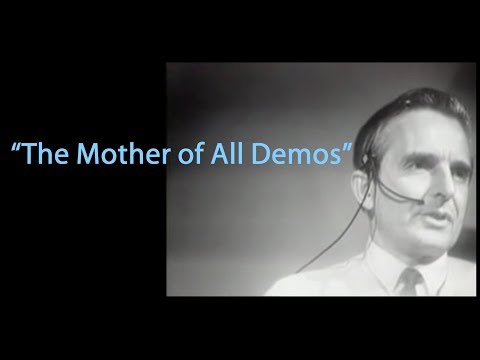
1968 “Mother of All Demos” by SRI’s Doug Engelbart and Team

303K views · Dec 7, 2018 · 5:36 · 0 HN recommenders · 4 mentions · discussed 2020–2024

Highlights from Doug Engelbart's December 1968 demonstration at SRI, the first public showing of the mouse, hypertext, windows, real-time collaborative editing and shared-screen teleconferencing. This is a roughly six-minute condensed version of the full demo.

Why Hacker News points people here: HN uses it as the go-to reference for how many modern computing ideas, collaboration included, were demonstrated in 1968.

“52 years ago, people could edit content simultaneously, actually.”HN comment, 2020

What Hacker News said 4

Cites itDonHopkinsJan 2020

“52 years ago, people could edit content simultaneously, actually.”

Engelbart demo showed simultaneous collaborative editing in 1968.

Full comment

52 years ago, people could edit content simultaneously, actually. 1968 “Mother of All Demos” by SRI’s Doug Engelbart and Team this video link The failure to inherently support multiple cursors by default was one of Doug Engelbart's major disappointments about mainstream non-collaborative user interfaces, because collaboration was the whole point of NLS/Augment, so multiple cursors weren't a feature so much as a symptom. Bret Victor discussed it in a few words on Doug Engelbart that he wrote on the day of his death: link >Say you bring up his 1968 demo on YouTube and watch a bit. At one point, the face of a remote collaborator, Bill Paxton, appears on screen, and Engelbart and Paxton have a conversation. >"Ah!", you say. "That's like Skype!" >Then, Engelbart and Paxton start simultaneously working with the document on the screen. >"Ah!", you say. "That's like screen sharing!" >No. It is not like screen sharing at all. >If you look closer, you'll notice that there are two individual mouse pointers. Engelbart and Paxton are each controlling their own pointer. >"Okay," you say, "so they have separate mouse pointers, and when we screen share today, we have to fight over a single pointer. That's a trivial detail; it's still basically the same thing." >No. It is not the same thing. At all. It misses the intent of the design, and for a research system, the intent matters most. >Engelbart's vision, from the beginning, was collaborative. His vision was people working together in a sha

Cites ittwobitshifterAug 2021

“I think he had everything in your first couple paragraphs working in 1968!”

Demo already showed collaborative features in 1968.

Full comment

See Englebart’s mother of all demos. I think he had everything in your first couple paragraphs working in 1968! this video

in “GitHub’s engineering team has moved to Codespaces” · view on HN
Cites itGeekyBearJan 2023

“The infamous "mother of all demos" can be seen here”

Engelbart's demo, source of the mouse and early GUI ideas.

Full comment

People always seem to forget that Xerox borrowed a lot of ideas themselves. Douglas Englebart at Stanford Research Institute gets credit for many innovations, including the mouse. The infamous "mother of all demos" can be seen here: this video Going back to the early 60's, there was an equally famous GUI demonstration at MIT, using a light pen instead of a mouse as a user input device for rudimentary CAD. link Finally, anybody who claims that the Mac or Windows was nothing but a copy of the Alto has never seen an Alto in action. link

in “The Xerox Thieves: Steve Jobs and Bill Gates [video]” · view on HN
Cites itskibzNov 2024

“He demonstrates it at about 1:40”

Shows Engelbart's chorded keyboard around 1:40.

Full comment

I don't think I have the skill to learn a stenographer's keyboard, but I would love to have a small chorded keyboard just for macros. I always liked the look of Doug Engelbart's one in the Mother of All Demos. It's very basic, but I'd be quite satisfied with something like that today. He demonstrates it at about 1:40: this video

in “Ask HN: Has anyone tried adapting a court reporter keyboard for writing code?” · view on HN