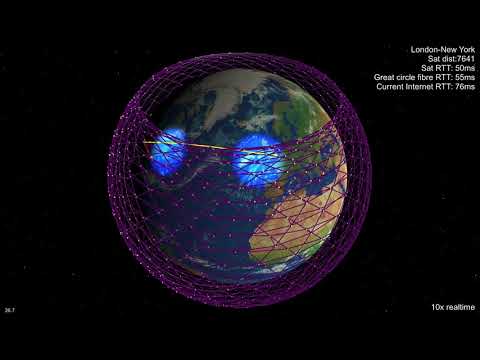
A short visualization from HotNets researchers of routing and latency over SpaceX's proposed Starlink constellation, based on its FCC filings. It shows orbital shells, link topology and how inter-satellite routes could beat terrestrial fiber on long distances.
Why Hacker News points people here: It is the go-to visual for how Starlink's constellation and laser links could cut global latency, linked in many satellite internet threads.
“This video goes a bit into the probable topology of the links and gives a good look at how the eventual constellation would look.”HN comment, 2021
“This video [0] really puts into perspective what SpaceX is trying to accomplish.”
Puts into perspective what SpaceX is trying to accomplish
Full comment
This video [0] really puts into perspective what SpaceX is trying to accomplish. Incredible stuff if they pull it off! [0] this video
RecommendstortargaNov 2018
“Very interesting watch.”
Simulation of the constellation based on a research paper.
Full comment
There was recently a video posted theorizing this here: this video Very interesting watch. Based off the paper: link
RecommendskristofferRApr 2019
“I really recommend watching this simulation of how the Starlink Constellation would massively cut global internet latency”
Simulation showing how Starlink would cut global internet latency.
Full comment
I really recommend watching this simulation of how the Starlink Constellation would massively cut global internet latency: this video
RecommendsrtkweJan 2021
“This video goes a bit into the probable topology of the links and gives a good look at how the eventual constellation would look.”
Shows probable link topology and how the full constellation would look.
Full comment
This video goes a bit into the probable topology of the links and gives a good look at how the eventual constellation would look. Eventually in the full constellation there will be 4 easy links to the birds in front, behind, left and right, those 4 will stay in largely the same relative position until they reach the highest latitude of their orbit. Those alone will make an ok link with a bit of a zig zag. The tough ones are those ~180 degrees out of phase those will be crossing roughly perpendicular and at a really high speed. this video
Cites itgpmNov 2018
“This constellation should have lower latency over long distance than is even theoretically possible using terrestrial fiber”
Research on low-latency routing through satellite constellations
Full comment
This constellation should have lower latency over long distance than is even theoretically possible using terrestrial fiber, because the speed of light in space is substantially better than the speed of light in fiber. [0] Even over short distance the latency (which the "Legal Narrative" pdf quotes as 15ms) is negligible for almost all applications. [0] paper link / video this video
Cites itTrueDualityNov 2018
“You can see international links that have latencies lower than the existing internet by a significant margin.”
Simulation of latencies based on FCC filings
Full comment
There were recently two simulations done on possible latencies based on the FCC filings. You can find the video simulations in the links at the bottom of this post. You can see international links that have latencies lower than the existing internet by a significant margin. Unfortunately neither of those simulations take into account that the first iteration has been changed to only use radio and no laser links. [0]: this video [1]: link
Cites itubercoreNov 2018
“First, check out the video explaining the orbits”
Explains the satellite orbit shells and constellation layout visually.
Full comment
First, check out the video explaining the orbits: this video Doing some quick math, the shell in which they'll be orbiting has a surface area of 373,367,808km. With ~7000 satellites, an even distribution would leave them 533,382 km between satellites. All the satellites have station keeping thrusters to keep them in LEO with drag. Keeping them from running into each other is probably pretty simple, in comparison to the other challenges they'll need to solve.
Cites itavarNov 2018
“The first video mentions at 6m55s[1] that as part of the third phase they're deploying satellites in high inclination orbits”
Describes phased deployment including high inclination orbits for polar coverage.
Full comment
The first video mentions at 6m55s[1] that as part of the third phase they're deploying satellites in high inclination orbits, among other reasons to provide coverage for Alaska, since this is an FCC requirement. I wonder if it's exclusively because of that reason, and if so that the reason international customers will enjoy coverage at high northern and southern latitudes is because of the accident of history that the US ended up acquiring Alaska, and that there's some FCC regulation that says you need to provide coverage for all 50 states. 1. this video
Cites itskunkworkerApr 2019
“did some simulations with what a LEO constellation would allow for latency reduction and improved routing”
Simulations of LEO constellation latency reduction and routing.
Full comment
An individual over at the /r/spacex subreddit did some simulations with what a LEO constellation would allow for latency reduction and improved routing (beyond your own continent) this video
Cites itgpmApr 2019
“with a nice video of the simulation here”
Nice simulation of Starlink latency.
Full comment
Latency, yes: link with a nice video of the simulation here: this video and a bunch of vidoes that include updated information here: link Bandwidth, not to my knowledge. As the nice paper above says its too speculative. Nothing official.
Cites itrtkweJan 2021
“it does show how starlink's linking may work and how it's not a perfect net”
Visualizes how satellite linking forms a non-perfect mesh.
Full comment
My understanding is it's tough to beat point to point microwave arrays for directness in a lot of cases, they're already pretty close to the straightline path between some locations. The same is basically true for the longer range low bandwidth links that curve around the Earth. Starlink is at a disadvantage because fundamentally it's pathing across a sphere with a larger radius so even when the path is direct across the Starlink cluster it still has to traverse a longer distance than the equivalent path on the ground. Adding to that the path won't always be directly across the surface of the constellation, depending on where you are and where the destination is you'll find some pockets where the link has to zig zag across the constellation slightly adding to the additional link distance. This [0] isn't necessarily a perfect representation but it does show how starlink's linking may work and how it's not a perfect net. It also doesn't account for the acquisition times for new laser links which were on the order of 20 seconds in another laser sat link test. [0] this video (it's also comparing fiber to Starlink where the best in class now is radio links generally)