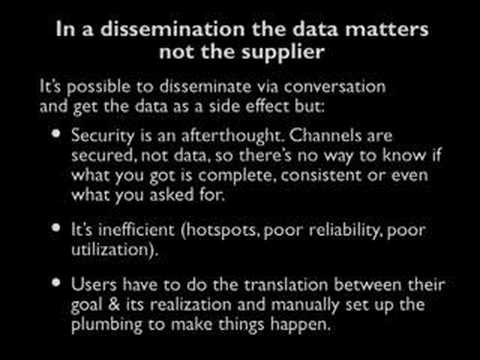
Van Jacobson's 2006 Google Tech Talk argues for rethinking networking around named data rather than host-to-host connections. He gives the history and the unsolved problems of the current internet architecture.
Why Hacker News points people here: Recommended as the foundational talk on content-centric and named-data networking, and for its internet history stories.
“There's an old tech talk that got me out of the IP-shaped box a lot of us are trapped in”HN comment, 2024
“There's an old tech talk that got me out of the IP-shaped box a lot of us are trapped in”
Data-centric networking idea that breaks out of IP thinking
Full comment
Consider a society that has left Earth. If light takes minutes to travel between locations, is a chatty protocol what you want? Or do you need a whole host of different application-level solutions to this problem? There's a different lens to look at it. There's an old tech talk that got me out of the IP-shaped box a lot of us are trapped in: this video I got Gemini 1.5 Pro to summarize the transcript, which I butchered a bit to fit in a text box: The Problem: The Internet is treated as a binary concept: You're either connected or not, leading to issues with mobile devices and seamless connectivity. The focus on connections (TCP/IP conversations) hinders security: Security is tied to the pipe, not the data, making it difficult to address issues like spam and content integrity. Inefficient use of resources: Broadcasting and multi-point communication are inefficient as the network is unaware of content, leading to redundant data transmission. The Proposed Solution: Data-centric architecture: Data is identified by name, not location. This enables: Trust and integrity based on data itself, not the source. Efficient multi-point communication and broadcasting. Seamless mobility and intermittent connectivity. Improved security against spam, phishing, and content manipulation. Key principles: Data integrity and trust are derived from the data itself through cryptographic signatures and verification. Immutable content with versioning and updates through supersession. Data segmentation for
RecommendsseijiJul 2012
“Ye olde, but still worth watching: Van Jacobson's Google Talk from 2006”
Van Jacobson's talk on a new approach to networking
Full comment
Ye olde, but still worth watching: Van Jacobson's Google Talk from 2006, "A New Way to look at Networking": this video
RecommendspololeeJun 2017
“I'd also recommend Van Jacobson's talk You'll learn some good stories about internet history.”
Internet history stories from congestion control pioneer
Full comment
Very good reading. I'd also recommend Van Jacobson's talk this video You'll learn some good stories about internet history. He has done a lot of work on TCP congestion control, especially the fast retransmission idea by using duplicate ACKs. There is an interesting thing about TCP. A lot of popular TCP implementation use city names, e.g. TCP Reno, TCP Vegas, TCP Westwood. TCP Westwood is a very interesting implementation. It has very intelligent way to estimate bandwidth, (not just based on duplicate ACKs). You may find this paper very interesting. link
Cites itth-aiOct 2016
“Integrity and trust are properties of the data; not of the way that you obtain it.”
Full comment
Any bashing on Named Data Networking? link Rather than the system getting less reliable exponentially as it scales up, it gets more reliable exponentially as it scales up. this video Integrity and trust are properties of the data; not of the way that you obtain it. this video There's no routing. You get rid of all of the routing chatter. You get rid of all of the routing brittleness. link We wanted to turn around the incentive structure where right now senders have a lot of power and receivers have basically nothing, they have to eat what they're fed. link
Cites itpwdisswordfish2Jul 2020
“(Google Tech Talk from Van Jacobsen on CCN many years ago)”
Full comment
In what ways is this different/similar from "content centric networking"? this video (Google Tech Talk from Van Jacobsen on CCN many years ago)
Cites itanaphorOct 2021
“Named-data networking is literally what this is describing”
Full comment
Named-data networking is literally what this is describing, except NDN works as a replacement for TCP, not HTTP. In the long term I'd rather have it work at a lower level and not have to think about it much. this video
Cites itxccxOct 2021Full comment
NDN is the way p2p no huge IP infrastructure between nodes interest packets at narrow waist (like human attention, scarce) sign all packets, more secure, easier to trust|not hash for pointers, no surprises in containers crypto apply more cryptography, less web3 baloney broadcast radio native, no emulation of copper wire data, closer to where you want, find faster, keep content you want w/out intermediation, need to find "where" within IP/udp/tcp addresses link node to node link more application, less security hassle link hash name the data this video data integrity w/out need to trust foreign server