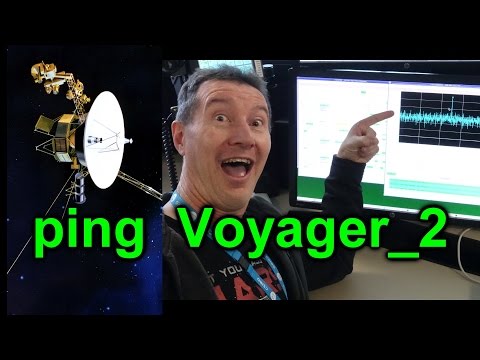
Part two of EEVblog's visit to the NASA/CSIRO Canberra Deep Space Communication Complex, showing the control room and how operators contact Voyager 2. It includes live data and spectrum displays.
Why Hacker News points people here: Commenters recommend the series for hearing an operations supervisor explain how Voyager signals are actually received.
“Dave Jones of EEVBlog has a nice series of videos talking to Richard Stephenson, Operations Supervisor at the DSN's Canberra site.”HN comment, 2018
“Dave Jones of EEVBlog has a nice series of videos talking to Richard Stephenson, Operations Supervisor at the DSN's Canberra site.”
Series talking with a DSN Canberra operations supervisor about contacting Voyager 2.
Full comment
Dave Jones of EEVBlog has a nice series of videos talking to Richard Stephenson, Operations Supervisor at the DSN's Canberra site. How To Contact The Voyager 2 Probe: Part 1: link Part 2: this video Part 3: link (the playlist is a mess, and videos are unordered) There are also a couple of Behinde the Scenes videos.
Recommends7373737373Apr 2023
“Video recommendation”
How to contact and ping Voyager 2.
Full comment
Video recommendation: How To Contact The Voyager 2 Probe ( link ) and Pinging The Voyager 2 Probe ( this video ) by EEVDiscover
Cites itbsderApr 2018
“Deep space network video where they talk about the fact that Voyager I/II is NOT the toughest signal to grab”
Deep space network talk on how hard Voyager signals really are to receive.
Full comment
Big antennas can pick up really small signals. Deep space network video where they talk about the fact that Voyager I/II is NOT the toughest signal to grab (apparently Mars Exploration Rover is due to small antennas): this video That being said, I doubt you could pick up WiFi and dig it out of the noise at space distances. However, you probably can relay signal intelligence from a drone or a human who is using a specific modulation known to the satellite.