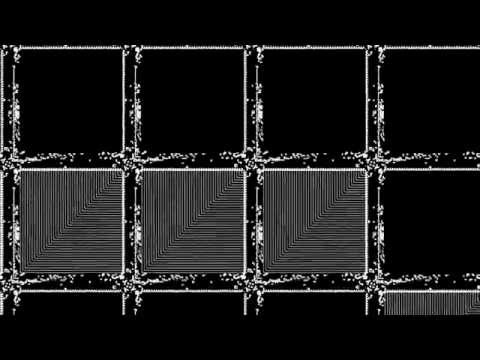
A two-minute video of Conway's Game of Life running inside Conway's Game of Life, built from OTCA metapixels and Golly. It zooms smoothly between scales.
Why Hacker News points people here: The canonical visual for nested simulation, Turing completeness and self-reference; HN readers call it mind-blowing and reach for it constantly.
“here's a famous and really clear sub-2 minutes representation of the scales involved”HN comment, 2023
“I remember seeing that video 3 years ago and being blown away.”
Game of Life simulated in Game of Life
Full comment
I remember seeing that video 3 years ago and being blown away. In case someone doesn't already know it, here is Conway's Game of Life simulated in Conway's Game of Life: this video
Strongly recommendspierreyodaJan 2023
“here's a famous and really clear sub-2 minutes representation of the scales involved”
Famous clear sub-2 minute representation of the scales involved
Full comment
This is an excellent link, well known in the "community" around this. To add to it, here's a famous and really clear sub-2 minutes representation of the scales involved if it helps make things clearer, for those who've never seen the scales involved: this video (and that's "just" the Game of Life in the Game of Life). I think I would enjoy helping push the state of the art in this field, but it's far beyond my abilities for the moment. If it wasn't, I would love to work on a new library specifically built for the kind of things like your idea, with the API aimed at working with metapixels-based "hardware", but with the lowest-level constructs (maybe by far) being thinks like RAM or CPU caches as building blocks - while still being able to zoom to the lowest level of cells in the renderer. But it's basically R&D and HPC combined if one wants to offer an interesting alternative to the established libraries. From what I know of upcoming hardware, such a library may have to wait a couple of years and basically target (as in, full buy-in, maybe at the programming language-level, certainly in tooling) the next Apple Silicon-like (or beyond) breakthough in commonly accessible hardware for a nice, "free" performance boost. Maybe GPUs are next?
RecommendsavianSep 2017
“Here's a nice video showing OTCA metapixels in action, implementing Game of Life in Game of Life.”
OTCA metapixels implementing Game of Life in Game of Life
Full comment
Here's a nice video showing OTCA metapixels in action, implementing Game of Life in Game of Life. this video It would be amazing to see this Tetris computer rendered into a video like this.
RecommendsGroxxApr 2020
“has a much-needed youtube video of the metapixels”
Video of metapixels from an earlier post
Full comment
2017 post has a much-needed youtube video of the metapixels as the top comment: this video I haven't been able to find one for tetris tho
RecommendsfishtoasterDec 2022
“I've seen "life in life" as a video from ages ago”
Earlier Life in Life video
Full comment
This is amazing! I've seen "life in life" as a video from ages ago[0], but this is just suck a slick implementation of it! [0] this video
RecommendszamalekFeb 2025
“Here's the game of life running in the game of life”
Game of Life running in Game of Life using Golly
Full comment
It might be argued that one of the dynamic programming (caching) ones would be the best by a reasonable standard. These can be used to simulate absolutely monstrous grids, and is where we see simulated CPUs and whatnot. Here's the game of life running in the game of life: this video - that one uses Golly.
Cites itlelfSep 2013
Game of Life simulating itself
Full comment
Not only that, but it can find lowest common denominator, solve a system of linear equations, and even run the complete RSA algorithm (albeit with a pseudorandom RNG that's deterministic). Or run a game of live's simulation this video
Cites itposterboyJun 2017
Game of Life emulated inside Game of Life
Full comment
I'd guess that GoL and Cellular Automaton Theory preceded and inspired rule 30 etc. So, maybe the architects implied metarecursion, that GoL metaphorically generated rule 30. GoL is Turing complete. I guess that means there is a starting condition that converges to a rule30 cellular automaton. edit: video of GoL emulated inside a turing machine in GoL this video (link replaced)
Cites ittrevynDec 2018
Game of Life example
Full comment
Molecular biology: link Game of Life: this video Sure, one is 2D and discrete, the other is 3D and continuous... oh wait, Lenia is 2D and continuous. That’s interesting.
Cites itmunificentOct 2020
“here's Conway's Game of Life implemented using... Conway's Game of Life”
Game of Life implemented in Game of Life shows many inner steps per outer step
Full comment
I find this initially unintuitive, but it makes sense when you think about it. Look at any other system that produces aggregate emergent behavior out the behavior of smaller parts. For example, here's Conway's Game of Life implemented using... Conway's Game of Life: this video It takes many many steps of the inner game of life to produce a single iteration of the outer simulation. In general, with emergent behavior, it takes a lot of inner steps to produce a single meaningful step in the outer system. So it makes sense that our cells are much faster than we intuititively think of as "fast". Because our intuition about speed is itself the product an emergent system. We are that larger Game of Life there, so it looks incredibly fast to watch the inner one according to our own time scale.
Cites itBenoitPNov 2020
Example of enormous speedups from memoization
Full comment
My secret wish is that they start working on Factorio 2 with a new item state-memoizing game engine. Let me explain. Conway's game of life organisms' different states can be memoized. Starting the simulation slowly, an engine can memoize the following computations. This is what Hashlife [1] does. Quoting from Wikipedia: "the rapid increase in speed is often described as "exploding"." So much so that this kind of thing is possible: this video Simulating the next ticks just entail looking up the future. Except for things the users touch. Since Factorio is a game about reaching the next scale of automation, I believe this is a worthy follow-up to Factorio 1. [1] link
Cites itknomeMar 2021
Complexity from simple rules
Full comment
They are a novelty that is often surprising in the how their simple set of rules can lead to quite amazing emergent complexity. That the one-time chaotic game of life was eventually shown to be able to stably infinitely expand and be turing complete is quite interesting. I don't know that they'll ever be useful for efficient computation, but they will likely always remain fun. this video I have not read it myself, but I know that Stephen Wolfram ( of Mathematica/Wolfram Alpha) laid out some arguments for the usefulness of studying cellular automata in his early 2000s book "A New Kind of Science".
Cites itehsankiaApr 2021
“This Game of Life video shows what I mean perfectly”
Shows complexity at scale looks like lower level
Full comment
Right, obviously as scale goes up, much more complexity is needed to maintain the same level of behavior. A bit like how unicellular organisms can replicate simply, but humans need to go through a whole process to make an offspring. This Game of Life video shows what I mean perfectly: this video Yes, there's a ton of complexity in there, but when you zoom out enough, it looks and acts very similar to the lower level.
Cites itscotty79Jul 2021
Nested simulation
Full comment
Unknowable. And no, you'll have no way to break out of simulation and access api of the simulator, because if it's in place it works similarly to this: this video
Cites iteggyNov 2021
Recursive Game of Life emulation
Full comment
I missed that, thanks! I'll have to take another look. When I think of neural networks that evolve changes in their topology and the weights between those connections, over and over towards optimizing a solution to function, I get the vision of the recursive Life in Life video[1] where Conway's Game of Life is emulated in Game of Life. [1] this video
Cites itcafFeb 2022
“you can implement Game of Life within Game of Life”
Game of Life implemented within Game of Life
Full comment
One thing it doesn't mention is Conway's Game of Life itself. So of course, you can implement Game of Life within Game of Life: this video
Cites itwoojoo666Jun 2022
Turing complete systems simulating inside others
Full comment
I think the author is misunderstanding the XKCD comic about rocks [1] (or maybe I am). Just because it's possible to run a simulation of the universe on rocks, doesn't mean that rocks are conscious or turing complete. You can't forget about the person who is manipulating the rocks. The system as a whole is turing complete. Likewise with the bar of iron example that the author gave, you can't forget about the person interpreting the atoms in the bar of iron. The system as a whole is turing complete (and also naturally conscious, because the person doing the interpretation is conscious). And there is nothing physical necessary to represent such systems. You can simulate turing complete systems inside turing complete systems [2]. So I don't see why consciousness has to be a "physical phenomenon" as the author claims. [1]: link [2]: this video
Cites itDougBTXSep 2022
Game of Life emulating itself
Full comment
FWIW: this video If you allowed toggling particular points manually as input from a controller... probably not too far away from possible!
Cites itgbell12Jan 2023
“Game of Life running in Game of Life”
Game of Life running in Game of Life as surreal technology
Full comment
Computers implemented in other computers. Specifically: Minecraft running in Minecraft link or Game of Life running in Game of Life this video Bonus: Digital clock implemented in Game of Life link Surreal because it makes it apparent that our universe could really be emergent behavior from a simple set of rules.
Cites itumviApr 2023Full comment
> This combined with the fact those interactions have been happening for billions of years in parallel at such a massive scale does not make it surprising that persistent and self replicating patterns emerge. On a large enough scale, even improbable events become likely. I don't think anyone has proven the scales necessary for life to happen by chance. What you have done is worked off the base assumption that abiogenesis happened accidentally and therefore the time and scale needed to do so is the age and scale of the observable universe. Under the infinite monkeys theorem that the works of Shakespeare would eventually be produced, but we are not working with infinite time and resources here. We are working "just" 9 billion years and "just" 100 billion galaxies, which, for abiogenesis seems pretty short especially considering what % of planets have zero chance for life due to their composition and star proximity. How many billions of years of compute time across how many parallel computers do you think it would take Conway's game of life with random RNG seeds to simulate itself ( this video )? Regardless of your answer, I still find it more likely Conway's game of life simulating itself points to an intelligent force of some sort having iteratively created it.