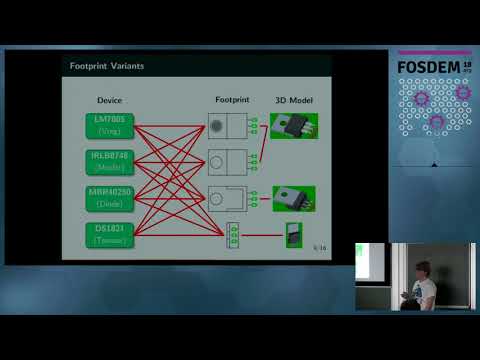
Urban Bruhin, LibrePCB's main author, introduces the open-source EDA tool at FOSDEM 2018. He explains why he started it and how its library concepts differ from KiCAD.
Why Hacker News points people here: Linked by the author and others in LibrePCB threads as the best explanation of its design rationale.
“Here's a video from FOSDEM where Urban (the main author) explains why he started LibrePCB”HN comment, 2020
Explains LibrePCB's new library management concepts
Full comment
U. Bruhin (the primary author of LibrePCB) answered this question on Reddit ( link ): ---Quote:--- Hi! LibrePCB has some very new concepts, especially for library management. You should take a look at my talk at FOSDEM: this video (Slides: link ) As these are extremely different to KiCad's concepts, it would be very difficult to contribute that to KiCad because they need to provide backward compatibility. And KiCad already has a lot of legacy code, so it would become even worse when changing very fundamental concepts. It's very questionable if KiCad developers even would accept such fundamental changes - actually I'm pretty sure that they wouldn't agree with some of LibrePCB's concepts. So the only way was to create a completely new project. And LibrePCB 0.1.0 is only the beginning - I have many more ideas how an EDA tool should look like. With a standalone project I'm much more flexible to implement new features than if every feature would need to be contributed to KiCad.
RecommendsdbrgnNov 2018
“It explains some of the core design concepts and the rationale for them.”
Explains core design concepts and rationale of LibrePCB
Full comment
There's also an "Intro to LibrePCB" talk recording from FOSDEM this year: this video It explains some of the core design concepts and the rationale for them. In case you don't have time to watch the video, here are the slides: link
RecommendsdbrgnDec 2019
“Talk by Urban that explains why he started LibrePCB, and how the library concepts are different from other similar tools like KiCAD”
Why LibrePCB was started and how libraries differ from KiCAD
Full comment
Before people start asking: Comparison with KiCAD and Eagle: link Talk by Urban that explains why he started LibrePCB, and how the library concepts are different from other similar tools like KiCAD: this video (Slides: link ) If you want to try it: link Previous HN discussion: link
RecommendsdbrgnMay 2020
“Here's a video from FOSDEM where Urban (the main author) explains why he started LibrePCB”
Author explains motivation and library concepts
Full comment
Here's a video from FOSDEM where Urban (the main author) explains why he started LibrePCB and how the library concepts are different from other similar tools like KiCAD: this video (Slides: link ) Also, previous HN threads: linklink
Cites itsingronMay 2020
“this LibrePCB talk explains why they wanted an alternative”
Explains why an alternative to existing tools was wanted
Full comment
I haven't used any of these before, but this LibrePCB talk explains why they wanted an alternative: this video Horizon docs have this explanation: link
Cites itraphlinusMar 2021
“LibrePCB (see ) who devised their own text based format specifically to make version control more friendly”
Example of text-based format designed for version control
Full comment
It's something we thought about, but I think it's somewhat orthogonal to the question of serialization - you still need code to go back and forth between the representation in the database and the native data structures. See link for a deeper discussion of issues around a file format for a font editor. One of the biggest current pain points is dealing with merges in version control (usually git). I think there are ways of dealing with that in an sqlite-based file format, but I worry it would require some custom tooling, especially to make sure invariants aren't violated. Another interesting example is LibrePCB (see this video ) who devised their own text based format specifically to make version control more friendly.