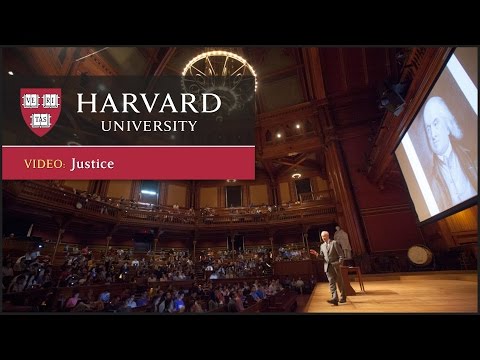
The first episode of Michael Sandel's Harvard course on moral reasoning, opening with the trolley problem and the choice between killing one to save five. Sandel draws out student arguments and introduces utilitarian and other approaches to justice.
Why Hacker News points people here: One of the most frequently recommended online lecture series on HN, praised for giving people vocabulary to examine ethical positions and for Sandel's skilled teaching.
“Two lecture series I always recommend, and feel like everyone should watch”HN comment, 2015
“I found these lectures on the topic absolutely amazing to watch”
Lecture series on moral philosophy found absolutely amazing
Full comment
It's like asking what makes 5 greater than 5. Humans are all significant simply because they have rational minds and are rational beings. A human being cannot impose on others a value or worthiness, because we are rational beings and have independent minds. As you probably have noticed by now this is not me saying these things, it's from Immanuel Kant. I found these lectures on the topic absolutely amazing to watch: this video
Strongly recommendsclusterfooMar 2015
“Two lecture series I always recommend, and feel like everyone should watch”
Harvard justice course everyone should watch
Full comment
Be well versed in genetics / molecular biology! - If I had the time to finish school, I'd double in biology / math or CS. Man will that be a killer combo when that kid is 30. It feels like biotech is where computing was in the 1930's... what's to come, and how it will change the world is both frightening and exciting. On the "soft" side (whatever that means): ethics, the history of ethics, from every point of view. Two lecture series I always recommend, and feel like everyone should watch with a gun to their head (as the instructor himself says): - this video -- Harvard course on justice / ethics. - link -- Robert Saposky (and guests) on the biology of human behavior. Literary theory. Gaining a deeper understanding of how masters of symbolism, language, and creativity think and put together their work; the history of literature; etc. will open you up to new ways of thinking just like studying pure maths or programming would. Now to invent a time machine and give myself this advice! Boy I could've used it.
Strongly recommendskevindeasisNov 2015
“I find it the most interesting. It's Harvard's philosophy course”
Most interesting online course, Harvard's philosophy course
Full comment
It has been over a year and I haven't finished it yet, but I find it the most interesting. It's Harvard's philosophy course [1] Also, intro to comp sci by Harvard's open courseware. Without these, I might've dropped out of comp sci in my second year [2] [1] this video [2] link
Strongly recommendsnopinsightJul 2017
“This Harvard session on Justice (The Moral Side of Murder) is edifying and surprisingly fun to watch”
Edifying and fun session on the trolley problem and moral reasoning
Full comment
Unfortunately, no one can really articulate the full set of human values yet, especially since they are often in conflict in real-world situations. Which value(s) should be prioritized over others? How about differing values between cultures and human groups within each culture? You might have heard of the Trolley Problem. There are many and more complicated variations of that. This Harvard session on Justice (The Moral Side of Murder) is edifying and surprisingly fun to watch: this video The problem with AGI is more acute than most other technologies because it is software-based, which makes it nigh impossible to regulate effectively, especially globally.
Strongly recommendsljiljanaApr 2018
“great course on moral reasoning, covers different theories of justice based on ideas from Aristotle, Kant, John Stuart Mill, John Rawls and many more”
Well presented course on moral reasoning and theories of justice
Full comment
Came here to suggest Robert Sapolsky's class as well. I would also add Michael Sandel's Justice: What's the right thing to do? this video great course on moral reasoning, covers different theories of justice based on ideas from Aristotle, Kant, John Stuart Mill, John Rawls and many more, extremely well presented too.
Strongly recommendsmettamageApr 2020
“it did give me a vocabulary to better articulate myself”
Gives vocabulary to articulate and examine ethical stances
Full comment
Indirectly related, if you have some time to spare follow Harvard's course in ethics! [1] Here is why: while it didn't teach me anything new (in a sense), it did give me a vocabulary to better articulate myself. Having new words to describe certain ideas means you have more analytical tools at your disposal. So you'll be able to examine your own ethical stance better. It takes some time, but instead of watching Netflix (if that's a thing you do), watch this instead! Although, The Good Place is a pretty good Netflix show sprinkling some basic ethics in there. [1] this video
RecommendslvsOct 2016
“Sandel's complete course "Justice" is on Youtube.”
Sandel's complete Justice course addresses false-choice moral dilemmas
Full comment
Many of these are what we call "false choices" of the sort that typically arise in hypothetical utilitarian dilemma used in rhetoric and debate. Humans are creative enough to see alternative options that obviate the dilemma, at least to some extent. See Michael Sandel on moral dilemma. Edit: FYI, Sandel's complete course "Justice" is on Youtube.[1] [1] this video
RecommendsubershmekelJun 2019
“The lecturer got explanations that I thought at the time were laughable, but somehow in his response he rephrased them to be reasonable”
Lecturer rephrases student answers charitably to deepen the conversation
Full comment
I learned this lesson from the videos of the Harvard course on justice. The lecturer got explanations that I thought at the time were laughable, but somehow in his response he rephrased them to be reasonable and a great platform to deepen the conversation. It requires a great deal of empathy and intelligence to do that and I try my darndest to read as much sense as possible from any question directed my way. Here's an example: this video
Recommendsmgh2Nov 2020
“I recommend this Harvard video series on ethics”
Harvard ethics series, with taxes covered in later episodes
Full comment
Please follow HN guidelines- your comment appears vitriol As for taxes, I recommend this Harvard video series on ethics: this video Note: Taxes appear way after several videos though...
RecommendsmettamageApr 2021
“ethics courses teaches people to gain a more fine-grained vocabulary on explaining their own positions and understanding other's positions”
Gives fine-grained vocabulary to understand others' ethical positions
Full comment
Sure, from a persuasion point of view I agree. But from a "trying to understand another human" point of view, I'd recommend you to read the Wikipedia page on ethics [1]. My own education on the topic: a course in college (as a business student) and watching some of the Harvard lectures on ethics [0]. IMO ethics courses teaches people to gain a more fine-grained vocabulary on explaining their own positions and understanding other's positions. GP clearly uses a deontological line of thinking on this matter. Something that GP considers to be "inhuman and barbaric" invokes a line of thinking in where he/she believes one ought to not do a certain action, because it simply is wrong. I'm not the best at explaining deontological ethics, nor are the people who think like this. My point is: a lot of thought has gone into the types of statements that GP makes, and IMO it's worth thinking about. [0] this video [1] link
RecommendspagadeJul 2022
“I would highly recommend.”
Harvard lecture opening with the trolley problem discussion
Full comment
Reminds me of Harvard University lecture that starts with this discussion: this video I would highly recommend.
RecommendsjasonhongJan 2025
“Prof. Michael Sandel (Harvard) on Justice: What's the Right Thing to do?”
Sandel's Justice course shaping thinking about wealth and impact
Full comment
I was in a somewhat similar position as the OP, having had a successful exit many years ago and trying to figure things out. I was lucky that I still had a faculty position at a top university, young kids, and a good family to help ground me and guide me. My general take on things is this: money is one of the closest things we have to a superpower in this world. With enough money, you can build new things, make steps toward solving hard problems, and influence people and organizations to do things you want. Given all this, what kind of world would you want to live in? And with your newfound superpower, what kind of steps can you take that might get us closer to that world? Now, of course, this path is fraught with many challenges and dangers (especially as evidenced by so many superpowered billionaires around the world that want us to live in an oligarchy, but that's a rant for another day). Instead, I'll end by sharing a few things that have helped shape my thinking about how I spend my time and what kind of positive impact I want to make on the world: - link - John Rawls on the Veil of Ignorance and the original position link - Prof. Michael Sandel (Harvard) on Justice: What's the Right Thing to do? this video - Prof. Robert Reich's course on Wealth and Poverty (former US Sec of Labor) link There's also an interview with a sci-fi author (Ted Chiang I believe, but I can't find it to confirm), that also posed an interesting question: what is your ideal world, and what step
Cites itheraldgeezerAug 2024
Listed among alternatives to short-form video content
Full comment
Ok. Does not change the facts. Are things like this on TikTokSloppatoppa? Justice: What's The Right Thing To Do? Episode 01 "THE MORAL SIDE OF MURDER" from HARVARD UNIVERSITY this video BBC The Great War - 1of26 - On the Idle Hill of Summer link The World At War 1973 WW2 EP 1 From Bluray: Hitler's New Germany link