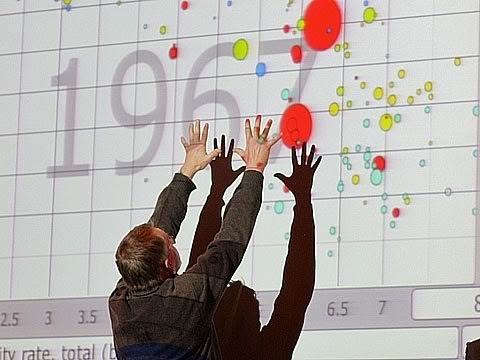
Hans Rosling uses the Gapminder animated-data tool to debunk myths about world development, with sportscaster-like energy. It shows trends in health, income and child survival across countries.
Why Hacker News points people here: HN invokes it as the classic evidence that the world has improved and that people misjudge it, and as an example of great data presentation.
“the original 2007 Gapminder talk[1] still surprised and educates people today”HN comment, 2013
“the original 2007 Gapminder talk[1] still surprised and educates people today”
Classic Gapminder talk that still surprises and educates people.
Full comment
80% of everything is crap. And yet the original 2007 Gapminder talk[1] still surprised and educates people today [1] this video
Strongly recommendsjspersonSep 2019
“Rosling also gave one of the best TED talks ever”
One of the best TED talks, showing the world has improved.
Full comment
You should check out the book Factfulness by Hans Rosling. Rosling, a now deceased Swedish doctor, makes the case that the world has improved immensely over the past two centuries. He backs it up with copious statistics from the UN and other international NPOs. Rosling also gave one of the best TED talks ever: this video
Strongly recommendsmywacadayJun 2020
“always worth a watch.”
A talk worth watching repeatedly, from a great presenter.
Full comment
Probably been posted a lot before but always worth a watch. this video The Great Hans Rosling. His book is well worth a read as well.
Strongly recommendssdht0May 2021
“This classic TED talk [0] by Hans Rosling presents the same idea.”
Classic talk showing people misjudge the state of the world.
Full comment
The choices are deliberately wide. The idea is that people are unable to make even broad estimates of the state of the world correctly. This classic TED talk [0] by Hans Rosling presents the same idea. I recommend watching all his other talks as well [e.g., 1-2]. [0] this video [1] link [2] link
RecommendsmziMay 2026
“I find him an excellent lecturer.”
Data-driven talk by an excellent lecturer on similar subjects.
Full comment
This kind of data was shown by late Hans Rosling and his foundation Gapminder¹. He gave a Ted talk² about similar subjects as well, and I find him an excellent lecturer. ¹ link ² this video
Cites ittrevorstrohmanDec 2013
“shows how most indicators are improving worldwide”
Shows most global indicators like child mortality and GDP improving.
Full comment
This Hans Rosling talk from a few years ago shows how most indicators are improving worldwide (e.g. reductions in child mortality, GDP per capita). this video
Cites itoconnor663May 2016
“Obligatory link to Hans Rosling's economic play-by-play of the last 50 years”
Offered as an economic play-by-play of the last 50 years.
Full comment
> If you buy some shares in M&S or BP on the stock market, the money you pay goes to the previous owner, not the company. You are what Keynes called a ‘functionless investor.’ When such so-called ‘investments’ pay off they extract wealth from the economy without creating anything in return. This doesn't seem very coherent. How could a company ever sell stock to raise capital, if the people who bought that stock didn't have a functioning market to resell it on? Obligatory link to Hans Rosling's economic play-by-play of the last 50 years: this video
Cites itkeanzuFeb 2020
“According to Hans Rosling the world has already changed dramatically for the better”
Cited as showing the world has already improved dramatically.
Full comment
> if you try to objectively make life better for the billions According to Hans Rosling the world has already changed dramatically for the better, you just didn't notice. this video
Cites itasjwJun 2020
“Hans Rosling explained very well why advancements in National wealth leads to smaller families”
Explains how national wealth leads to smaller families and longer lives.
Full comment
Hans Rosling explained very well why advancements in National wealth leads to smaller families (less children per family) and longer lives It's linked to becoming richer countries, which China has become this video
Cites itrocknorJun 2021
One of several links showing global birth rates have fallen.
Full comment
> if the 1 billion "rich people" drop their emissions down to below average then the majority of the problem will still be here. True. But the "majority" is not as big as you think. > there will be 1 billion less wealthy people Just wrong. There are lots of ways to reduce emissions without any effect in wealth. Eating less meat is one example. > for no particular net gain. Very wrong, there are huge gains: link > I advocate the radical approach of encouraging people to have less children. I knew you would say this, I was just waiting for it. Global birth rates have been in freefall for decades now, it's tragic that people don't know about it. You'd assume that supposedly "better" education in western countries would make people more aware, but western governments are only concerned with maintaining global western hegemony which requires falsely accusing the rest of the world and keeping their citizens ignorant. Also, you can't force people to have less children, that's inhumane. I suggest you go through the following links. linklinkthis videolinklink
Cites itcowlDec 2021
Supports the claim that humanity has improved on measurable metrics.
Full comment
By every measurable metric, Humanity has gotten better. Longer lifespan, lower child mortality, better education, easier access to basic life neccessities and goods, (ironic to say at this time but yes even) better health, etc etc etc. We live in an age where every problem is weaponised and we are hyperaware of the problems now so that we don't see all the progrees that is done. linkthis video
Cites itincomingpainMay 2022
Linked as supporting evidence in a discussion of doomerism and bubbles.
Full comment
>Is losing faith/hope in humanity something others experience as well? Generally considered the 'doomer' political circle. No proper political alignment, often seen as purple or populist. Also not necessarily a pessimistic world view. >s it due to the way i perceive things (i.e. my entourage)? Most likely yes, but can be independently derived. >Am I in a bubble and I don't see it? How do I get out? Should I be in a bubble to keep my sanity? How do I build those filters? Everyone is in a bubble. Imagine a venn diagram of things you know and things you dont know. That's your bubble. Being in a bubble isn't inherently bad. Being in an echo chamber is bad and the probability you are in an echo chamber is very high. To evaluate if you're in an echo chamber, pretend to say something you dont agree with inside your echo chamber just see how it's reacted to. "climate change is false for X reason" >- climate change or how society/corporations/governments are destroying the environment and/or are barely doing anything. All I think about sometimes is how we'll begin to see famines spreading across poor countries until it's all too late... Yet Elon buying Twitter is still in the news till this day. Climate change is often the first one in the doomer field lately. Take extinction rebellion for example, or the maya calendar or y2k doomers. They are all climate change now. Their climate change echo chamber is quite problematic. All this 10 years left or various ultimatums are absurd. They'v
Cites ityencabulatorJan 2024
“Having more children is near-universal reaction to poor child survival rate”
Shows how birth rates respond to child survival rates.
Full comment
Having more children is near-universal reaction to poor child survival rate, and vice versa. (Though usually it's not about the offspring dying as adults .) this video
Cites itvishalonthelineApr 2024
“Urbanization and education are the two most effective ways of getting a population to have fewer children.”
Says urbanization and education reduce birth rates.
Full comment
Hans Rossling's talk, "The best stats you've ever seen" had something to say about this: this video Urbanization and education are the two most effective ways of getting a population to have fewer children. Singapore is a highly educated and urbanized country.
Cites itGudDec 2025
Used to argue the poor have a decent life in most places.
Full comment
This is completely wrong. Even “the poor” in most parts of the world has a pretty good life weight where they are. this video