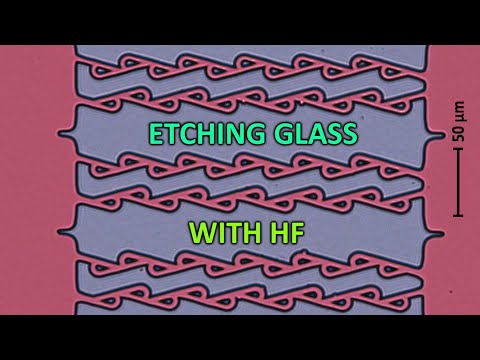
Huygens Optics experiments with etching tiny patterns in glass, covering hydrofluoric acid risks, buffered oxide etch, photoresist and chromium masks, and laser-induced etching. It ends with attempts at microscopic Tesla valves.
Why Hacker News points people here: HN recommends it as a highly informative look at micro-etching glass and the smallest Tesla valves.
“The video on micro etching glass with HF is highly informative on this post...”HN comment, 2024
“There is an youtube video[1] by the excellent channel Huygens Optics”
Attempt at a microscopic Tesla valve in etched glass
Full comment
There is an youtube video[1] by the excellent channel Huygens Optics which goes through trying to make a microscopic tesla valve. The valve does not work as a checkvalve (it is sufficiently small that surface tension and all that work differently than in a macroscopic system), but the author argues that it did satisfy the real goal of being a tesla valve -- which is to look sexy and high tech. [1] this video
RecommendsshowerstAug 2021
“Also seconding the Huygen's optics video”
Huygens Optics Tesla valve video
Full comment
For a fun visual demonstration, check out nighthawkinlight's video where he runs a flamefront through one -- link Also seconding the Huygen's optics video osamagirl69 already posted below -- this video
Recommendsthrown_22Aug 2022
“on the bright side I've found something I have not been desensitized to no matter how many time I've watched it.”
Full comment
I read that, then I saw this guys youtube channel: this video on the bright side I've found something I have not been desensitized to no matter how many time I've watched it.
RecommendssamstaveMar 2024
“The video on micro etching glass with HF is highly informative on this post...”
Informative on micro etching glass with HF
Full comment
link Seems like it would work beautifully. What would be cool is to make a logic-gate-tesla-valve-micro-hydraulic computer? -- The video on micro etching glass with HF is highly informative on this post... he talks about etching tesla valves at the end... link <-- 30 microns long with channel width of 4 microns via etched glass... linkthis video -- So I wonder what resolution would be possible via the 3d version. What would be really interesting to see with this method would be to make a blend of a spiral-screw with the tesla valves to climb or control vertical rates of flow. --- Since this process can print in ceramics, I wonder if the can effectively make a "super-conductive-nano-wire with spiraling interconnected bucky-ball-shaped lattice of particles"