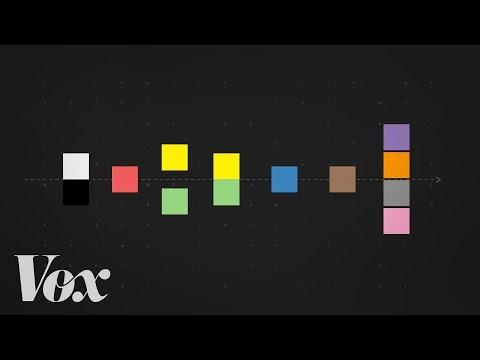
Vox explains the Berlin and Kay research showing that languages around the world tend to invent color words in the same order. It walks through the hierarchy and the debate around it.
Why Hacker News points people here: HN commenters recommend it as a clear, well-made summary of the linguistics of color naming and how culture shapes it.
“there is a pretty well done video by Vox on how color names are influenced by culture”HN comment, 2024
“This Vox video summarizing the research of linguistic anthropologists is much more clear”
Clear summary of linguistic research on color naming.
Full comment
Text really isn't the best medium to discuss color perception. This Vox video summarizing the research of linguistic anthropologists is much more clear: this video
RecommendsmaxwellSep 2017
“also covers a bit about the research by Berlin and Kay”
Covers Berlin and Kay's color naming research.
Full comment
Just watched this Vox video on a (potential) pattern behind color names last week, which also covers a bit about the research by Berlin and Kay: this video
RecommendsdghughesOct 2023
“Here is a good video on colour and how many cultures perceive colour and name them, or not.”
Good video on how cultures name colors.
Full comment
I also find it fascinating that cultures have so many words for colours or so few words for colours either way it's interesting. Here is a good video on colour and how many cultures perceive colour and name them, or not. "The surprising pattern behind color names around the world" this video
RecommendsJeremy1026Sep 2024
“there is a pretty well done video by Vox on how color names are influenced by culture”
Well-done video on cultural influence on color names.
Full comment
It's very cultural. For example, Japan used the same word for green and blue, so their green light on traffic lights is as blue as possible while conforming to international standards for the light to be "green". Also, there is a pretty well done video by Vox on how color names are influenced by culture this video
Cites itsabizmilMar 2019
“many languages define colors differently”
Example of languages defining colors differently.
Full comment
I'm not saying that emotions don't exist, just that the meaning is completely separate from the way that we define it. For example many languages define colors differently ( this video ), but this doesn't mean that the different wavelengths don't exist. Cultures categorized them for the purpose of communication and it's only within the context of that categorization that you can understand the meaning. Earlier I referenced "finger pointing at the moon" and this is exactly it. The word is the finger and the meaning is the moon, and we shouldn't mistake the finger for the moon. > i am sure there are animals willing to discuss it with you, it’s just that you (us) can’t understand them. I was half-joking, there are already animals that we can understand and communicate with. It's just a matter of finding them :P link > it is very possible that animals feel deeper emotional connections than we do. orcas showcase some very deep emotional states. No doubt. Even visiting an animal shelter exposes some of the deep emotional state that dogs and cats can be in, and I'm sure that barely scratches the surface when considering all of the different species and circumstances.
Cites itromaaeternaAug 2019
“Here is an linguistic explanation of color language around the world”
Linguistic explanation of color language worldwide.
Full comment
Yes, the ancient Greeks knew about the color blue, as do most old world primates. Here is an linguistic explanation of color language around the world: this video The sculpture reconstructions you've linked are rather imaginative -- German grad students with UV lights, not chemical reconstructions -- and are probably only vaguely like the original colors. Where original colors have actually survived, in frescoes, etc., the ancients display a reasonable eye for beauty in color.
Cites itBalgairJul 2020
“with colors like blue being the last to be named in a culture.”
Pattern in order cultures name colors.
Full comment
The perception of color is a pretty wild area of science. Colors seem to be culturally dependent. In that, people literally cannot see the difference between blue and green if their language does not have words to distinguish them. Even when big rewards are given for the 'correct' answer. Colors also follow certain patterns, with colors like blue being the last to be named in a culture. this video Fun fact, the color blue does not appear at all in the Iliad , Homer describes the ocean as wine, despite the stunning blue colors of grecian seas.
Cites itshagieNov 2025
Related Vox video on color names.
Full comment
link and also link VOX : The surprising pattern behind color names around the world this video If you're interested in this is as a board game - link