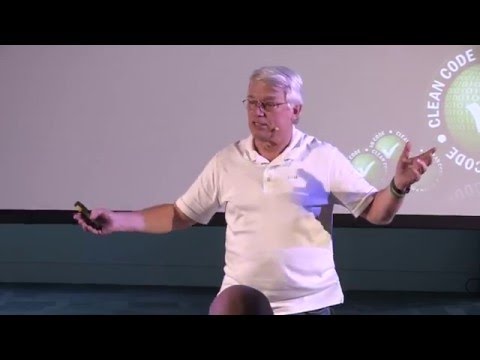
Robert C. Martin (Uncle Bob) traces the history of software from 1948 to today, looking at the problems programmers faced, how they were solved, and what mistakes the profession made. He then projects where the field is going, including professionalism and regulation.
Why Hacker News points people here: HN recommends it as an engaging overview of programming history and an argument for professional standards, citing the agile manifesto section and the claim that software has advanced little since the 1950s.
“It's a fascinating introduction to the evolution of hardware and programming languages.”HN comment, 2019
“Please, see the video. It is an awesome informative”
Informative on the maturity of the software industry
Full comment
For an informed answer you can see: "Uncle" Bob Martin - "The Future of Programming" this video Please, see the video. It is an awesome informative and it will give you a lot of insight on our current situation. It is not about startups, but about the maturity of the industry itself.
Strongly recommendsrb808Jul 2018
“Anyway he's a great speaker and this is one of my favorites.”
Great talk illustrating computing history and industry discipline
Full comment
Bob Martin has a great talk this video , which illustrates a lot of history of computers. He asserts that the number of devs is doubling every 5 years which means that half the developers have < 5 years experience. The industry has lots much of its scientific discipline which has to return, or regulations will force more structure. Anyway he's a great speaker and this is one of my favorites.
Strongly recommendsneoviveDec 2019
“It's a fascinating introduction to the evolution of hardware and programming languages.”
Excellent intro to evolution of hardware and programming languages
Full comment
For those interested in the history of computer programming, "Uncle" Bob Martin gave an excellent talk in 2016 called "The Future of Programming", starting with Alan Turing in 1936. It's a fascinating introduction to the evolution of hardware and programming languages. I was particularly amazed at how Turing used CRT screens for memory and output. The history discussion starts at around 11 min: this video
Strongly recommendsghowardJul 2022
“the whole talk is worth watching”
Talk on software professionalism and serving users
Full comment
I am not working in industry; I'm such a loner programmer that I struggle in industry. But since my wife likes her work, I have space to write the software I want to write. My first goal is to make that software good enough and useful enough to create an engineering-only company like Hwaci, the company that does SQLite and Fossil. If I succeed at that, I'll see about trying to pull in enough money to retire early and do charity work through my church. But I have another goal for while I'm still in industry. I want to change our industry such that it is a professional industry, with a code of ethics, to where we create software that serves users , not our employers or government. This means fighting against slurping up user data, serving ads, and other ways that software disobeys users in favor of obeying its creators. I even created a Twitter account to show some of those things. [1] Yes, that means an uphill battle against basically all of Big Tech, and I don't expect to win. But if I make people think about it, I'll take that as a win. But regardless, I feel strongly about it because users depend on us to make software that will serve them. If we don't, no one will. Uncle Bob Martin talked about this. [2] (That link starts at a good point, but the whole talk is worth watching.) So that's my goal: make good software and change the industry for the better. Lofty, yes, but I'll be satisfied by completing one of those goals. [1]: link [2]: this video
RecommendsalgoldOct 2016
“This is a newer and also really good talk about programming languages and their future”
Good talk on programming languages and their future
Full comment
Really good talk! This is a newer and also really good talk about programming languages and their future: "Uncle" Bob Martin - "The Future of Programming" this video
RecommendsEdSharkeyJan 2017
“Uncle Bob recently has shared some good food for thought in this area.”
Food for thought on professional standards and regulation
Full comment
To me, the real issue is that the managers got ahold of agile. Most managers just want waterfall, I'm convinced, which I suspect is where so much of the head scratching about Agile comes from. We developers have done an abysmal job developing, socializing, and formalizing our standards and practices. Needing to keep agile things loose because teams and industries and people and projects differ is one thing. But, we don't even try to establish unambiguous definitions for general topics like test-driven development, big visible charts, or sprints. Frankly, we need industry leadership and earned certifications for developer craftsmanship. Uncle Bob recently has shared some good food for thought in this area. Not only does he recommend the direction we professional devs need to head, but he also speculates as to what will happen if we don't (loss of freedom.) this video
RecommendsgeksillaApr 2018
“Uncle Bob Martin - "future of programming”
One of several favorite tech talks listed
Full comment
Rich Hickey - "simple made easy" link Rob Pike - "concurrency is not parallelism" link Uncle Bob Martin - "future of programming" this video Martin Kleppmann - "transactions: myths, surprises and opportunities" link Simon Brown - "software architecture vs code" link
RecommendsfogettiApr 2019
“Also a relevant talk by Uncle Bob”
Relevant talk on sloppy engineering
Full comment
Let me tell one thing: I absolutely hate sloppy engineering. And by sloppy I also mean rushing. There is a class of engineers and engineering managers who think that they are rockstars because they can churn out code quickly. I am absolutely disgusted and sick of this attitude. And why do I bring it up here? Because I suspect this kind of attitude was partly blamed for this fatal and tragic accident. Of course this is pure speculation. But my 12 years experience in the software industry makes me believe that's what happened. Also a relevant talk by Uncle Bob: this video
RecommendsmiguelmotaSep 2019
“A good presentation on the history of programming and how we got to where we are”
Presentation on history of programming and how we got here
Full comment
A good presentation on the history of programming and how we got to where we are is Bob Martin - The Future of Programming this video
RecommendsHokusaiApr 2020
“I has a lot of content and insights.”
Content-rich talk with many insights
Full comment
I found it! :) I has a lot of content and insights. "Uncle" Bob Martin - "The Future of Programming" this video
Cites itkowdermeisterDec 2016
“one of the key messages were that software hasn't advanced much since the 50s”
Key message that software hasn't advanced much since the 1950s
Full comment
I've watched Uncle Bob's talk today and one of the key messages were that software hasn't advanced much since the 50s: this video Visual programming may or may not be the next big step, but I have to applaud anyone who attempts it in an OS manner. Unreal Studio for example executed it really good and the code it generates operates in god knows how many games.
Cites itpurerandomnessMar 2018
“The coaching gap”
Cited for the coaching gap among early-career developers
Full comment
The coaching gap: this video People early in their career thinking SQL is something UNIX greybeards did in ancient times, and which is not necessary anymore.
Cites itteddyhSep 2018
“Robert ‘Uncle Bob’ Martin has a theory about what happened, starting around 1970”
Theory of what changed in programming around 1970
Full comment
Robert ‘Uncle Bob’ Martin has a theory about what happened, starting around 1970, to change this to the present situation: this video
Cites itballenfOct 2018
“foretells a future in which software kills some people and then regulations are put into place”
Predicts software deaths leading to regulation
Full comment
There’s a YouTube talk from Uncle Bob where he foretells a future in which software kills some people and then regulations are put into place governing software development. I think he was close in his vision. It will be Facebook and Google and millions of IOT devices that push us to that future. Big companies won’t be hurt, but your startup better be able to afford the certs or too bad. this video
Cites itelectrotypeMay 2019
Loosely linked in a comment about ignoring new trends
Full comment
At one point, you have to stop "looking for the next magical/better thing". You pick something mature enough, that works well, and you ignore new cool trends (anyway there will be cooler things soon enough). this video What I am trying to do with my framework, link , is to ignore new cool trends as much as possible and focus on real use cases. Comments welcome.
Cites itmaerF0x0Jan 2020
“at one time programmers were 50% women”
Notes programmers were once 50% women
Full comment
Here are a couple sides of the arguments: link -- According to the DOL there is a much smaller than typically quoted wage gap, and there are additional variables not accounted for. link Also WRT forcing women: "Uncle" Bob Martin observes that at one time programmers were 50% women. this video
Cites itarminiusreturnsApr 2020
“linking at the timestamp that includes the manifesto for agile”
Timestamp covering the agile manifesto
Full comment
I recently listened to a lecture about the future of programming, and there was a sentence that really stuck out to me. The speaker said something along the lines of "If you go to an agile conference, there aren't that many devs there and it's mostly management.* As an ops type usually only on the peripheral of sprints etc I feel I don't fully grasp the nuances of the different methods enough to really comment, but that just really got my attention for some reason. Found the video, linking at the timestamp that includes the manifesto for agile (which I think has some obvious flaws) this video
Cites itjodrellblankApr 2020Full comment
> when you spend 30 seconds making a Reddit submission to save you 3 seconds of googling, what exactly are you accomplishing? You might have seen someone say "welcome to learning Spanish, if you have any questions just ask!" and simply believed them instead of thinking it was a sperglord den where people were waiting to jump on you for not asking superior enough questions, for one thing. The sidebar of /r/learnspanish even says " If you have a question about anything Spanish-language related, ask and we'll help the best we can! ". For another, when learning something new you're pushing the edge of what you're capable of - what you want is a direct answer to just this sticking point, not a video of "5000 words every beginner MUST know!" or a page of "Twenty False cognates" which might have the answer, or a page of "Introductory Spanish" which is an advert for a training course in another country which isn't even running and hoping you can divert your already-strained attention to digging an answer out of a lot of unrelated stuff; asking a narrow, focused question on just the thing you need might be as much as you can manage. And as you say, you would ask a teacher, you would ask a friend, you would ask an IRC/Discord/etc chat, why would you assume you can't just ask Reddit? I get it, /r/powershell is full of "how do I get rid of {Name=bob} in my output" because they don't understand the object pipeline, and I answer the ones I want to answer and ignore the ones I don't want to
Cites itwnevetsApr 2021
“According to Robert Martin 50% of developers at any given time have less than 5 years of experience.”
Source for half of developers having under five years experience
Full comment
According to Robert Martin 50% of developers at any given time have less than 5 years of experience. [1] [1] this video
CriticalPopeDotNinjaMay 2020
“when asked to provide examples, he could/would/did not provide any”
Full comment
I remember watching a talk of Bob's where he pumped up how good his approach to coding was, and when asked to provide examples, he could/would/did not provide any. Seriously, if you can't demonstrate what you're talking about, I'm just gonna take you less seriously. I think it was this video, but I can't watch it all the way through right now -- this video