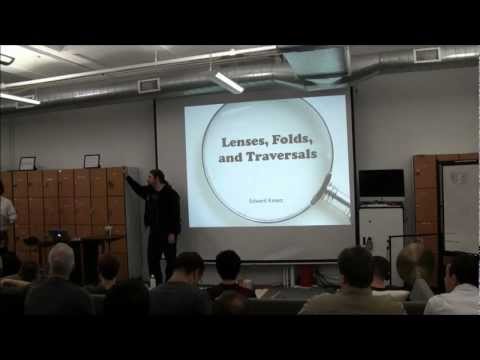
Edward Kmett's talk to the NY Haskell User Group on the lens library, building from fmap and function composition up to lenses, folds and traversals. It shows how these composable combinators access and modify parts of data structures.
Why Hacker News points people here: HN calls it dense but mind-blowing, the go-to way to understand lenses through algebraic derivation.
“I found this talk by edward kmett incredibly helpful[0].”HN comment, 2014
“I found this talk by edward kmett incredibly helpful[0].”
Dense but mind-blowing introduction to lenses and traversals
Full comment
I found this talk by edward kmett incredibly helpful[0]. I kept rewatching parts of it bit by bit until I managed to absorb it all (there is a lot of information for a beginner) but I found it hugely helpful and mind-blowingly powerful. [0] this video
RecommendsjerfJan 2013
“Edward Kmett's video on his lens library walks through how you can derive it with this sort of logic”
Kmett derives the lens library through algebraic reasoning
Full comment
If you want to work in an environment where a lot of people are thinking like this routinely, instead of a few lone voices in a vast sea of otherwise uninterested people, the Haskell community is doing a lot of work in this area, and able to move much faster since it's so much easier in Haskell than C++ templates (which isn't really a criticism of C++ templates, a lot of their capabilities are accidental rather than intended). This is why the Haskell community talks so much about monoids and applicatives and semigroups and a variety of other interesting structures in that area (and no, I did not forget to say monad, that structure is actually uninteresting here because it is too powerful). I believe the Fortress language is also doing some work here. A sample of the interesting sort of algorithm work that you can do when you think this way: link Edit: See also the Typeclassopedia: link And if you're really interested and want to take it hardcore, Edward Kmett's video on his lens library walks through how you can derive it with this sort of logic: this video
RecommendsdllthomasAug 2014
“Great things the parent has done with the language”
Showcase of great things done in Haskell
Full comment
"The best forms of language advocacy probably involve showing the great things you've done with a language and forgetting about comparisons to the competition." Great things the parent has done with the language: this video