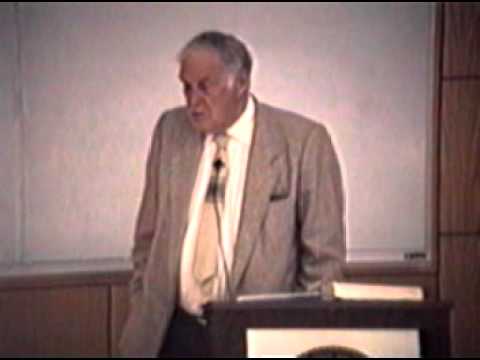
Richard Hamming's 1995 recording of his talk 'You and Your Research', drawn from his graduate engineering course. He discusses how great scientists pick important problems and build careers, drawing on his years at Bell Labs.
Why Hacker News points people here: HN recommends it as career and research advice on choosing important problems and doing first-class work.
“So much sage advice as compiled over a very long and fruitful career.”HN comment, 2016
“So much sage advice as compiled over a very long and fruitful career.”
Sage advice from Hamming's long career
Full comment
It's been posted here before, but Hamming's talk "You and Your Research" is one for the ages. this video Hamming passed in 1998, this talk was given about three years earlier. So much sage advice as compiled over a very long and fruitful career.
Strongly recommendsf00_Jan 2018
“the associated lectures he gave at the naval postgraduate academy are tremendous”
Hamming's naval postgraduate lectures on engineering and learning to learn
Full comment
Richard Hamming developed error-correcting codes while working along side Shannon at bell labs, his book The Art and Science of Engineering: Learning to Learn and the associated lectures he gave at the naval postgraduate academy are tremendous this video
Strongly recommendsgumbyJan 2019
“It's on picking the right problems.”
Hamming on picking the right problems to work on
Full comment
Richard Hamming: You and Your Research It's on picking the right problems. When I heard him give it I was shocked that he criticized Einstein for working on a unified field theory (of course unlike me, he was actually qualified to offer such criticism). His point for that example was that the necessary tools to attack the problem hadn't yet been developed so it was a fruitless endeavor. While many very important problems are tractable. this video He gave this talk several times (I heard it at NASA in 84). Here's a good transcript: link
RecommendssadgaOct 2012
Hamming's talk on doing great research and career
Full comment
this video > Intro: I have given a talk with this title many times, and it turns out from discussions after the talk I could have just as well have called it "You and Your Engineering Career," or even "You and Your Career." But I left the word "Research" in the title because that is what I have most studied"
RecommendsstiffApr 2013
“Single best is difficult, here are some favourites of mine”
Listed among favourite technical talks
Full comment
Single best is difficult, here are some favourites of mine: "You and your research" by Richard Hamming: this video "How to design a good API and why it matters" by Joschua Bloch: link Google TechTalk on Git by Linus Torvalds: link All talks ever given by Alan Kay, for example: link
Recommendslate2partMar 2014
“Keep learning - read Richard Hamming's _You and Your Research_”
Hamming on lifelong learning and career success
Full comment
Complete luck. Timing to start out in the right industry, followed by vigorous effort, learning, and experimentation. I also built many relationships early on in my career that I've mostly kept alive throughout the last decades. I've changed careers twice when the old skills/industry lowered the value of those skills. Keep learning - read Richard Hamming's _You and Your Research_ [1]. Keep friends and work hard. [1] this video
RecommendsJSeymourATLFeb 2017
“On this subject, Richard Hamming offers excellent advice”
Hamming on working on the most important problems in your field
Full comment
> I am eager to learn something new... Learning is a life-long process. As it relates to the industry, consider these questions. 1) What are the most important problems in your field? 2) Are you working on ONE of them? 3) Why not? On this subject, Richard Hamming offers excellent advice > this video
RecommendsnestorDJan 2019
“focusses on the selection of the problem you should work on as a researcher.”
Hamming on selecting problems, applicable beyond academia
Full comment
In his "You and Your Research" talk, Hamming focusses on the selection of the problem you should work on as a researcher. I believe it does apply even if you are not in academics : this video (transcript : link )
RecommendswcarssApr 2020
“it's a great inspirational essay”
Inspirational talk on greatness and culture at Bell Labs
Full comment
Don Eyles' writing about programming the lunar module (which was something he did!) is fantastic [1]. There's also a gallery of photos on that site and he has a whole book! And, click around on Bret Victor's references page[2] -- it's a real treasure. Despite my constant fear that mentioning it will make it go away, it needs to be shared to be useful. It's a big collection of classic papers and interviews. Someone mentioned "As You May Think", which is on there, as is Bush's follow-up from ~20 years later, and Douglas Engelbart's own partly annotated version of the original! Also check out folklore[3], which is a great bunch of stories about working at Apple in its early days, by people who worked there (mostly Andy Hertzfeld, I'm pretty sure). Lastly, look up "Ignition!" by John Drury Clark[4], which is a tangent, but is amazing -- it's about the history of the design of rocket engines, largely about the wild experiments and chemical science involved, and is very well written. I didn't feel right finding a pdf to link straight to, but they aren't that hard to find. As a bonus, this isn't so much historical, but it's a great inspirational essay, Richard Hamming's "You and Your Research"(transcript[5], a video version[6]). Talks about working at Bell Labs and the different cultural elements there across people as part of analysing what makes certain people truly great. 1 - link 2 - link 3 - link 4 - link 5 - link 6 - this video
RecommendssireatApr 2022
“Hamming's writing is so clear and inspiring.”
Hamming's speech, quite good alongside his clear writing
Full comment
Fantastic recommendation! Hamming's writing is so clear and inspiring. Not a book but his speech "You and your research" is quite good: this video
RecommendstrombonechampJan 2023
“which is worth reading”
Hamming on working on important problems
Full comment
Maybe a nitpick, but Aaron Swartz was probably quoting Richard Hamming: And I started asking, "What are the important problems of your field?" And after a week or so, "What important problems are you working on?" And after some more time I came in one day and said, "If what you are doing is not important, and if you don't think it is going to lead to something important, why are you at Bell Labs working on it?" ... If you do not work on an important problem, it's unlikely you'll do important work. It is the main idea behind his lecture/essay "You and your Research", which is worth reading: link or watching: this video
Cites itsinwaveFeb 2015
“Hamming said in that talk [2][3] that Shannon didn't do anything killer after Info Theory...”
Hamming remarks on Shannon's later career
Full comment
I know! According to [1] the minimax algorithm does indeed originate here. And Hamming said in that talk [2][3] that Shannon didn't do anything killer after Info Theory... [1] - link [2] - link [3] - this video
Cites itnicklafSep 2017
“Study successes. If you study successes, when your time comes, you'll know how to succeed.”
Hamming advises studying successes over failures
Full comment
It's true that we ought to be comfortable experimenting without fear of embarrassment, as well as to learn to tolerate more serious failure on occasion, and certainly unexpected failures can serve to draw attention to symptoms of deeper issues worthy of rectifying before they cause you even greater trouble down the road. However, I will point to Richard Hamming's advice to learn from our successes rather than our failures. "There are so many ways of being wrong and so few ways of being right that it is much more economical to study successes." And: "Study successes. If you study successes, when your time comes, you'll know how to succeed. If you study failures, then you'll know how to fail. So study success very closely: not only yours, but other people's. Why did Galileo do what he did? How did Newton do it? Try as best you can to study other people: how they succeed, and what the elements of their success are, which elements of that can you adapt to your personality. You can't be everybody, but you have to find your own method. Studying success is a very good way of informing your own style." (The latter quote is from 25:30 of this video )
Cites itenjoylifeMay 2019
“a good proxy is to listen to one of his colleagues, Richard Hamming explain.”
Hamming discusses his colleague Shannon around 4:30
Full comment
Unfortunately it would be hard to ask him directly as to why but a good proxy is to listen to one of his colleagues, Richard Hamming explain. this video . He mentions Claude around the 4:30 mark.
Cites itpyankoffAug 2020
“Doing something really first class and knowing you've done it is better than anything else they can think of.”
Hamming says first-class work beats wine, women and song
Full comment
Richard Hamming disagrees: "Is effort to be a great person worth it? ...those who did succeed said - Yes it's better than wine women and song put together... Doing something really first class and knowing you've done it is better than anything else they can think of." this video
Cites itmacromagnonOct 2020
“I am reminded of this lecture by Hamming entitled you and your research”
Hamming on why researchers fail
Full comment
I am reminded of this lecture by Hamming entitled you and your research where he basically says you will fail at research because you're lazy and/or will lose time reading useless stuff. this video
Cites it_virtuDec 2020
Hamming's lecture linked to his book
Full comment
I picked up Hamming’s book: “The Art of Doing Science and Engineering Learning to Learn”, I already love the messages he’s conveying. Is this the lecture you speak of? this video
Cites itsvatDec 2020
“Knowledge and productivity are like compound interest.”
Hamming on knowledge compounding like interest through hard work
Full comment
Given the Bell Labs mention, you may be thinking of Hamming's talk “You and Your Research” ( link ), where that idea is mentioned: > Now for the matter of drive. You observe that most great scientists have tremendous drive. I worked for ten years with John Tukey at Bell Labs. He had tremendous drive. One day about three or four years after I joined, I discovered that John Tukey was slightly younger than I was. John was a genius and I clearly was not. Well I went storming into Bode's office and said, “How can anybody my age know as much as John Tukey does?” He leaned back in his chair, put his hands behind his head, grinned slightly, and said, “You would be surprised Hamming, how much you would know if you worked as hard as he did that many years.” I simply slunk out of the office! > What Bode was saying was this: “Knowledge and productivity are like compound interest.” Given two people of approximately the same ability and one person who works ten percent more than the other, the latter will more than twice outproduce the former. The more you know, the more you learn; the more you learn, the more you can do; the more you can do, the more the opportunity - it is very much like compound interest. I don't want to give you a rate, but it is a very high rate. Given two people with exactly the same ability, the one person who manages day in and day out to get in one more hour of thinking will be tremendously more productive over a lifetime. Slightly edited in the version publishe
Cites ityesenadamAug 2021
“It was the final lecture in his 31 lecture graduate engineering course”
1995 recording, final lecture of Hamming's course
Full comment
Or watch him giving the talk in 1995 this video It was the final lecture in his 31 lecture graduate engineering course "The Art of Doing Science and Engineering: Learning to Learn": link
Cites itjzelinskieMay 2023
“Here's a recording from '95 entitled the same”
1995 recording of the same Hamming talk
Full comment
Here's a recording from '95 entitled the same: this video I also highly recommend reading the Stripe Press book also with the same name: link