I quite like this one: link AUTOMATICA - Robots Vs. Music - Nigel Stanford More industrial robot arm choreography and creative film making, but with some fun mindless destruction too. (And if you like that, another one of his I like is tghis: this video )
Cites itpeter_d_shermanJul 2019
“Intuitively, there seems to be a relationship between Oscilloscope Music and Cymatics”
Related to oscilloscope music and cymatics.
Full comment
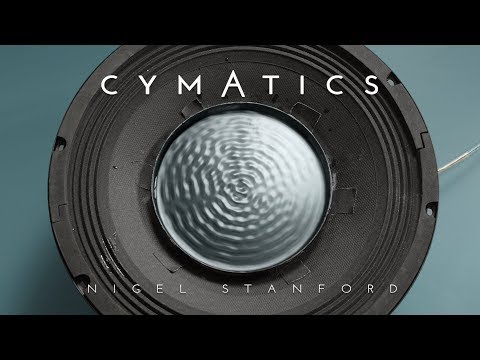
Related: What is Oscilloscope Music and how do you display it on your oscilloscope? link Jerobeam Fenderson's Oscilloscope Music YouTube Channel link Intuitively, there seems to be a relationship between Oscilloscope Music and Cymatics: CYMATICS: Science Vs. Music - Nigel Stanford this video (Also, there's an implied 2D to 3D mapping from the Oscilloscope experiments...)
Cites itmotohagiographySep 2021
“When you look at what you can do with magnets hooked to a synth with a ferrofluid, e.g.”
Example of sound waves producing physical effects in ferrofluid.
Full comment
Thanks! With the caveat that I profoundly lack depth on both, and am a bit artsy craftsy in my intuitions, I did buy the Maths module precisely because it was an analog computer. The intent was to create some generative music, and seeing if I could use it to create 1/f noise, and exploring self-similarity using a musical ear instead of in code. Still working on it. When you look at what you can do with magnets hooked to a synth with a ferrofluid, e.g. this video , the sound and your ear helps to develop an sense for what kinds of waves can be used to yield physical effects. If you can functionally suspend and maipulate a ferrofluid with waves, there are likely analogies to laser pulses and electrons for quantum computing. Waves gonna wave, etc. The other piece that grabbed me recently was "analog fractals," ( link + that rabbit hole) where if you can get those artifacts instantaneously as the effect of physical feedback instead of rendering them computationally, there are likely faster functional approaches to a lot of other problems, only a subset of which we use ASICs and FPGAs to implement today. It's speculative based on laughably incomplete understandings on my part, but that's hacking.