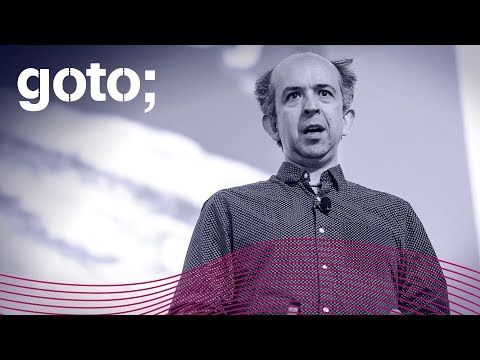
Kevlin Henney's GOTO 2018 talk argues that much of what looks new in software is a recycling of concepts with long histories. It draws on history to show the slow, steady current beneath constant churn in frameworks and trends.
Why Hacker News points people here: HN recommends it for historical perspective on software ideas and for dispelling myths such as the origins of waterfall.
“There's a talk well worth watching by Kevlin Henney called 'Old Is the New New' [1]”HN comment, 2019
“There's a talk well worth watching by Kevlin Henney called 'Old Is the New New' [1]”
Waterfall originally included design iteration, later forgotten
Full comment
There's a talk well worth watching by Kevlin Henney called 'Old Is the New New' [1], where he points out that waterfall was initially conceived with design iteration in mind and yet that part was just essentially forgotten and replaced by something overly-simplified in common understanding. [1] this video
RecommendsluggOct 2019
Covers programming concepts that keep being recycled as new
Full comment
You remind me of this Kevlin Henney talks that manages to cover a rather big range of programming concepts that keep getting recycled as the big new thing this video
RecommendskqrMar 2020
“I can recommend Old Is the New New by Kevlin Henney for a good, historical perspective”
Historical perspective on how little actually changes in software
Full comment
The points on the fluff in particular resonate with me because idespite being a fairly good software engineer, I would say it was only recently I truly started seeing past the fluff. However, typing this out, I realise I would have said the same thing 10 years ago, and 5 years ago, and I probably will again another 5 years from now. I think the truth is that we're always missing the forest for all the trees -- only at increasing levels of abstraction: at first, everything is foreign, then syntax becomes fluff, then APIs become fluff, then patterns, then languages, then compilers, then ... I look forward to learning what the next level of fluff will be. > The majority of the stuff being released every day is just a rehash of the same ideas. Truly revolutionary stuff only happens every few years. Maybe not even that often. I can recommend Old Is the New New by Kevlin Henney for a good, historical perspective on how little actually changes sometimes: this video Edit: now this was more interesting than I anticipated. What is the next level of fluff? Concurrency? Advanced data structures? Phrasing problems for SMT solvers? Probabilistic modeling? Or are the things I picture as fluff just specific techniques, because the next level of fluff is so meta I wouldn't even recognise it now?
RecommendseralpsApr 2020
“I would recommend watching this talk [0] from Kevlin Henney to anyone who likes that book.”
Pairs well with The Mythical Man-Month
Full comment
I've read only the The Mythical Man-Month from this list. It is amazing how the project management really did not change much. Similar ideas (sometimes same) to similar problems. I would recommend watching this talk [0] from Kevlin Henney to anyone who likes that book. [0]: this video
Cites itpieterrJul 2018
“not every ‘new’ development is as new as it appears; “Old is the New New”.”
Supports point that new developments are often old ideas
Full comment
I don’t think so. Building software is a creative process that benefits from team diversity in multiple aspects. You need both young and older people. I’m 54 and still going strong. :-) Also, not every ‘new’ development is as new as it appears; “Old is the New New”. this video