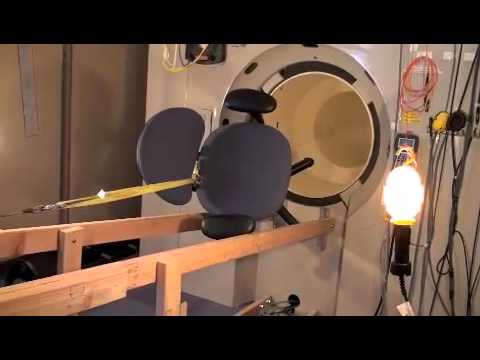
A three-minute demonstration with a decommissioned 4 tesla MRI magnet showing how magnetic objects are pulled in and oscillate along the bore. It illustrates the safety hazards of ferromagnetic items near MRI scanners.
Why Hacker News points people here: Linked in threads on magnets and implants as a vivid demonstration of how violent MRI magnet forces are.
A topic I can speak intelligently about! (I am a Radiologist.) This article is a great discussion of modern imaging technology and I 100% agree that MRI is incredible. But CT has become much more impressive than the single-slice scanners of yore. Watch this video of a modern scanner rotating at full speed: link Currently, the race to improvement is about speed and lower radiation dose. The newest scanners can take hundreds of 2D slices in a single rotation of less than a second and reconstruct the image with a huge variety of algorithms accounting for body part, patient size, etc. that all allow for lower dose and noise resulting in better diagnostic quality. MRI is truly the cutting edge of human achievement. Watch this video to see the forces involved: this video And this for a detailed explanation of MRI principles: link Medicine uses 1.5T and 3T routinely for imaging, but higher field strengths are in use for research purposes. Innovation lately has been about developing new sequences (ways to differentiate types of tissue), and increase speed of aquisiton and comfort.
Cites itpoDec 2011
“Not exactly safe.”
Shows hazards of magnetic items near MRI magnets
Full comment
They are superconducting magnets kept that way through cryogenic helium. They can lose their magnetism through a process called quenching. If you search on youtube for "MRI quench" there are several videos of people messing around with MRI's before they get decommissioned. Not exactly safe. linkthis video There is a lot of helium in there and it can explode: link
Cites itphren0logyMar 2012
“There's some people horsing around with 4T MRI that might give you pause.”
Illustrates risks of strong MRI fields near metal
Full comment
Obviously I have no first-hand experience with implanted magnets, but MRI magnets are generally getting stronger. What is safe for a 1.5 tesla MRI may not hold for a 3-4 tesla MRI. The rapid magnetic oscillation has been known to heat up wires and cause burns. There's some people horsing around with 4T MRI that might give you pause. this video
Cites itben_wMay 2023
“magnetic material can be rapidly drawn towards the magnets”
Shows magnetic material being drawn into MRI magnets
Full comment
"Trans-cranial magnetic stimulation" — it has both been called "the god helmet" and has been used in that way. IIRC it's a pulsed field to induce electric fields in your brain, and also has an extremely short range. Somewhat more significant to human health is that magnetic material can be rapidly drawn towards the magnets: this video At very high field strengths, you also need to account for "your blood is electrically conductive, and electrical conductors resist motion when in a magnetic field due to induced electrical currents". According to test subjects, this "tingles". At the most extreme fields strengths we can currently make, you also have to account for the water in your body being diamagnetic and repelling the magnets, but we can't ask any of the test subjects what that feels like as they were a frog and a rat because that's all that would fit in the tube.