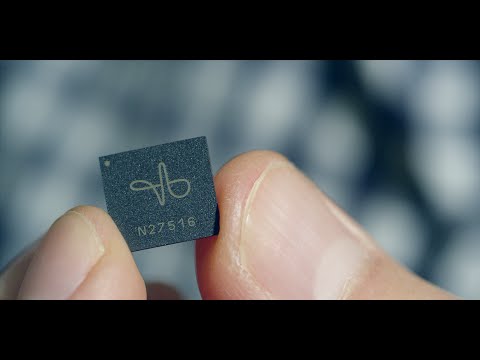
Google ATAP's 2015 introduction to Project Soli, a radar-based sensor on a chip that tracks sub-millimeter hand motions for gesture interaction in small devices.
Why Hacker News points people here: Referenced for years as the go-to example of fine gesture input, often in discussions of keyboard replacements and later its appearance in the Pixel 4.
“Google finally ships a research project in a real product”HN comment, 2019
“Google finally ships a research project in a real product”
The 2015 announcement showing Soli's potential.
Full comment
Google finally ships a research project in a real product and people don’t seem to understand the usefulness. Human nature for some reason often devolves to “what’s the point?” Here’s the 2015 announcement. There’s a lot of potential. Maybe we’d all benefit from “imagine what’s now possible “ this video
Cites itmellingJul 2015
“Google's Soli project might lead to better input”
Radar-based gesture sensing as better input.
Full comment
Better pen input would be great, especially for drawing. How about some form of chorded keyboard or glove? A chorded keyboard was demonstrated in 1968 by Engelbart: link Google's Soli project might lead to better input: this video
Cites itmellingAug 2015
“Google's Soli chip - 2016 -”
Soli radar chip as an example of gesture tech.
Full comment
How long before gestures move off the screen surface? This technology got off to an exciting start but it quickly hit a wall. It was disappointing, for example, when Microsoft had to unbundle the Kinect. Microsoft's Kinect - 2010 Leap Motion - 2010 Intel Real Sense - link Google's Soli chip - 2016 - this video Google's Touch Sensitive Fabric: link
Cites itmellingSep 2015
“Throw in eye tracking and precise gestures”
Precise gesture sensing as keyboard replacement.
Full comment
This tool is for people who can't use their hands, of course. For the average person, we're pretty close to being able to use voice instead of typing. linklink Throw in eye tracking and precise gestures ( this video ) and the keyboard isn't necessary.
Cites itmellingOct 2015
“Google's Soli project might get us there”
Soli demo of subtle gesture control.
Full comment
It would be great if some of the repetitive tasks didn't even require a keyboard but rather use subtle gestures, eye tracking, and voice commands. Leap Motion, for example, never panned out but Google's Soli project might get us there: this video Throw in better autocompletion ( link ) and software development becomes more precise and less repetitive.
Cites itmellingOct 2015
“Throw in some small gestures and that'll be faster than reaching for a key.”
Small gestures as faster input.
Full comment
No one said that the solution has to be all speech. Throw in some small gestures and that'll be faster than reaching for a key. this video Throw in eye-tracking and you can pick out any word quickly.
Cites itmellingFeb 2016
“Gesture based computing is almost here in some form.”
Soli among industry gesture efforts.
Full comment
Gesture based computing is almost here in some form. Apple, Google, Intel and Microsoft are all working on it: Apple: link Intel Real Sense - link Google's Soli chip - this video Microsoft shipped the Kinect 6 years ago. The need for hand tracking with VR headsets should give it another boost. By the 20th anniversary of Minority Report? link
Cites itmellingFeb 2016
“Hopefully, Google ships this silicon this year”
Soli as a path to dropping the keyboard.
Full comment
"The keyboard is the only thing I need, except for the glasses." I think this loses a lot of appeal until we can throw away the keyboard. We should be able to do better. Hopefully, Google ships this silicon this year: this video I'd rather have those monitors and no keyboard.
Cites itmellingMar 2016
Hand tracking demo for organizing information.
Full comment
Paper notebooks might be. link The cell phone, etc will be a much bigger extension. However, we still need better ways to input, organize and access the information. Handwritten notes, voice memos, pictures, drawings, unstructured and structured data, etc. Cortana/Siri with hand tracking ( this video ) and a HoloLens will allow people to organize everything in creative ways.
Cites itmellingMar 2016
“Google's new chip could probably help interpret a series of gestures”
Chip that could interpret gesture series.
Full comment
you can provide audible feedback when you move your hands. Many gestures don't provide anyone tactile feedback. Move your hands or fingers then something happens on the screen. Google's new chip could probably help interpret a series of gestures: this video
Cites itIanCalMar 2016
“Reminds me of SOLI (which is radar rather than sonar)”
Radar-based finger tracking comparable to sonar approach.
Full comment
Really interesting. Reminds me of SOLI (which is radar rather than sonar): this video Is there a way of trying this out? I know it'd only be demo line drawing applications but it'd still be interesting to try.
Cites itmellingApr 2016
Soli as gesture input option.
Full comment
Now we need a gesture keyboard so we can type, or twitch, instead of using an onscreen keyboard. Finger IO: link Google's Soli: this video Perhaps a modified game controller: link
Cites itmellingMay 2016
“Google's Soli would recognize small movements”
Soli recognizes subtle hand movements.
Full comment
Someone could devise a more subtle set of movements for text entry. Google's Soli would recognize small movements: this video There are others: link
Cites itmellingSep 2016
Subtle gestures to complement voice and keyboard.
Full comment
i'm disappointed that we haven't made more progress with voice interfaces. Many people are happy with the keyboard/mouse as their primary input devices but combined with subtle gestures like you might get with Google's Soli and we should get a better user interface for everyone. this video
Cites itmellingJul 2017
Soli chip idea for keyboards.
Full comment
How about a little more innovation in keyboards? It is 30 years later. Split keyboards? link Tenting capable? Add a Soli chip? this video
Cites itmellingJul 2017
Gesture control as an alternative to typing.
Full comment
Voice, eye tacking, and gesturing don’t offer possibilities? this videolink And yes, if you’re clicking away in a room of programmers, it won’t work for you, but with a Hololens I’ll find a quiet location.
Cites itmellingAug 2017
Gesture tech that could replace the keyboard.
Full comment
How old are you? It’s really not that hard to imagine the keyboard being replaced by one, or a combination, of technologies in the next decade or two. Voice has gotten dramatically better in the past few years. Another decade? There are also gesture technologies: this video Anyway, if you’ve got 3 or 4 decades of life, you still think we won’t have sufficient advances to replace the keyboard?
Cites itmellingOct 2017
Hand tracking for soft keyboards.
Full comment
In my dreams the keyboard disappears. My eyes, or fingers, move the cursor, I can speak interactively with the computer, gesture, etc. Can fingers/hands be tracked sufficiently to provide an accurate soft keyboard? this video
Cites itcboltonOct 2019
“The radar chip is especially interesting.”
Original presentation of the radar chip.
Full comment
The radar chip is especially interesting. I remember being intrigued when it was presented by the ATAP team years ago: this video The team showed an impressive amount of cool stuff back then, it's nice to see one of these projects shipping on a flagship product. There's more info here on how it's used: link EDIT: found the original presentation: link . I think the touch sensitive cloth project also made it into a few products.
CriticalfermienricoJan 2018
“none of these replace haptical feedback.”
Full comment
Hand Gesture controls bother me. I see all these fancy implementations enabling hand gestures such as the Google ATAP project called Soli [1], but none of these replace haptical feedback. One of the major aspects of any haptical human-to-machine interface is feedback and robustness. When you turn a high quality 30 indent encoder from Alps [2] or avionics grade Elma encoder [3]; you'll realize the value of haptic feedback. There is a reason why cockpits are full of knobs and dials, although unfortunately, that's changing due to highly integrated multi-function glass instruments. Problem with hand gestures is robustness. Theramins (hand gesture based music instrument) are cool, but they take forever to master and I am not saying they are trying to replace pianos, but let's just say - iPad pianos are not fun precisely because of the lack of feedback. I really think gesture based controls are inferior. They have no place in my living room, my car or anywhere in my life. That said, I think the implementation of hand gesture based systems as pointed out in this article are truly interesting. It is a challenging problem. [1] this video [2] link [3] link