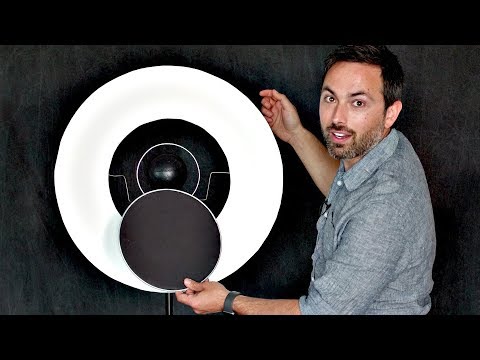
Veritasium explains what a black hole should look like, using J.P. Luminet's 1979 work and a cardboard 3D model to show how light bends around it. It was made just as the first black hole image was released.
Why Hacker News points people here: Recommended for correctly predicting the features of the real black hole image and clearly explaining the lensing physics behind it.
“Good video that correctly predicted the image and describes why it looks the way it does”HN comment, 2019
Explains how the black hole image was predicted before release.
Full comment
Related video, made by Veritasium yesterday, is one of my favorite videos in a long time. He explained how the prediction of this image was made (before the image got released) and the video is great and fun to watch. this video
RecommendsJumpCrisscrossApr 2019
“Good video that correctly predicted the image and describes why it looks the way it does”
Predicts the black hole image and explains why it looks that way.
Full comment
Good video that correctly predicted the image and describes why it looks the way it does [1]. TL; DR The dark area is the entire surface of the event horizon, including the side facing away from us, plus some more due to photons missing the event horizon "directly" being drawn in. One side is brighter due to its being Doppler boosted. [1] this video
RecommendsdelectiApr 2019
“This video predicts pretty well all of the features we expected to find”
Predicts the features later seen in the actual black hole image.
Full comment
If you mean the brightness asymmetry, it's because the accretion disc is spinning. This video predicts pretty well all of the features we expected to find, and it lines up with the actual image. this video
RecommendstempestnApr 2019
“This video explains in much more detail”
Detailed explanation of why light bends around a black hole.
Full comment
The black hole itself is spherical, but the light we're seeing around it isn't projected by the event horizon; rather, it's light from behind/around the black hole that isn't blocked. This video explains in much more detail: this video
RecommendskaslaiJul 2019
“Derek explains the physics in a reasonably understandable manner”
Understandable explanation of the physics behind the black hole image.
Full comment
Derek explains the physics in a reasonably understandable manner in this video on his Youtube channel: this video
RecommendssudhirjSep 2019
“There's a clearer explanation of why the disk looks that way and how the gravitational warp makes those light paths”
Clear explanation of why the accretion disk looks warped.
Full comment
There's a clearer explanation of why the disk looks that way and how the gravitational warp makes those light paths this video
RecommendssovaSep 2019
“Veritasium made an excellent youtube video explaining how this effect works (before the image was released!)”
Explains the lensing effect, made before the image was released.
Full comment
Veritasium made an excellent youtube video explaining how this effect works (before the image was released!) this video
Recommendsgus_massaAug 2021
“There is a nice 3d cardboard simulation and clear explanation in a video by Veritasium”
Cardboard 3D simulation and clear explanation of black hole appearance.
Full comment
If the black hole is not spinning, it should look the same from every angle. A spinning black hole is deformed (like the spinning Earth.) Anyway, we are not seeing the black hole (because it looks just like a black circle in front of a black background). The interesting part of the image is a disk of material spinning around it. There is a nice 3d cardboard simulation and clear explanation in a video by Veritasium this video
Cites itcodesternewsApr 2019
Shows how scientists predicted the black hole's appearance.
Full comment
It's really amazing that human mind can predict and tell the things without even seeing it. How come we even know and predicted the radius and things far away in galaxy without even seeing it. It's just amazing. Wow it just amazes you that scientist even have predicted the radius of thing and how it work etc.[1] [1] this video
Cites itbrandonjmApr 2019
“See Veritasium's video [1] on why it looks like it does”
Explains the asymmetry of the black hole image.
Full comment
> Then the data was compiled and rendered into an image A digital camera is just an array of tiny sensors that detect how much light hit them and a computer takes those values and renders an image from them. > you really think it's that bright? If you take a photo in a dark room with increased exposure then the resulting image is brighter than what you see with your own eyes. This was taken over a long period of time, effectively a long exposure. If you were close enough to see it at the scale you are seeing it on your computer screen it would probably be far brighter. > How about orange? As mentioned in another comment on this thread, it's just the colour scheme used in the output to show the brightness differences. The accretion disk is not necessarily orange, this photo is essentially greyscale mapped to a black -> orange -> white scale. This is just an array of relatively large sensors with very high exposure gathering information from something very far away and combining that data in greyscale. > I wonder why it's not symmetrical? See Veritasium's video [1] on why it looks like it does, in short, the effects of the black hole and our angle to the accretion disk. [1] this video