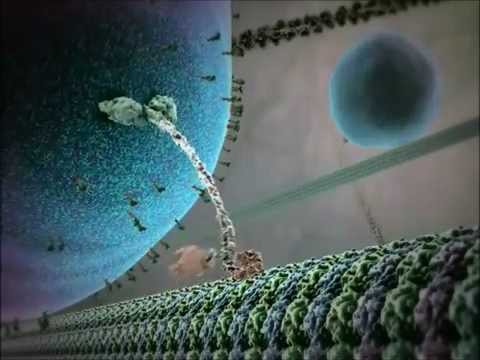
Animation of a kinesin protein walking, illustrating protein machines.
Full comment
Proteins are 1-dimensional chains of 'lego-like' molecules that fold into atomically-precise 3D tools. There are ~20 types of legos that have properties that differ along a number of axis like hydrophobicity, charge, reactivity, size, flexibility, etc. And those 20, in combination, seem to be enough to build all of the tools life needs to interact with its environment. Most proteins are assemblies of a few hundred such 'legos' (again, of which there are 20 types). Those 3D structures then, because they're encoded in the 'tape-like' DNA, can actually themselves be modular, rearranged, and this chunk can be lopped off and plopped onto that chunk, or assembled with this chunk over here. When you string a 'firefly-shine' protein next to a 'in-the-nucleus' protein, the firefly-shine protein will now be physically connected to the 'in-the-nucleus' signal, so you get firefly-shine in the nucleus. Now encode all the things proteins can do: bind to things, enzymatically make things, go places, make structures, sense chemicals, light, force, electricity, other atoms, etc. - and you get little multi-part robots made of those various active 'chunks'. If you have a protein piece that itself assembles in a hexagonal-like shape, you could imagine assembling a number of them into a soccer ball - just as a virus does to protect its DNA. Or if there are small Brownian-aware 'ratchets' attached to stiff fiber-like proteins, you can get proteins that move or walk: this video The microtubule's they'