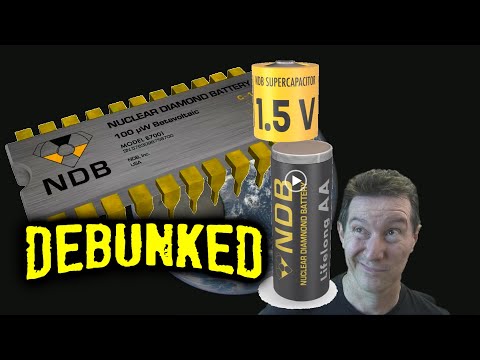
Dave Jones of EEVblog debunks the marketing claims of the self-charging nano nuclear diamond battery from NDB Inc. He argues it is no better than existing 100uW betavoltaic batteries, with an added graphene supercapacitor.
Why Hacker News points people here: Repeatedly linked under hype stories about nuclear diamond batteries as the definitive debunk.
EEVblog did a debunk of this at this video Basically, the power density of these are so low that they're useless for most applications. Sure, it might last 28,000 years, but you're only getting 100 microwatts from a battery the size of a normal AA battery.
Criticalgus_massaSep 2020
“eevblog had a good video about this product”
Full comment
It is not clear that they have a real working prototype. The current is very low, only 100uW, and there are similar batteries made with tritium. More info in a video by EEVblog eevblog had a good video about this product: this video Also, there is a calculation of the low the maximal current per kilogram in link
CriticaldiimdeepSep 2020Full comment
Where is innovation and efficiency ? To me it smells like this video and all about patents, marketing and money burning, but I don't know as much as these professors do so maybe I am wrong.
CriticalChrisGrangerSep 2020
“Here's EEVblog's take”
Full comment
This nonexistent product has been discussed and debunked here before. Here's EEVblog's take: this video
Criticalcolejohnson66Feb 2021
“Dave Jones of EEVBlog debunked it pretty quickly”
Full comment
To add to the sample size of n=1, a few months ago, there were many articles about “nano diamond” batteries that will supposedly solve the radioactive waste problem. Dave Jones of EEVBlog debunked it pretty quickly: this video Basically, every few months, a company comes out with claims that battery tech or e-waste has been revolutionized , but it’s always a bunch of bunk claims made using a multitude of weasel words.
Criticalgus_massaApr 2021
“eevblog had a good video about this product”
Full comment
It is not clear that they have a real working prototype. The current is very low, only 100uW, and there are similar batteries made with tritium. More info in a video by EEVblog eevblog had a good video about this product: this video (it's old, but I can't find any evidence of improvements.) Also, there is a calculation of the low the maximal current per kilogram in link
CriticalmikewarotApr 2021
“For a longer debunk -”
Full comment
Why are you interested in this? If it is for anything other than very LOW power (microwatts), you're going to be disappointed. It is essentially a beta emitter hooked to a capacitor via some electronics to handle voltage conversion. The thing is the beta source is use it or lose it, and very low power. If you scaled this up to power a Tesla, it would be a nightmare, as it would need to dissipate the full power the car requires, all the time, or it would melt down (aka Fukashima) For a longer debunk - this video
Criticalgus_massaApr 2022Full comment
It was heavily discussed a few years ago, for example in link They last for a log time, but the important detail is that they have very low power, like 1mW with the size factor of a normal battery, so you need like a dozen for a (old) wrist watch and s few hundred to turn on a led. More details in: linkthis video (EEVblog)
Critical0xbadc0de5Jan 2024
“This idea has actually been debunked more than once.”
Full comment
These are woefully underpowered for consumer electronics and always will be - only really useful for maintaining volatile memory. This idea has actually been debunked more than once. this videolink