
“from Veritasium is related and also a fantastic video”
Veritasium on how electricity actually works
Full comment
"How Electricity Actually Works" ( this video ) from Veritasium is related and also a fantastic video.
12.8M views · Apr 29, 2022 · 24:31 · 4 HN recommenders · 12 mentions · discussed 2023–2026
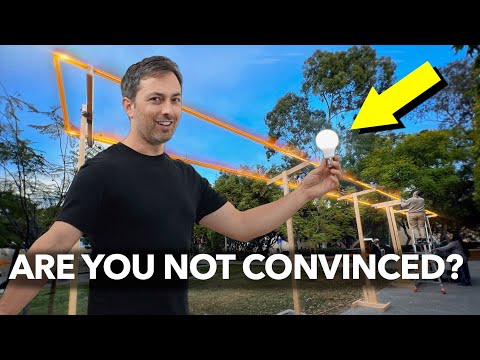
Veritasium explores how electrical energy actually travels in a circuit, arguing that it flows through electromagnetic fields around the wires rather than through the electrons. It builds a long-cable experiment with Caltech to test when a distant bulb lights.
Why Hacker News points people here: HN cites it for the field-based picture of power transfer, noting it was controversial at release but the experiment largely backed the creator.
“And why magnets work due to relativity”HN comment, 2024
“from Veritasium is related and also a fantastic video”
Veritasium on how electricity actually works
"How Electricity Actually Works" ( this video ) from Veritasium is related and also a fantastic video.
“the electricity videos he's done in the last year”
Controversial electricity video later vindicated by experiment
The video in question for reference: link Interestingly, when I saw that I figured this channel for a goner because he was going to turn to the darkside, but quite contrary to expectations I feel like his channel has actually blossomed since then. His older videos are fine, but often just explaining concepts that you can find a lot of other explanations on, but some of his recent videos have rocked the boat even among physicists and IMHO he was ultimately proved to be correct for them. I particularly point at his videos about how nobody has measured the one-way speed of light ( link ), which was well-known among people very very deep in the field of relativity but not very well known outside of that (even amongst physicists in other fields, let alone lay people) and the electricity videos he's done in the last year ( link , this video ) which attracted a whole whackload of "debunking" videos, which were themselves wrong (the best "bunking" video, if I may call it that, is probably AlphaPheonix's: link , since he actually set up the experiment, albeit on a smaller scale). They aren't all of that caliber, but the knot theory video was very good too and not something I've seen a hundred times elsewhere, and the airships video that preceded that one clearly had a high degree of research put into it beyond just the hype.
“It was pretty controversial at release but it gives a good overview.”
Good overview of electromagnetic waves guided by wires
Sort of, electricity and magnetism are two sides of the same coin, electromagnetism, so it's waves in the electromagnetic field with the wire acting as a wave guide. (as far as I understand) Veritasium has a video that goes over this. It was pretty controversial at release but it gives a good overview. this video And why magnets work due to relativity link
“Good intrpduction are Veritasium videos”
Good introduction to how electricity works
Good intrpduction are Veritasium videos: "How Electricity Actually Works" this video "The Biggest Misconception About Electricity" link
“You can invalidate the circuit theory with, well perhaps not $50 worth of hardware, but a bit more”
Experiment on how energy flows in circuits
You can invalidate the circuit theory with, well perhaps not $50 worth of hardware, but a bit more: this video I'm not sure how do you plan to invalidate Maxwell's theory, which shows that energy flows entirely outside of wires, with $50. It would be very much welcome in the physics community. This misconception is even more widespread than "planes fly because of Bernoulli" because it's so incredibly useful when designing most circuits/PCBs. Though it is, fundamentally, a lie. PS. Circuit theory is made to match reality for the case showed in the video via the concept of a transmission line.
“Here's a video discussing some of the implications of this effect”
Counterintuitive effects of magnetic fields in conductors
> Is there any understanding as to why superconductivity breaks down at higher amperage? This is a good read [1] > As long as the induced magnetic field at the edges is less than the critical field, the material remains superconducting, but at higher currents, the field becomes too strong and the superconducting state is lost. This limit on current density has important practical implications in applications of superconducting materials – despite zero resistance they cannot carry unlimited quantities of electric power. Tl;Dr (and probably wrong) as current flows through any conductor it creates a magnetic field. In superconductors when that magnetic field gets too strong it impedes current from being able to flow. A little like a traffic wave [2]. Everything works fine so long as there's enough space between cars to allow for them to speed up and slow down, but as the density of the cars increases if someone slows down that has a reverberating effect down the chain. The magnetic field on a superconductor in turn induces a current on the conductor in the opposite direction. Here's a video discussing some of the implications of this effect in a way that seems counter intuitive :) [3] [1] link [2] link [3] this video
“TL;DW: the power is transferred by the electric fields”
Power transfers via electric fields
There was a whole mess of STEM YouTubers arguing about this last year, e.g.: this video TL;DW: the power is transferred by the electric fields, it's the electric fields which move the electrons, if there's a break in the circuit the electrons necessarily accumulate in the places that minimise the electric fields.
“In response to all the controversy he made a follow up video [0].”
Follow-up recreating the experiment and apologising
In response to all the controversy he made a follow up video [0]. In the video he recreated the experiment, explaining the effect in a more technically correct manner and also apologised for not doing so on the original. He also made it clear that the light globe in the original video did not receive enough current to light up.. it was hooked up to an alternative power source and an oscilloscope and upon receiving any signal above baseline would switch on the globe. [0] this video
“Veritasium's experimental video with CalTech with like a mile of cable”
Experiment testing signal timing over long cable
Transmission line > Matrix parameters > Variable definitions: link But, FWIU how this applies to line length and transmission time hadn't been tested until Veritasium's experimental video with CalTech with like a mile of cable: this video So, it doesn't need multiple length parameters.
“generated a lot of controversy and he ended up being right”
Controversial video where the creator turned out right
agreed. This one: this video generated a lot of controversy and he ended up being right. Hence the criticism. It's almost like the Monty Hall problem for Marilyn vos savant where even people with PhDs derided her for being wrong when in fact they were all wrong themselves.
“I learned this gap in our understanding of electron behavior from this experiment”
Experiment on signal delay in circuits
Thanks, quite the useful simulator; I hadn't found that page yet. Additional considerations for circuit simulators: What does the simulator say about signal delay and/or propagation in electronic circuits and their fields? How long does it take for a lightbulb to turn on after a switch is thrown, given the length of the circuit and the real distance between points in it? (I learned this gap in our understanding of electron behavior from this experiment, which had never been done FWIU: "How Electricity Actually Works" (2022) this video ) FWIW, additionally: Hall Effect and Quantum Anomalous Hall Effect; "Tunable superconductivity and Hall effect in a transition metal dichalcogenide" (2025) link ScholarlyArticle: "Moiré-driven topological electronic crystals in twisted graphene" (2025) link NewsArticle: "Anomalous Hall crystal made from twisted graphene" (2025) link From "Single-chip photonic deep neural network with forward-only training" link : "Fractional quantum anomalous Hall effect in multilayer graphene" (2024) link "Coherent interaction of a-few-electron quantum dot with a terahertz optical resonator" (2023) link .. link > "Room-temperature quantum coherence of entangled multiexcitons in a metal-organic framework" (2024) link Electrons (and photons and phonons and other fields of particles) are more complex than that though.
“he set up an experiment to test it and the light does turn on instantly as claimed”
Experiment showing the light turns on as claimed
> suffice to say that the lightbulb does not turn on immediately like he claims Many people said this, but he set up an experiment to test it and the light does turn on instantly as claimed: this video > There second one takes a mathematical model for the path integral for light and portrays it like that's actually what is happening I know nothing about this. Is there a more accurate mathematical model available than the one he uses? Otherwise, I think it seems sensible to portray our best mathematical model as "what's really going on". And I didn't get the sense that light was "choosing" anything when watching the video, I got the sense that the amplitudes of all possible paths were cancelling out except for the shortest path (or something along those lines)