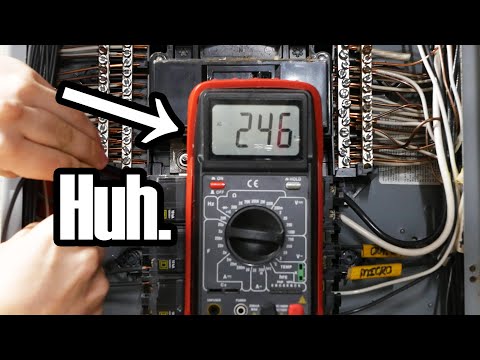
Technology Connections explains that US household power is split-phase, with two 120V legs that combine to 240V for large appliances. It covers the breaker panel and how the system works.
Why Hacker News points people here: HN commenters point to it to correct misconceptions about US voltage and to explain 240V availability in American homes.
“There's a lot of misconceptions about US electricity. This video does a nice job at pointing out the good and the bad.”HN comment, 2022
Explains the breaker panel and how US homes get 240V.
Full comment
Relevant video: Technology Connections, "The US electrical system is not 120V", where there is a (long) discussion of how the breaker panel works and how you get 240V. this video
Recommendscoreyp_1Aug 2022
“There's a lot of misconceptions about US electricity. This video does a nice job at pointing out the good and the bad.”
Corrects misconceptions about US electricity, good and bad.
Full comment
There's a lot of misconceptions about US electricity. This video does a nice job at pointing out the good and the bad. this video
RecommendsRimintilJan 2023
“Technology Connections (YouTube) explains this fairly well”
Explains US 240V split-phase for large appliances.
Full comment
Single family homes in America are 240v rails for large appliances, like stoves/ovens, furnaces, and dryers (two-phase). Technology Connections (YouTube) explains this fairly well: > this video
RecommendsjamesbfbSep 2024
“Reminds me of this great Technology Connections video”
Great video on US voltage.
Full comment
Huh, what?! Mega TIL moment for me as an Australian with an electric kettle and dryer plugged into whatever power socket I wish! Reminds me of this great Technology Connections video: this video
Cites itbreakingcupsJun 2022
“There's probably a large overlap between software people and people who subscribe to Technology Connections”
Full comment
There's probably a large overlap between software people and people who subscribe to Technology Connections: this video
Cites itthrow0101cSep 2022
“The US (and CA) runs on 240V as well”
US runs on split 240V.
Full comment
The US (and CA) runs on 240V as well, it's just split in half for smaller appliances. See requisite Technology Connections video: * this video My stove and clothes dryer are certainly not 120V.
Cites itandrybakDec 2025
“a 2020 video about different voltages in the US electrical systems”
Covers different voltages in the US electrical system.
Full comment
A 2022 Technology Connections video explores various ways to boil water: link And a 2020 video about different voltages in the US electrical systems: this video
Cites itkibwenMay 2026
“Plenty of US home appliances are already 240 volt; this is a solved problem.”
Shows US homes already have 240V.
Full comment
> Also our infra not being 240v is hurting us. The rest of the world can just plug in overnight to any regular outlet and it is good enough for almost any commute. US homes don't need any significant accommodations for 240 volt infra. Plenty of US home appliances are already 240 volt; this is a solved problem. this video