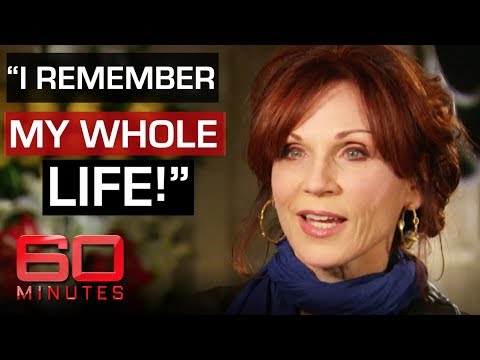
A 60 Minutes Australia segment on people with highly superior autobiographical memory, who can recall the details of any day of their lives. It presents the rare phenomenon through interviews with people who have it.
Why Hacker News points people here: HN links it as an example of extraordinary episodic memory in threads on memory and knowledge.
“Some quite clearly have incredible abilities in this regard”HN comment, 2025
Shows people who recall every day of their lives by date.
Full comment
There are some people, most notably the actress Marilou Henner, who remember and can instantly recall everything they did every day of their life, by date. It’s astounding. More info here: this video
Cites itrectangApr 2022
Linked as an example of people with extraordinary memory.
Full comment
> The way Vaughn describes it, any time he reads something in a book, he can remember it almost perfectly. When he returned to school, he had even more to say, and more that he could understand. Giant caudate nucleus at work? this video
Cites itckemereSep 2025
“Some quite clearly have incredible abilities in this regard”
Example of people with incredible episodic memory abilities.
Full comment
Addressing the second paragraph here - while conflation and reconsolidation are real phenomena, it's also quite clear that most humans form episodic memories. Some quite clearly have incredible abilities in this regard [2]. A distinction between semantic (facts/concepts) and episodic (specific experiences) declarative memories are fairly well established since at least the 1970s. That the latter is required to construct the former is also long posited, with reasonable evidence [1]. Similarly, there's a slightly more recent distinction between "recollecting" (i.e., similar to the author's "I can remember the event of learning this") and "knowing" (i.e., "I know this but don't remember why"), with differences in hypothesized recall mechanisms [3]. [1] link or many other reviews by Eichenbaum, Squire, Milner, etc [2] this video [3] link