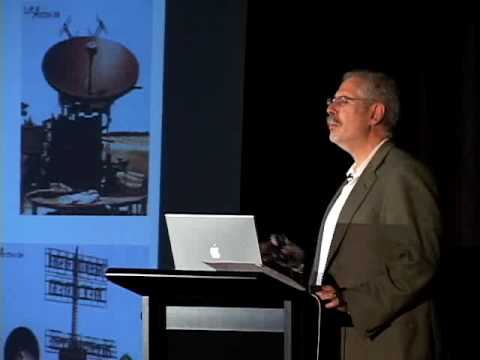
Steve Blank's Computer History Museum lecture argues that Silicon Valley's roots lie in WWII radar and electronic warfare work, Stanford's Fred Terman and Cold War military funding rather than the semiconductor alone.
Why Hacker News points people here: HN commenters call it a favorite introduction to Valley history and cite it whenever government and military funding of tech comes up.
“my favorite introduction to the valleys history was Steve Blanks The Secret History of Silicon Valley. It's well worth the hour”HN comment, 2012
“my favorite introduction to the valleys history was Steve Blanks The Secret History of Silicon Valley. It's well worth the hour”
Favorite introduction to the Valley's history by Steve Blank
Full comment
When I first moved here my favorite introduction to the valleys history was Steve Blanks The Secret History of Silicon Valley. It's well worth the hour this video
Strongly recommendscprJan 2014
“You've gotta watch Steve Blank's "The Secret History of Silicon Valley". Goes back to its post-war roots in 40's and 50's. A real gem and quite surprising.”
Post-war roots of Silicon Valley in the 40s and 50s
Full comment
You've gotta watch Steve Blank's "The Secret History of Silicon Valley". Goes back to its post-war roots in 40's and 50's. A real gem and quite surprising. this video
RecommendsjstrateMay 2012
“I suspect many of you haven't seen his take on the history of the valley”
Steve Blank's take gives context on the Valley's evolution
Full comment
I see a lot of comments addressed to "this guy" referring to Steve Blank. Let's not forget he's been involved in silicon valley startups since the 70s, including founding semiconductor companies. While they're no hello world rails startup, he has a proven track record and a first-hand experience of how the valley has evolved. I suspect many of you haven't seen his take on the history of the valley, which might give context to his views. this video
RecommendsDeBraidApr 2020
“Not a book, but a great video via Steve Blank”
Great video on Silicon Valley history via Steve Blank
Full comment
Related thread: `Ask HN: What's the best book on the early history of the Internet and/or Web?` link My previous reco: Not a book, but a great video via Steve Blank: this video Also `Bret Victor The Future of Programming`, which is misleading as above is performance piece where title slide reads `1973` link
RecommendsdundariousJul 2022
“I like this talk given at the Computer History Museum about the history of Silicon Valley”
Talk on the long-secret history of Silicon Valley
Full comment
Yes, Silicon Valley grew out of quite sophisticated WW2 military R&D, so quite similar to USSR actually. I like this talk given at the Computer History Museum about the history of Silicon Valley, which was secret for many years: this video You can argue USSR lacked followup demand for computing from outside the military, and that this was caused by organizational issues. It’s probably pretty important to also state the relative wealth disparity at the start of the relevant period, from 1940 onwards, say. Russia was basically feudal in 1910, and it would be hard for advancement to catch up to US levels by 1940 no matter the organization of the economy, and then we have to account for the devastation of WW2 which followed (WW2 was expensive for US, but it didn’t lose industrial capacity except via opportunity cost). I don’t say this as any kind of apologia, but think it makes more sense to compare USSR to less developed countries than US — where it still doesn’t compare favorably in many ways, but it’s far more interesting and debatable.
RecommendsrapseyApr 2024
“this is a very good presentation on the topic (of Silicon Valley and Stanford).”
Presentation on the history of Silicon Valley and Stanford
Full comment
I'm sure there are lots of reading options but this is a very good presentation on the topic (of Silicon Valley and Stanford). this video
Cites itsamratjpApr 2010
“Stanford is what it is today thanks to Terman's meddling and the army”
Terman and military's role in Silicon Valley's rise
Full comment
He has a good frame of reference: “I see this as an opportunity for academics in New York to contribute to start-up culture,” says Wiggins, referring to the pivotal role that Stanford’s dean of engineering, Frederick Terman, played in the rise of Silicon Valley. Stanford is what it is today thanks to Terman's meddling and the army ( this video ). If Wiggins is NYC's Terman, what's NYC's army equivalent?
Cites ittastybitesFeb 2011
“If you've seen Steve Blank's presentation on the 'secret history' of Silicon Valley”
Parallels between Silicon Valley and San Fernando Valley aerospace
Full comment
A California subtlety often missed by those who didn't grow up here (and many that did) is the fact that Silicon Valley started out a lot like the other 'the valley' that grew up with the aerospace / defense industry, the San Fernando Valley, which have extensive similarities, including small details like the Fry's electronics and bigger details like the main drags through town. Ventura Blvd. and 82 are basically the same El Camino Real. The 101 (which parallels Ventura Blvd for quite a distance) is marked as El Camino Real, as is 82 in Silicon Valley. Both have foundations in the Spanish missionary trail. They're basically two sections of one very long road. If you've seen Steve Blank's presentation on the 'secret history' of Silicon Valley you'll see where I draw the parallels. Lockheed Martin, Rocketdyne, General Dynamics, Litton, Rockwell, and many others were once based there. this video But the divergence was inevitable I suppose - the valley up north has gotten comparatively nicer in the past 15 years, though, as San Fernando's fortunes have faded a bit. The SF valley now basically lacks a coherent high technology business base and all the aerospace and defense has moved out. It's been replaced by Hollywood entertainment, healthcare, porno, import/export, and a bunch of other smaller industries and some light manufacturing. It's not defunct in any way - it's still pretty nice, but it's just not as nice as up north. Most of the newer wealth is in other areas of LA. Both ar
Cites itpatrickkApr 2011Full comment
"Is the U.S. rich in happiness? contentment? My perception is no." Happiness is relative. Struggling to scrape by on a dollar a day, and wondering where your next meal is going to come from must be pretty awful. Perhaps more people should do volunteer work to realise just how lucky we have it in the west. I think that by being wealthier, you can "move up" Maslow's Hierarchy of Human Needs[1], and if you reach 'self-actualisation' i.e. you are intellectually fulfilled, have pride in your work and accomplishments etc., that that is it's own kind of happiness. I agree that you are never going to achieve any kind of happiness by simply pursuing some arbitrary dollar amount. That is a fool's game. Beyond a certain point increasing your bank account balance is a meaningless exercise. The second and third paragraph mention some things are are an unfortunate byproduct of an industrialsed nation. They are also arguably unnecessary - the means are there to combat obesity, products made by slave labour, destruction of the environment etc. I don't really have a good answer for these. It's important to note that some of these things can happen in a poor country too - I remember in the movie "Black Hawk Down" that the soldiers were admiring the lovely view of the ocean, but they were warned to not go in as it was extremely polluted. It probably wasn't the Somalians that polluted it though! "Your point appears to be that financial innovation (money pursuits) can and sometimes do lead to ben
Cites itmpolotonMay 2015
Military-funded innovation origins of Silicon Valley
Full comment
This might be the case but I don't think that is the main reason. In fact, Europe has many excellent universities. I believe one of the reasons that Europe is lacking IT giants is because investors are risk averse and they would rather invest in tangible industries. For example, in Switzerland which is ranked first in global innovation index [1] the IT industry is almost non-existing even though it has vibrant medical, food, financial industries. Another reason in my opinion is the lack (or weakness) of military industrial complex. In the US many innovations are funded directly or indirectly with public money through military contractors and projects. (DARPA, Silicon Valley [2], Internet,...). Just by looking at patent portfolio of NSA you get a taste of technology transfer with public money to private sector. 1- link 2- this video
Cites itNoseshineOct 2016
“Reminds me of the real history of Silicon Valley”
Government WWII spending seeded Silicon Valley
Full comment
Reminds me of the real history of Silicon Valley: this video TL;DW The seeds are based on unrestrained spending of huge amounts of non-existing money by the government during WWII.
Cites ithuevingMar 2018
“California remains the center because the companies are already headquartered there due to decisions made 50 years ago by the military for radar technology”
Military radar decisions made California the tech center
Full comment
California remains the center because the companies are already headquartered there due to decisions made 50 years ago by the military for radar technology: this video That's despite it's often idiotic regulations driven by populist ignorance. A governance policy in favor of developments of new technology most certainly can have an impact over time. > Laissez-faire regulation and rolling out the red carpet for bad actors in Arizona didn't change that. Oh, red carpet for bad actors? Where is it that Uber is headquartered again? And doesn't Waymo also test in Arizona?
Cites itnibepinsJun 2020
“military funded research from WWI all the way through the Cold War led to the birth of Silicon Valley”
Military-funded Stanford research and Terman's startup encouragement
Full comment
One of the great things about the Corbett Report is that you don't have to believe it, you can just look at the sources because every source is referenced. The case in point over Google's Sergey Brin and the NSA comes from a Freedom of Information Act request fulfilled by the NSA: link . The second point about backdoor data collection through PRISM comes from the Snowden leaks and the reporting from the Guardian: link . In the video lecture of this post, Steve explains that military funded research from WWI all the way through the Cold War led to the birth of Silicon Valley as we know it today. After making Stanford the "MIT of the West" by bringing hundreds of million dollars of taxpayer money to Stanford for MIL research, in the mid 1950's Fred Terman "encourages his students to leave and start companies" and "professors to leave and consult for companies", and makes his position clear that "I don't want to build production systems for the military, I want to do research. I want other people to start companies and have the military fund them." this videolink Some of Silicon Valley's biggest companies today are the product of tax payer money through the same mechanism which privatizes profits from taxpayer funded MIL research. A prime example is Google. Sergey Brinn and Larry Page had been doing research and building Google at Stanford with taxpayer MIL research money since at least 1995: "In 1995, one of the first and most promising MDDS grants went to a computer-scienc
Cites itthrow0101aDec 2020
“See Secret History of Silicon Valley”
Terman and Cold War money built Silicon Valley
Full comment
> The Valley's seeds were planted in the 1920s when the Stanford-graduated, radio-enthusiast, electrical engineer sons of John Osborne Varian[0] patented the vibrating magnetometer. SV was built by Fred Terman using post-WW2 Cold War money: * link MIT, Caltech, and Harvard/Columbia were the pinnacle radio research in WW2 and got most of the money: * this video Stanford was (considered) mostly a backwater at that time. It was only starting in ~1950 that Stanford took off. See Secret History of Silicon Valley: * link
Cites itdragoneliteOct 2021
“Silicon valley and western semi conductor supremacy was build by US military spending in ww2, 1950s and 1960s.”
US military spending built Silicon Valley semiconductors
Full comment
Silicon valley and western semi conductor supremacy was build by US military spending in ww2, 1950s and 1960s. this video Its was only in the late 1970s that wallstreet got their money into silicon valley. Given the channel I did not do any fact checking and just assume the presentation is historically correct.
Cites itSquishyPanda23Oct 2021
“The government and military fund the creation of startups that have tactical value.”
Government funds startups with tactical value
Full comment
> Essentially the government has built a surveillance state by outsourcing it to private enterprise. Well, yes, that's essentially the whole point of silicon valley. The government and military fund the creation of startups that have tactical value. Those businesses become self-funding and improve the US economy, which also has military value since a robust economy is harder to attack. This has been explored in a few places, e.g. [0], [1]. But it's not like any of this was secret. The off-loading of government operations to private industry, combined with the lobbying for reduced regulations on private industry effectively gives the government carte blanche with the added bonus of plausible deniability. Whether or not these trends are good has been debated for half a century in the US. [0] link [1] this video
Cites itnickffMar 2022
“Radar countermeasures were actually a critical part of Silicon Valley's origins”
Radar countermeasures were critical to Silicon Valley's origins
Full comment
The Germans and the Japanese developed radar systems during the war, though they were 'behind' the Brits and Americans. Radar countermeasures were actually a critical part of Silicon Valley's origins: this video
Cites itnradovFeb 2024
“The original companies largely grew out of WW2 military contracts for radar and electronics.”
Original Valley companies grew from WW2 military contracts
Full comment
There were tech companies in Silicon Valley long before the 1980s-90s boom. The original companies largely grew out of WW2 military contracts for radar and electronics. this video
Cites itapiMay 2025
“None of this would exist without probably trillions in DARPA, NASA, DoD, and government-funded university research on computers and networks.”
History of government funding behind Silicon Valley
Full comment
> The rural way of life is already insanely subsidized. So is ours: this video None of this would exist without probably trillions in DARPA, NASA, DoD, and government-funded university research on computers and networks. We live in a complex internetworked and interdependent civilization. Everyone is subsidized by everyone else, and balancing the books is incredibly hard.
Cites itbfungMar 2026
“The Silicon Valley tech jobs we have now has a history rooted in World War 2 and funding of it by the US gov.”
Silicon Valley's roots in WW2 and government funding
Full comment
I don’t feel that old, but I guess being 45 is ancient in tech. The Silicon Valley tech jobs we have now has a history rooted in World War 2 and funding of it by the US gov. this video I’m not saying war is good or anything, but also don't ride a high horse cause none of it would be here w/o WW2.