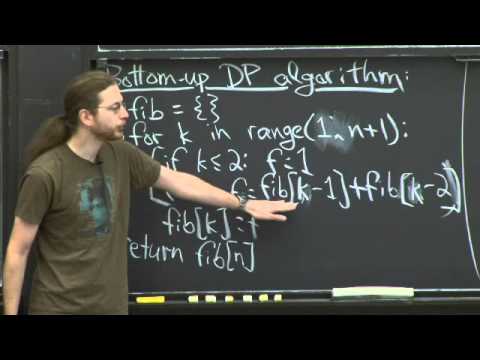
Erik Demaine's MIT 6.006 lecture introducing dynamic programming through Fibonacci numbers and shortest paths. It covers memoization, subproblems and optimal substructure.
Why Hacker News points people here: Recommended as a clear introduction to dynamic programming from a well-regarded instructor.
When you deal with large data sets (e.g. Hadoop/Spark...), BigO starts to hit badly. Dynamic Programming also requires you to have a clue about it. See this video for some cool explanations.
RecommendsgbaconApr 2019
“You may also like a couple of lectures by Erik Demaine”
Erik Demaine's MIT lecture on dynamic programming
Full comment
You may also like a couple of lectures by Erik Demaine: Dynamic Programming I: Fibonacci, Shortest Paths this video Dynamic Programming II: Text Justification, Blackjack link
RecommendsdehrmannFeb 2021
“I liked the MIT lecture on it”
Liked MIT lecture on dynamic programming
Full comment
I don't think I've ever been asked a DP problem in an interview, and only had to use it while programming once . That said, I liked the MIT lecture on it: this video
RecommendsdominotwApr 2021
“Please watch this MIT intro”
Intro to dynamic programming, correcting misconceptions
Full comment
> on interviews they want you to explicitly construct the array very often i.e. it's the different between hire and a strong hire exactly because @lru_cache is much easier are you serious? someone really asked you to "use array". Beyond stupid if they really did. > you can easily blow the stack for real production grade implementations using recursion recursive solution doesn't automatically mean using a the method stack. you can implement recursive solutions using explicit stack . > dynamic programming proper please. There is no "proper" dynamic programming. Please watch this MIT intro this video .