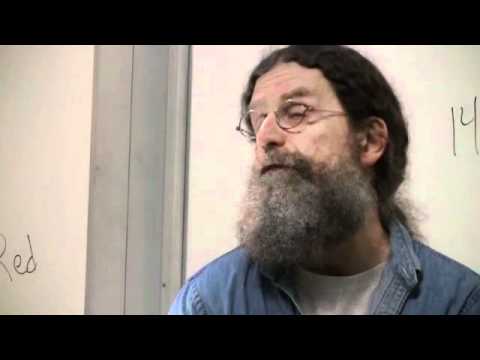
The opening lecture of Robert Sapolsky's Stanford course on Human Behavioral Biology, explaining the course premise and how to avoid categorical thinking. It starts a roughly 25-lecture series on how biology, genes, hormones and environment shape behavior.
Why Hacker News points people here: One of the most consistently recommended lecture series on HN, praised as fascinating, funny and eye-opening about human behavior across many scales.
“this 25 hour video course is also a must see for pretty much everyone”
25-hour Stanford course on behavioral biology
Full comment
That's well known if you ever took evolutionary biology course, or game theory course. Even popular books like Richard Dawkins' "The Selfish Gene" talk in some detail about it, and this 25 hour video course is also a must see for pretty much everyone: this video
Strongly recommendsploomansJun 2015
“For me one of the best teachers you will find online”
Sapolsky's lecture series on biology of behavior
Full comment
BTW, you should watch his lecture series on the biology of behaviour: this video For me one of the best teachers you will find online
Strongly recommendsguzmanovichMar 2016
“Fascinating, funny and gives insights into many different topics like cultural differences and nationalism.”
Fascinating, funny lectures on many topics
Full comment
Robert Sapolsky`s lectures on human behavioral biology. Fascinating, funny and gives insights into many different topics like cultural differences and nationalism. this video
Strongly recommendsFrozenlockMay 2016
“I would recommend the complete playlist to anyone here. It is simply fascinating.”
Shows how susceptible we are to hormones; eye-opening
Full comment
I like that you accept to evaluate someone else's position before instantly putting them into the little "bigot" box. It's much better to leave traces of your thinking process, instead of simply declaring that your conclusions are the only ones that are acceptable and others are idiots. Let's take me for example. It just so happens that I'm rethinking my position on interracial marriage (yes, really). I haven't reached any solid conclusion yet, but I'm not as sure of my position as I once was. My current uncertainty is based on a few things I learned in the past few years. First, Sapolky's excellent "Human Behavioral Biology" did show me how incredibly susceptible we are to hormones; how a tiny little change can have huge impacts in our daily life. The part on delaying gratification was also eye opening for me. Some people are wired in a way that makes it very difficult for them to refuse a cookie now in exchange for two cookies later. So it's not necessarily that you are making a greater effort; you might be born in a way that makes it easier for you for delay gratification. I would recommend the complete playlist to anyone here. It is simply fascinating. this video Second, the psychology professor Jordan B Peterson ( link ) teaches how an amazing predictor of success IQ is. You can see a little of what he has to say here: link Then I learned how IQ is highly correlated to genetics (from 0.75 to 0.8). By the way, for you parents, this means that you might not be as good tut
Strongly recommendsyesenadamNov 2017
“Best course I've ever done.”
Accessible multi-scale course from evolution to brains and genes
Full comment
Try Sapolsky's incredible 25-or-so-part online lectures on Biology of Human Behavior. A great lecturer on a most fascinating subject, it's accessible to a general audience. Covers the topic on all different levels, scales, approaches, from evolutionary psychology to the minutiae of brains and genes, with a lot of stories about the discoveries and researchers involved, and jokes, he's a funny guy. Best course I've ever done. Part 1: this video
Strongly recommendsjmcqk6Mar 2019
“I would highly recommend Robert Sapolsky's course "Human Behavioral Biology" from stanford.”
Stanford lectures that taught the commenter a lot
Full comment
If people are interested in exploring this topic, I would highly recommend Robert Sapolsky's course "Human Behavioral Biology" from stanford. The lectures are all available on YouTube and I learned so much from them: this video
Strongly recommendsnomilkJan 2023
“A rare combination of both extremely important and extremely interesting.”
Gripping, important lecture series
Full comment
Bob Sapolsky's Stanford Biology lecture series is... amazing. A rare combination of both extremely important and extremely interesting. If you watch just 3 or 4 minutes, you'll struggle to stop watching. this video
Strongly recommendsculiApr 2023
“I also highly recommend Sapolsky's Human Behavior Biology course which he taught for Stanford but published on YouTube”
Sapolsky's course on human behavior biology
Full comment
for anyone unaware, this is a book by Stanford professor Robert Sapolsky: link The book is about stress and the impact of glucocorticoids on the body. The chemical stress response used in "the wild" by animals is actually the same as the stress response we have when worrying about losing our job, not being able to complete a paper for school, dealing with poverty, etc. It's a partial explanation for why modern humans have so many chronic diseases that are rarely seen in other animals (or even archeological/anthropological evidence of non-industrial societies but he doesn't really go there much in the book) I also highly recommend Sapolsky's Human Behavior Biology course which he taught for Stanford but published on YouTube: this video
Recommendsehsanu1Jun 2012
“Here's a 25 lecture course from Stanford that explains just that”
Course explaining how evolution works at all levels
Full comment
This is a common fallacy about evolution, and is explained beautifully by the anthropic principle, or in other words, the innate selection bias of our existence. I'm a little confused about how the anthropic principle explains this fallacy (and it is a fallacy to be sure). I guess you're referring to how natural selection (and all the other sorts of selection that occur regularly) lead to the existence of "appropriate" organisms and features. But I think knowing some of the actual details in how evolution works at all the different levels (molecular bio, epigenetics, competition/cooperation, behavior, etc, etc, etc) serves as an even better explanation. Here's a 25 lecture course from Stanford that explains just that: this video
RecommendsdaodedickinsonAug 2015
“Dr. Sapolsky, in this lecture series, explains, for just one example, how and why Lamarckian evolution sometimes occurs”
Sapolsky explains environment effects on genes, including Lamarckian evolution
Full comment
There are definitely known links between psychology and genes; we know the epigenetics behind why if mothers are stressed when pregnant, their children will be more stressed for their entire lives. Far too many people still have the Jurassic Park view of DNA and believe in Central Dogma—but it has become clear that environment and all sorts of post-conception events effect genetics. Dr. Sapolsky, in this lecture series, explains, for just one example, how and why Lamarckian evolution sometimes occurs: this video
RecommendsmrdoopsSep 2019
“Sapolsky's lectures are great for getting a Biology perspective to how human's operate.”
Biology perspective on how humans operate
Full comment
Trial and error as a programmer dealing with depression and anxiety accounts for a lot, but for resources I'd point you to Robert Sapolsky's lectures on Behavioral Biology (here: this video ). Sapolsky's lectures are great for getting a Biology perspective to how human's operate. Jordan Peterson's has lectures on Personality (here: link ) which are also great and echo similar ideas from a Psychology perspective.
Recommendsi2sharOct 2019
“the initial few lectures from Robert Sapolsky's lecture series[1] were an eyeopener for me.”
Explains how environment affects epigenetics mechanistically
Full comment
Also, the initial few lectures from Robert Sapolsky's lecture series[1] were an eyeopener for me. The exact mechanism of how environment affects epigenetics (transcription factors, etc.) was really fascinating! [1] this video
RecommendseastendguyJul 2021
“High-quality lecture series around the same topic (Human Behavioral Biology)”
High-quality lecture series on related topic
Full comment
This blog post is low quality marketing/SEO copy and paste. But the topic itself is very interesting. High-quality lecture series around the same topic (Human Behavioral Biology) this video
Recommendszer00eyzMar 2023
“Robert Sapolsky has a Stanford lecture series on this”
Biology of behavior and aggression
Full comment
> - I got more confrontational which almost got me into fights, but also got me laid These systems are likely deeply tangled up in your biology. Robert Sapolsky has a Stanford lecture series on this: this video Well worth a watch!
RecommendsphilipovAug 2024
“Anyone who wants to look at heritability numbers should make sure to watch these lectures first.”
Explains misleading heritability statistics and twin study confounders
Full comment
Anyone who wants to look at heritability numbers should make sure to watch these lectures first. Heritability is often a misleading stat, because it has an unintuitive definition. Sapolskiy covers common failings of heritability numbers, as well as confounding factors for twin studies. linklink Full Lectures: this video An example of how non-intuitive heritability is: whether a person wears earrings or not would be a heritable trait if we're looking at mid-20th century America, because the variability is entirely explained by whether you're male or female. Heritability is unable to identify whether a trait is caused by genetics, only whether the variation correlates with genetics.
Cites ittotetsuAug 2020
“Robert Sapolsky - Introduction to Human Behavioral Biology”
Full comment
on "What's the right way to understand and model personality?" Personality is an outdated concept, personality types triply so. There is no fundamental stability of personality, just behavior context. Christian Miller - The character gap linklink Robert Sapolsky - Introduction to Human Behavioral Biology this video
Cites itcolechristensenJan 2022
“Good arguments are resources by Robert Sapolsky”
Sapolsky as a good source on stress and inequality
Full comment
Many studies show chemical markers of these things, it's not just psychological behavioral studies (which are often quite dubious) but easily measurable outcomes. If you're thinking quite narrowly, your point seems reasonable, it's probably below significance to say your neighbor with the bigger house and nicer car is "healthier", but this is a lot different than them vs the family that sometimes skips meals because they can't afford to put food on the table with the knowledge that a lost job will mean homelessness. Good arguments are resources by Robert Sapolsky link or this video or any of the books he has published (many have significantly overlapping content)
Cites itbelornOct 2022Full comment
Question like those is why researchers goes to animal observations. Easier to make conclusions without introducing too much cultural assumptions. In the jungle people find a dead young female baboon. She is apparently dead from starvation, so we hastily conclude it was natural causes. The researcher however who observed the flock gives a different explanation. The young female was healthy just a few weeks ago, but after joining the flock she got continuously bitten and scratched by other females whenever she went to eat or tried to sleep. After weeks of constant stress, lack of sleep and food she died. In contrast we might find a dead young male baboon clearly beaten to death. They joined the same flock recently and after a large fight over dominance the young male acquired injuries and died. Which of the two cases displayed more capacity for violence, brutality or aggressiveness? Is a brawl better or worse than cold calculated murder? > why did we come to have a culture that fears men Very good question. One likely answer is that we have a culture that reward men who commit violence in the right context. Why do men get rewarded for violence? There are many contradicting theories and books on that subject. Are humans inherently violent or peaceful? Is society holding back the savage beast or is cooperation the human default behavior? A lot of questions, a lot of research, a lot of theories. If you want to dig down into those question there are good books and other sources on
Cites itsitkackDec 2022
“explains the basic premise of the course and how he aims to avoid categorical thinking.”
Opening lecture explaining course premise and avoiding categorical thinking
Full comment
> Stanford professor Robert Sapolsky gave the opening lecture of the course entitled Human Behavioral Biology and explains the basic premise of the course and how he aims to avoid categorical thinking. this video
Cites itgobdovanMay 2026
“It was recommended by Robert Sapolsky in his Introduction to Human Behavioral Biology lecture series”
Full comment
It's even more amazing when you think about Christianity not as a clear category, but as a cloud of practices, beliefs and institutions in a broader family of religious patterns. Mircea Eliade asks how Christianity reinterpreted sacred history, myth, salvation. What does Christianity do with motifs older than itself, such as paradise, rebirth, sacrifice? In A History of Religious Ideas [0], he treats the emergence and development of Christianity, including Judaism, early Christianity, Gnosticism, late antiquity, medieval religious forms and also how it interacted with other traditions. I think it complements quite nicely the geographical spread of Christianity by also clarifying what kind of transformations of religious symbols make it recognisable as Christianity across such different contexts. There's also "Darwin's Cathedral" [1] that analyses religion as group-organizing system, with a focus on Calvinism. Didn't go through it, but seems relevant. It was recommended by Robert Sapolsky in his Introduction to Human Behavioral Biology lecture series [2]. [0] A History of Religious Ideas - Mircea Eliade [1] Darwin's Cathedral - David Sloan Wilson [2] this video