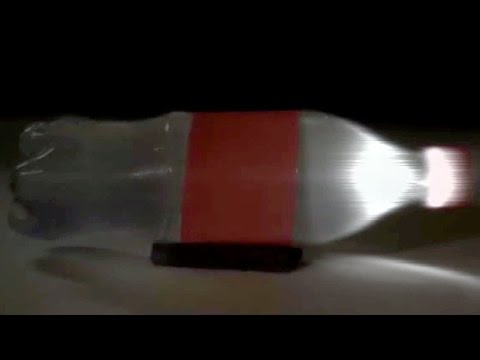
MIT Media Lab shows an imaging system capturing a trillion frames per second, fast enough to film light pulses travelling through objects in slow motion.
Why Hacker News points people here: HN cites it as the original and still-wow reference whenever newer ultra-high-speed light imaging comes up.
Since you are finding about femto-photo today, I think you are gonna love this: linkthis video By the way. Femto laser are somewhat common nowadays. They are used in eye surgery and microscopy. I even seem papers talking about using them in finger print scanners! See Optical coherence tomography for more info.
Cites itjcrDec 2011
“MIT researchers have created a new imaging system that can acquire visual data at a rate of one trillion exposures per second.”
MIT camera capturing light at a trillion fps
Full comment
The relevant video from MIT Media Lab is here: this video > MIT researchers have created a new imaging system that can acquire visual data at a rate of one trillion exposures per second. That's fast enough to produce a slow-motion video of light traveling through objects. > link
Cites itsoulofmischiefNov 2024
“One of the coolest things I'd ever seen.”
Prior art capturing light in a coke bottle
Full comment
For those curious, here is prior art from 12 years ago, capturing light in a coke bottle with a single streak camera. this videolink I remember when this dropped and where I was when I watched it and read the paper. One of the coolest things I'd ever seen. This seems like a great extension of the work. I'm okay with trading accuracy for crude usefulness as a model. Making this interactive and putting it in the hands of curious minds is the next step.
Cites ititishappyNov 2024
Earlier video used a blank red label
Full comment
> There's zero purpose for having a bottle with any label. Light interacts quite differently with the label than the material of the bottle. We get to observe scattering, diffusion, color... y'know, science stuff. It is rather interesting that the first video (from 12 years ago) used a blank red label instead. (See how it differs in from the rest of the bottle? I particularly like how it obscures the pulse itself and highlights the wavefront on the surface.) this video
Cites ititishappyNov 2024
“It's quite realistic, here's the same thing without AI”
Same effect captured without AI
Full comment
It's quite realistic, here's the same thing without AI: this video I still share your concern, however, particularly because they seem to be avoid moving the camera without time moving as well. I was expecting bullet-time!
Cites itwesturnerMay 2025
High-speed imaging of light pulses
Full comment
Photons certainly appear to have a real physical location with 1e9 FPS imaging capabilities: "Visualizing video at the speed of light — one trillion frames per second" (2012) this video But is there an identity function for a photon(s), and is "time-polarization" necessary for defining an identity function for photons?
Cites itgetpostAug 2025
“Video with explanation.”
Video explaining 1.7 ps exposure imaging
Full comment
It's an apples-to-oranges comparison, but I'm reminded of the ~10^12 fps (1.7 ps exposures) demonstrated in work at MIT[0], which was for a completely different application. [0] link EDIT: Video with explanation. this video
Cites itjval43Oct 2025
“The original MIT video from 2011”
Original MIT video that inspired the project
Full comment
The original MIT video from 2011: "Visualizing video at the speed of light — one trillion frames per second" this video (project site: link ) He mentions this as the inspiration in his previous video ( link ).
Cites itwesturnerOct 2025
Earlier trillion-fps MIT work
Full comment
"Visualizing video at the speed of light — one trillion frames per second" (2011; MIT) this video "Single-shot real-time femtosecond imaging of temporal focusing" (2018) link "Filming the Speed of Light at 10 Trillion FPS" (2019; The Slow Mo Guys) link