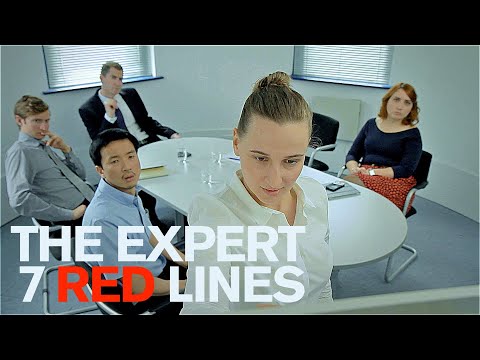
A comedy sketch of a business meeting in which an engineer, the expert, is asked to do impossible things like draw red lines with blue ink.
Why Hacker News points people here: Shared constantly as a painfully accurate depiction of absurd requirements, clueless management and estimation pressure.
“Relevant clip perfectly highlighting the problems you have during requirement analysis”HN comment, 2021
I really enjoyed the post. I reminded me a lot of this Youtube video( this video ). I understand this is a comical post but as the son of a carpenter and understanding the profession decently well I would say these are none of the questions that would be asked of a carpenter. There are however many important questions a person would need to answer to be hired as a carpenter or more likely be able to join a union. There they would be able to get experience and training. Then the company the union carpenter work for already knows the skills and abilities they have and there is really no need for any interview. Any GC or sub asks for guys to do a job. The local sends them the qualified guys. Pretty simple actually.
JokeTerr_Oct 2014
“I'm sure this clip has probably crossed your screen before”
Full comment
> to appear utterly confident in his ideas and proposals I'm sure this clip has probably crossed your screen before, but I think that protagonist eventually realizes he has to out-BS the BS: this video
Jokes_kilkFeb 2015
“Jesus, that's painfully real.”
Full comment
> I really enjoyed the post. I reminded me a lot of this Youtube video( this video ). Jesus, that's painfully real.
JokeameliusApr 2015
“The Expert (Short Comedy Sketch)”
Full comment
Or ask somebody to draw three lines on a whiteboard that are mutually perpendicular ([1]) [1] The Expert (Short Comedy Sketch), this video
JokeNadyaJul 2016
“The alternative to micro-managing is asking for the impossible [0].”
Full comment
>If you did your job right, you have people that are much more experienced than yourself. "You hired me as your UX expert. I use A/B trials, prior trials, studies, and knowledge I've pieced together over the past 20 years." The question of "What are you even paying me for if you're going to ignore my advice?" is one I'd love to ask but fear getting fired for pointing it out. The alternative to micro-managing is asking for the impossible [0]. Which also happens frequently. I was once asked to make a transparent .jpg because .png are "too heavy". I had to explain how .jpg's work, tell them I could make it a .gif, but that the .png compressed better and would be more lightweight than the .gif. They insisted on the .jpg at which point I gave up, matched the jpg's background color to the blue background they had and saved it as a .jpg. Which turned out to still be a bigger file size than the equivalent .png. [0] this video
Jokerthomas6Aug 2018
“you need enough people with enough domain knowledge to avoid this situation”
Full comment
Yes, this is a major con! Luckily my job involves a lot of R&D for the government, so UX and customer adoption isn't as important, though it still is important. Like other commenters have said, you need a balance. A workplace where everyone does not understand what the customer wants is crazy. A workplace where (almost) everyone does not understand any technical details of how to build what the customer wants is also crazy. Basically, you need enough people with enough domain knowledge to avoid this situation: this video
JokeDanielBMarkhamSep 2018
“Obligatory link”
Full comment
Completely agree. They don't flub around trying to figure out and contextualize issues. They're able to both categorize the issue and the disagreement and present in ways that everybody can consume.* We're not all so lucky, though. Many times I've had to tell teams "This is going to sound right. Please forgive me because I'm concerned about X". You can't replace that kind of give-and-take with wordsmithing. The second skill I've noticed is to be a storytelling master. Great leaders tell engaging stories that emotionally draw you into their way of seeing things. *A problem occurs when the leader thinks they know what's going on but they are mistaken. In this case better leadership skills can actually lead to poorer overall results. I've seen good people with mission-critical ideas get "facilitated" out of them by well-meaning, nice, and intelligent people who don't know what the hell they're talking about and are unable to accept that fact. Obligatory link: this video
JokejohnsonjoNov 2018
“These comments kind of reminded me of the comedy sketch, “The Expert” [1].”
Full comment
These comments kind of reminded me of the comedy sketch, “The Expert” [1]. When nobody else will say no to an idea your meeting might end up sounding like that. I agree though that you should let people know the constraints and alternatives if you want to help forge a path ahead for their ideas. [1]: this video
JokescouttOct 2019Full comment
9) The expert barely tolerates when the title 'expert' is used by everybody else to merely justify their lack of knowledge in a given area. "I don't know nothing about databases, but X/Y can solve it because he/she is the software expert". "I heard you are the expert in firmware, can you fix the coffee machine?" More or less like the fact one cannot play like Mozart just because Mozart was a 'genius' (putting aside all the effort he put into it since childhood), the same applies to the 'expert'. Edit: "The expert" this video
JokedeanCommieJan 2020
“I'll leave you with this "Expert" saying that something is simply not possible”
Full comment
> somebody said that a thing is simply not possible and a manager asked "but what if it was possible?" I've been an Individual Contributor, and a Manager, and am back to being an IC. I've been on both sides of this conversation. One of the benefits of being a manager is being able to see the forest from the trees while your team members may be so focused on their tasks they do not see the big picture. Sure, sometimes the answer to "but what if it was possible?" if just "it's not." But a lot of times, the good managers I've had would propose an approach to MAKING it possible that I just simply didn't see. And I've been able to do the same in their shoes. Sometimes it requires a paradigm shift - Q: "How do we get to the other town faster?" A: "The horses are running as fast as they can" Q: "What if we found a faster horse?" (e.g. a car) But honestly in day to day office culture it rarely needs to be so revolutionary - Q: "Could we finish the project faster if Bill's team helped us?" A: "No, it's not possible. Bill's team said they are completely swamped" <Goes off to do some managerial work> Q: "Okay, I've chatted to Bill, and his team is fully available to help us finish the project." I'll leave you with this "Expert" saying that something is simply not possible: this video And an actual expert showing how it can be done: link
JokenameloswMay 2020
“It reminds me of the video[0] which asks the developer to draw red lines with blue ink”
Full comment
I hate this so much. But it's so common. I was told not to mention the caveats, instead, render a confident image for the team many times in my career. It's like doctors suggest their patients to use some drugs without mentioning any side effects. It reminds me of the video[0] which asks the developer to draw red lines with blue ink, while the project manager keeps pushing the developer like "You're the expert, of course you can do draw red lines with blue ink!". [0] this video
JokejjavJun 2021
“But blindly following a "let's make it work" approach just leads to this”
Full comment
But blindly following a "let's make it work" approach just leads to this: this video An expert "That Can't Work" early saves a lot of time.
Jokelittlecranky67Dec 2021
“Relevant clip perfectly highlighting the problems you have during requirement analysis”
Full comment
Any analysis of a problem, requires understanding WHAT problem needs solving. The issue in real world is, buisnesses and markets (as well as technology) are changing very fast, and any in-depth analysis done two years ago might not have the same outcome as if done today again. This is a fundamental realization of agile. If you have a problem domain which is not subject to change, waterfall might be the right choice. But you almost never have that. I know it is hard to accept for us devs, often with backgrounds in Math/Physics/CS etc. because the problems we were trained to tackle there are always the same, and the laws of math and physics tend to never change (or change way slower than in modern markets). Relevant clip perfectly highlighting the problems you have during requirement analysis: this video
JokedmitriidJul 2022Full comment
We've been hearing that for years. And yet here we are. When an AI can understand and implement the customer's "parallel red lines some of which are perpendicular and some of them are green"[1], only then we're doomed. Until then, we're secure. [1] this video
JokexupybdFeb 2023
“That reminded me very much of this skit "The Expert".”
Full comment
> Often the business requirements are non-sensical, contradicting, or pointless. Someone has to actually figure out what they mean without pissing off steakholders. That reminded me very much of this skit "The Expert". this video
JokeiancmceachernApr 2023
“Once all your meetings turn to this you have to leave, or lobotomize yourself”
Full comment
It's basically this: this video Once all your meetings turn to this you have to leave, or lobotomize yourself
JokebtillySep 2023
“(A video about an expert being asked to do the impossible by people who have no idea what they are asked.)”
Full comment
The third 'no' is really well shown in this video . (A video about an expert being asked to do the impossible by people who have no idea what they are asked.)
JokeIanCalOct 2023
“Always a good time to rewatch the expert”
Full comment
Always a good time to rewatch the expert: this video > most people are okay at describing their problems, but suck at proposing solutions Yes, it's best to focus on their problems and the consequences of proposed solutions. They shouldn't care about your caching strategy internals but they do care about whether stale info impacts their users or what scale it's reasonable to hit, or how much extra it'll cost to implement.
JokeeloisantNov 2023Full comment
If it can pass it when you ask it in a way only a coder can write, then we will still need coders. If you need to tweak your prompt until you get the correct result, then we still need coders who can tell that the code is wrong. Ask Product Managers to use ChatGPT instead of coders and they will ask for 7 red lines all perpendicular to each other with one being green. this video
JokecitizenpaulOct 2025
“Oh snap that was some good "the expert" energy.”
Full comment
Oh snap that was some good "the expert" energy. this video Why cant we have parallel lines that intersect. Geometry.