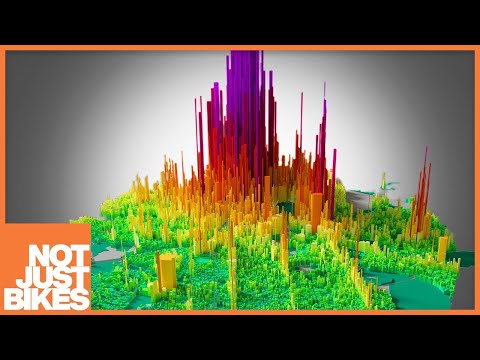
Not Just Bikes explains, using Urban3's property-tax analysis, why car-dependent suburbs generate less tax revenue than they cost to maintain, so dense urban cores effectively subsidize them. It is part of a Strong Towns series.
Why Hacker News points people here: The go-to link in urban planning threads for the claim that suburban infrastructure costs more per resident than it pays back.
Good overview of research showing downtown tax revenue subsidizes suburban sprawl.
Full comment
Because "Office Vacancy Rate in San Francisco Just Hit a New High", That means property owners aren't making money. Workers aren't out spending to come in, stay and leave. All that is taxable, which is why government officials want people back in the office. In every city, the downtown core's tax revenue subsidizes the suburban sprawl all around it. Good overview of the research on this: this video
RecommendsuoaeiJan 2023
“Here's a video about some of the studies done to come to this conclusion”
Video summarizing studies showing suburbs drain city budgets.
Full comment
If we taxed suburbs by how much they actually drain city budgets, no one would want to live in suburbs. It is by now a well-studied fact that suburbs are effectively subsidized by metropolitan cores. Makers and takers, indeed... Here's a video about some of the studies done to come to this conclusion: this video The folks at Strong Towns also talk a lot about productive land use measured as property tax income per square foot. They say it is the gold standard way to make sure your budget remains solvent and you can provide the services people need to make your city thrive. Obviously this means building up.
RecommendsjwestburyJun 2023
“he does have a great video on this”
Great video showing suburbs are economically supported by cities, despite disliking the host.
Full comment
Curious, have you considered the in-between here? Consider medium-density European cities, which still have massively higher density suburbs, but rarely the density -- combined employment and population densities -- of the urban core of most American cities. I hated living in Seattle, but I'm now an American finding I enjoy living in London. I walk around trees and birds every day, because I have good park access, and I can walk to them without having to worry about car traffic. For what it's worth, by the way, you almost certainly AREN'T willing to pay for the infrastructure that supports you: Suburbs are almost overwhelmingly economically supported by cities. I hate NotJustBikes (his self-righteous attitude is just awful), but he does have a great video on this: this video
RecommendsrglullisSep 2025
“The whole series of videos from Strong Towns are good, you should take a look”
Shows suburbs cost more per capita and generate less tax revenue.
Full comment
No, suburbs cost more per capita than people living in the inner city, generate less tax revenue and end up becoming a net negative to municipalities: this video The whole series of videos from Strong Towns are good, you should take a look: link
RecommendsgpvosFeb 2026
“I find the arguments of Strong Towns and Not Just Bikes quite compelling”
Compelling argument that suburban finances are unsound.
Full comment
Well, you're parking it in other places as well, I assume, unless you're only making pleasure rides with no stops at all. I am speaking more generally than just about your particular situation, which I obviously don't know. But in case you live in an American suburb: their entire financial setup is unsound, which arguably means even your own ground is subsidized. I find the arguments of Strong Towns and Not Just Bikes quite compelling: this video .
Cites itkd913Mar 2022
Suburbs as financial hole for cities
Full comment
>I sure do understand it, but I also understand that when it comes to comparing the environmental impact of upper middle class urbanites and suburbanites, we're splitting hairs Yea that is not at all true. You can literally compare the CO2 per capita for an average American/Canadian and someone from Europe and in general they produce 1/3 of the CO2. It is not a negligible difference. This is largely caused because of the urban designs which don't focus on gas dependent suburbia. Or the benefits from efficiency at scale which can only be achieved in high density living accommodations. link It is also a plain fact that downtown urban blocks are the profit generators for cities whilst suburbia is largely a financial hole. this video You looking at a classist angle is I think an internal bias. There are poor/rich in both areas. It's just a straight fact though that suburban design is not sustainable both economically and ecologically.
Cites itkarmelappleMar 2022
True cost of suburbs to cities
Full comment
> I'm not sure how we can hope to stop that inertia short of being limited by cheap energy or running out of actual land. Having the residents of the suburbs paying for their true cost seems like a great way to start: this video As the video points out, would people be willing to start paying $9000 in property taxes instead of $1800 to stop operating the city at a loss every year?
Cites itafioriMar 2022
“Essentially urban sprawl/suburbia/single family homes cost more for the city”
Suburban sprawl costs cities more than taxes bring in
Full comment
To add a reference: Suburbia is Subsidized: Here's the Math -> this video Essentially urban sprawl/suburbia/single family homes cost more for the city (road upkeep, water/gas pipes, etc.) than what they contribute in taxes, so many cities are in a positive feedback loop of building more houses to get quick money to do maintenance on the previous rounds of growth.
Cites itflukusApr 2022
Sprawl unsustainable in the long term
Full comment
> When the demand for houses rises, Flatland metropolitan areas, which don't really have traditional downtowns, just sprawl some more. And this is the driving force behind those cities going bankrupt, they're easy to build but not sustainable in the long term: this video
Cites itHammershaftApr 2022
Suburban infrastructure subsidized
Full comment
> Of course it will distort choices and leave some people worse off. If the author can't see that, then they have a serious bias problem. The whole point of the land value tax is to tax land to encourage higher density and higher cost use. Under our current system we subsidize low value land uses by subsidizing the crap out of infrastructure to expansions of suburban areas zoned for single family homes. this video The only revenue positive portion of nearly any modern american city/town are the few sparse walkable mixed use neighbourhoods and the dense urban core. Policies like a land value tax that push for higher value land uses are necessary to stave off the oncoming wave of municipal bankruptcies America faces. > Income tax would only provide a disincentive to work if the alternative (assistance programs) is more attractive. You are thinking in absolute terms and not on the margins. If the marginal income tax beyond a threshold jumps by %10, then even discounting the increasingly marginal value of each additional dollar earned I will value the return on work less when I hit that tax threshold.
Cites itkogepathicApr 2022
Urban sprawl unsustainable at current tax rates
Full comment
> 1 house - tax breaks Why should society be subsidizing home ownership more than they already do? The real estate market already discriminates against people who cannot afford a deposit (an increasing proportion of people, since house prices are increasing so rapidly), and the design of North American cities encourages urban spawl which is unsustainable with current property tax rates. [1] > and I think to promote everyone's owning a house Why? Half of German households rent [2] and no one is wringing their hands about how people should be owning their home instead of renting. As someone who has lived in Europe and North America, there seems to be a borderline obsession with owning a house in anglophone countries, and I don't understand why. If the rental market is sane (e.g. rent is approximately equivalent to a mortgage) then it's up to the individual if they want to purchase a home (e.g. to renovate how they see fit) or is comfortable just renting. [1] this video [2] link
Cites itbelligerontJun 2022
“Suburban infrastructure is much more costly per resident than urban infrastructure.”
Suburban infrastructure costlier per resident than urban
Full comment
Suburban infrastructure is much more costly per resident than urban infrastructure. However, we massively subsidize suburban infrastructure and restrict urban environments with zoning. this videolink
Cites itthrow0101aAug 2022
Math behind suburbs being subsidized by dense city cores.
Full comment
> So why don't the cities expand their boundaries to include the suburbs […] Why would anyone want to absorb something that costs more to run to provide the same services? * link > […] instead of trying to kill the suburbs and pull the people back into the city (where they will generally be unhappy since they had chosen to live in suburbs in the first place)? Perhaps they want to kill them because they are wasteful of area (often paving over perfectly good agricultural land), and cause climate change due to their reliance on cars. Further, how much "choice" did suburban dwellers actually have? Post-WW2 most zoning has forced the creation of car-centric, low-density sprawl. Perhaps there are folks in the suburbs that want higher density neighbourhoods but because of the limited supply (due to lack of new build) the prices have gone up and they're priced out. Whose to say that walkable neighbourhoods wouldn't be popular if purchased in the "suburbs: * link > † Side note: I have not found to be true, personally. I think this depends on the municipal boundaries involved. Depending on where the border is, on one side it could be that things built in the "old" / pre-WW2 way and on the other the "new" / post-WW2 way, and the taxes go to each municipality appropriately. In other places there could be the pre-WW2 Old Downtown and is walkable, but everything new is non-walkable. In those latter situations the more walkable parts are probably subsidizing the less walkable ones: * [V
Cites itgernbAug 2022
“They just need to start paying for their externities and stop relying on being subsidized by the dense urban areas.”
Argues suburbs rely on subsidies from dense urban areas.
Full comment
That's fine. They just need to start paying for their externities and stop relying on being subsidized by the dense urban areas. this video
Cites itmwest217Dec 2022
“Lots of resources on the subject from Strong Towns[1], Not Just Bikes[2], and various consulting firms like Urban3[3]”
Listed among resources on suburban finances.
Full comment
Lots of resources on the subject from Strong Towns[1], Not Just Bikes[2], and various consulting firms like Urban3[3] [1] link [2] this video [3] link
Cites itthrow0101cApr 2023
Cited as one source that density subsidizes low-density areas.
Full comment
> Who cares? People who want fiscally responsible government? "The Many Costs of Too Much Parking": * link And that's not even getting into high(er) density areas subsidizing low(er) density areas: * link * this video * link * link
Cites itfnimickJul 2023
“the suburbs are going bankrupt because car infrastructure is so expensive.”
Backs claim that suburbs are going bankrupt from car infrastructure costs.
Full comment
> That money doesn't come from nowhere, the roads are paid for by the property and gas taxes of those burbs. Two points: many roads get federal and state funding from the general tax fund meaning we all pay for them whether we drive or not, and the suburbs are going bankrupt because car infrastructure is so expensive. this video As for your other complaints, why is living in an apartment you own in a city with shared public spaces rather than owning private land such a downgrade?
Cites itfmobusFeb 2024
Supports claim that suburban land use is subsidized like a pyramid scheme.
Full comment
> The US is a continent spanning nation How is that relevant? No one commutes from NY to LA everyday, much as no one commutes from Berlin to Munich everyday. > and half the country does not live in a city Yes, and that's what I mean by "dumb land-use patterns". That people living in suburbs are not technically within a city's boundaries is a distinction without a difference. Land is wasted to highways and parking lots no one can cross without a two-ton machine, useless lawns no one really has time to enjoy or maintain, dumb McMansions that cost and arm and a leg and so on. And all of that is subsidised in what is effectively a [pyramid scheme]< this video >.
Cites itjodrellblankNov 2024
Linked for evidence that dense centers subsidize sparse suburbs.
Full comment
> There is just no way to economically justify bikelanes everywhere Roads pre-date cars. Cars muscled in and took over, forced humans off the roads onto sidewalks. Now car drivers say it cannot be economically justified for people to move around outside cars? This is "car-brain" thinking. If the cars were banned, people could walk and cycle and wheelchair and skate on the roads their taxes are already paying for . They aren't "car roads", they are just roads - cycles are allowed on them. Car drivers don't want to share, don't want to slow down, keep hitting and killing people, can't control their vehicles safely, so demand cyclists be moved somewhere else - then complain about the cost of doing that! People say cars have taken over, they want somewhere safe from the dangers of cars, car drivers say no it's too expensive to make yourself safe from me commuting through the places you live and work ! It's crazy land. As if the only reason Christchurch exists at all is for cars to drive through . Can you point to a report that has a cost/beneift analysis of each individual road in Christchurch? Because when Urban3 set out to find out that kind of thing in USA and Canadian cities[2] they found that the dense urban centers ("poor") were the parts of a city with enough tax revenue to cover their infrastructure costs, and the sparse suburbs ("rich") were being subsidised by them. The people in city center apartments, possibly without cars, possibly transit riders, pay for the sprawli
Cites itnehal3mSep 2025
“low density suburbs are subsidised by high density cities”
Cited for low-density suburbs being subsidized by dense cities.
Full comment
The current cost of owning and operating an automobile is around 12K USD assuming 15K miles driven yearly according to BTS [0]. This would push it up to a little over 14K USD. Then there's oil and gas subsidies that should be taken into account, since around 24% of oil consumption is from cars and light trucks. [1] Then there's some other factors that are hard to quantify but have a huge impact on taxes, like how low density suburbs are subsidised by high density cities [2] as an effect of car-first infrastructure. It's not as simple as just the cost of roads. [0] link [1] link [2] this video