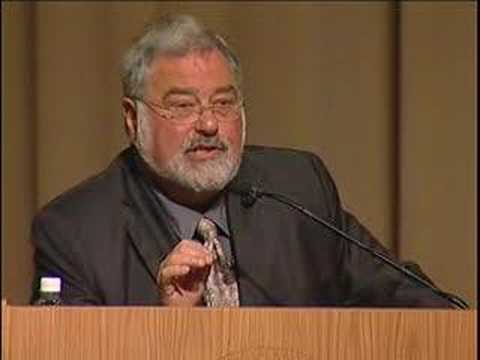
Cognitive scientist George Lakoff lectures on how political debates are framed through language and metaphors tied to values, and on the moral worldviews behind progressive and conservative politics. It was given in 2005 at UC San Diego.
Why Hacker News points people here: HN commenters repeatedly say it changed how they hear political speech and recommend it for understanding why opponents are not simply stupid.
“This talk changed my view on political speech and narrative dramatically.”
Explains how metaphors from upbringing shape political worldviews.
Full comment
I highly recommend the Moral Politics talk by Linguistics professor George Lakoff: this video In short, the two sides of the debate speak different language representing different world views rooted in upbringing and triggered / exploited by metaphors. This talk changed my view on political speech and narrative dramatically.
Strongly recommendsandrei_says_Jun 2016
“Changed how I process political speech and pretty much any media-supported narrative.”
Explains think-tank framing with metaphors to influence politics.
Full comment
I think you'll enjoy this lecture by linguistics professor George Lakoff: this video Among other things he speaks of the think-tank-driven concerted effort to influence political support by using language invoking specific metaphors to frame important issues. Like "Tax Relief" for dramatically reducing taxes for the rich etc. Changed how I process political speech and pretty much any media-supported narrative.
Strongly recommendsandrei_says_Mar 2017
“I found it extremely valuable in understanding the driving and defining forces behind the two movements.”
Linguistic analysis of conservative versus liberal speech and metaphors.
Full comment
George Lakoff did an excellent linguistic analysis of conservative vs. liberal political speech, metaphors and framing in his lecture Moral Politics. I found it extremely valuable in understanding the driving and defining forces behind the two movements. this video
Strongly recommendsandrei_says_Oct 2019
“You will never listen/read political speech the same.”
Exposes leverage hooks politicians use to manipulate audiences.
Full comment
His framelab podcasts are informal and easily digestable. link I highly recommend * truth sandwich time (if you only listen to one make it this one) * how republicans really think (if you only listen to one make it this one, too) * how trump uses twitter to control the media (very eye opening) * guns over people (on how to frame the gun debate) Also, this lecture on political language exposes the leverage hooks politicians and propagandists use to hook and manipulate us. You will never listen/read political speech the same. this video
Strongly recommendsandrei_says_Nov 2019
“It will change how you listen to political speech”
Changes how you hear political speech targeted at other orientations.
Full comment
May I recommend this talk on the neuroscience of language and thought by George Lakoff? link And also this one on political language, morals and metaphors? It will change how you listen to political speech, and especially political speech targeting people with different political orientation -- which can often sound nonsensical, but is actually carefully constructed to activate their metaphors. this video Basically, the ideas of enlightenment (we are rational beings) are not true. A couple of slides from the first lecture: Myth: Reason is conscious, you know what you think. Science: Reason is mostly unconscious, estimates are about 98% unconscious. Conscious thinking is linear. Brain circuitry is massively parallel. Myth: Ideas are made meaningful via their direct connections to the external world. Meaning is a matter of truth conditions. Science: Ideas are made meaningful via the brain's connections to the body and our embodied experience. Myth: Emotion gets in the way of rationality. Science: Emotion is necessary for rationality.
Strongly recommendsandrei_says_Mar 2021
“Changed how I listen - to anyone - forever.”
Lecture on framing and metaphors in political discourse.
Full comment
I highly recommend Lakoff’s lecture on framing and metaphors in political speech and discourse. Changed how I listen - to anyone - forever. this video His framelab podcast is also excellent.
Strongly recommendsandrei_says_Apr 2022
“Changed how I listen to mass media and political speech.”
Addresses nonsensical speech, metaphors and framing in political media.
Full comment
In this lecture on Moral Politics, George Lakoff addresses the “nonsensical” speech, metaphors, framing and more. Changed how I listen to mass media and political speech. this video Also highly recommend his Truth Samndwich methodology to defanging propaganda messages in the media. link
Strongly recommendsandrei_says_Oct 2024
“Instantaneous understanding of political language and identity politics.”
Instant understanding of political language and identity politics.
Full comment
Russ Olsen, author of Getting Closure, Eloquent Ruby and Design Patterns with Ruby, telling the story of the moon landing as a conference talk. Inspired me beyond measure and brought tears to my eyes. link —- George Lakoff’s lecture on Moral Politics. Instantaneous understanding of political language and identity politics. Incredibly important, especially today in time of extreme polarization. this video —- Sir Ken Robinson: Do Schools Kill Creativity link
Recommendsandrei_says_Jun 2016
“You may want to take a look at this lecture to see why language is so important and influential.”
Shows why language is important and influential.
Full comment
He refuses to use the commonly established language which distorts reality. It is a radical choice (given how well established the manipulative language is). I can see how some may find this irritating. You may want to take a look at this lecture to see why language is so important and influential. this video
RecommendsTheSpiceIsLifeAug 2016
“people who have different political opinions to you aren't necessarily stupid or greedy or bad actors”
Opponents have different morals and rationales, not stupidity.
Full comment
On that note, I found this talk on Moral Politics by George Lakoff[1] elsewhere on HN. The basic idea is that people who have different political opinions to you aren't necessarily stupid or greedy or bad actors, they just have different morals and therefore a different set of rationales. 1. this video
RecommendsTheSpiceIsLifeOct 2016
“George Lakoff give's this a fairly good treatment in this”
Treats Left and Right as having different moral experiences.
Full comment
You've probably seen this, but for those who haven't George Lakoff give's this a fairly good treatment in this[1] on 'Moral Politics'. By 'this' I mean the idea that the Left and the Right have different experiences of what is moral. My issue with politics is that I think we need to extricate it from morality. Like we have separation of Church and State a la Secular Society, we need amoral politics. 1. this video
Recommendsandrei_says_May 2018
“For more on framing, see George Lakoff’s lecture on moral politics”
Reveals how political language uses metaphors and framing to win debates.
Full comment
This would be a great way to prevent polititians from framing the bills. For more on framing, see George Lakoff’s lecture on moral politics — reveals the way political language uses metaphors and How framing a debate ensures its outcome. Repeating the frame reinforces the intended meaning. Merely Using the name of the bill defines its outcome. “Tax Relief” - no one wants to fight a “relief” effort. Tax cuts for the rich would be the correct name. “Clear sky initiative” is the name of a clear cutting bill. this video
Recommendspdkl95Jan 2019
“For a good explanation of how this works, George Lakoff's lecture”
Good explanation of how language establishes social hierarchy.
Full comment
The right[2] looks at intent because that's what matters in a hierarchical view of society. This division is from a fundamental difference in what societies are. This can be observed din how they use language; from one of the most enlightening articles[1] I've ever read: > One of the biggest problems of the entire Culture Wars is that people like us [the left[2]] use language impart information. We usually are not aware that a nice big chunk of population does not use language in that way at all. Their use of language is that of Phatic Language [...] In a hierarchical society [the right[2]], language is [often] not used for exchange of information [...] It is used to establish social hierarchy. For a good explanation of how this works, George Lakoff's lecture[3] "Moral Politics". [1] link [2] The "left"/"right" labels are being use in a general psychological sense, which doesn't always match the political groups with the same names. [3] this video
Cites itTheSpiceIsLifeAug 2016
“which side of the argument a person lands on probably depends on their moral politics”
Cited for progressive versus conservative moral divide.
Full comment
I tend to lean toward agreeing with you, by the way, but the other side of this argument is: We already know that giving money and food to poor people doesn't resolve poverty, when the aid / social welfare stops the poverty returns because aid / welfare prevents people from innovating your way out of poverty. Of course, which side of the argument a person lands on probably depends on their moral politics, see[1] - basically I'm referring to the progressive vs. conservative divide. Fortunately for me I live in Australia where we have social welfare to the tune of $527.60 a fortnight for a single adult[2], and $952.80 for a couple. But of course we still have bunches of poverty, but I've never been to the US so I can't really say how it compares. Also, I think the example of the Nordic countries is a poor comparison. The 'Nordic Countries* as a whole have a population of 26.6 million, comparable to Australia. Sweden has a population of about 10 million, the others are close to half that or much less. In a country that has a population the size of Melbourne (4.5 million) or Sydney (4.9 million) I would imagine it would be a lot easier to want to care for other people. I think that matters a lot. 1. this video 2. link
Cites itpdkl95Jun 2017
“first you have to open a real dialog”
Cited to argue learning people's language is needed to persuade.
Full comment
TL;DR - skip straight to [1] > I'm not sure it is possible to convince someone It is possible, but first you have to open a real dialog. That isn't going to happen without first learning to speak their language , because this is "More than just Resistance to Science"[1]. > Only new facts will do the trick Arguments based on facts are useful when trying to persuade people fluent in the language of science and logic. Unfortunately I suspect only a minority of the population has sufficient understanding of data-focused language. Most people instead see language as phatic expression [2][3] first. A good example of this from the other side of the language divide that still retains mutual intelligibility are Trump's repeated - and often self-contradictory - promises that he would "build the wall". People that primarily use language to convey facts often claims his rhetoric sounds ignorant, useless, or xenophobic. Trump's intended audience, on the other hand, hears the language of emotion that promises protection. Trump isn't trying to convey facts , so self-contradiction and other ignorant claims are not important. To reach people on the other side of this divide, it is probably necessary to first learn their language of social hierarchy, emotion, etc. Skipping that step and continuing to throw facts at them is about as useful as sending them a textbook written in ancient Egyptian hieroglyphs. [1] link [2] link [3] While I'm discussing this as a language problem, some people ma