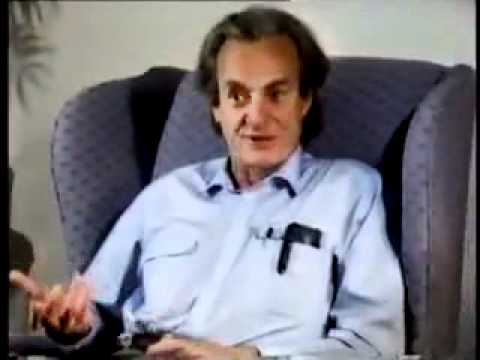
A short clip of Richard Feynman answering an interviewer's question about why magnets repel, explaining that a 'why' question depends on a shared framework of understanding. It illustrates how hard it is to explain fundamentals to a layperson.
Why Hacker News points people here: Cited constantly as the classic answer to 'why' questions, on explanation, frames of reference and the limits of physics.
“I like to refer people to Feynman's answer to a question about why magnets repel each other[0].”HN comment, 2020
“we can actually listen here Feynman's answer to " what is the meaning of... " and " why " questions”
Feynman on why questions needing a shared framework of understanding.
Full comment
And we can actually listen here Feynman's answer to " what is the meaning of... " and " why " questions: this video Note, despite the title of somebody presenting this segment of his talk, he definitely doesn't talk just about "magnets" but really about "the meaning" and "why" questions (the youtube poster got it). About the needed "expected framework" to avoid "perpetual why questions" etc. Even the things that we take for granted, e.g. using electricity in our day to day life, or the eventual "why" we don't fall through the floor can't be properly explained using just our "common" intuition. In another direction, it works, we are "used" to see some effects of the electrical forces all the time, so that's what is "intuitive" to us because we're familiar with it. So back to the original title of the article submission here: "why ... shrugged off the paradoxes..." it can be easily seen that once one is getting an answer inside of the expected framework, one doesn't "shrug it off," one is actually satisfied with the answer.
RecommendsGuthurSep 2019
“I think this video is a very good illustration of this fact”
Shows how hard it is to explain complex things to laypeople.
Full comment
It's not simple thing to explain non simple things in a way that it's comprehensible to a layman. I think this video is a very good illustration of this fact this video
RecommendstsbinzApr 2020
“I like to refer people to Feynman's answer to a question about why magnets repel each other[0].”
Feynman on why magnets repel and what explanation means.
Full comment
Regarding "fully" understanding physics, I like to refer people to Feynman's answer to a question about why magnets repel each other[0]. "Assuming something" is one integral part of the scientific method. You formulate a question, you build a hypothesis from prior knowledge, you make predictions, you test them, you analyze your results which might lead you to change your hypothesis or not. "Greatness" is finding simple hypotheses (like "the laws of physics are the same as viewed from any inertial frame and the speed of light is the same for every observer") that predict/"explain" effects that were inconsistent with prior hypotheses. Of course you can never really prove a model of the world is correct - another model that predicts differences that are too small for us to measure might be the "truth", but, until we can measure it, there isn't much use in pondering ... [0] this video
RecommendsrlpbMar 2021
“There's a really good clip by Richard Feynman on explanations and frames of reference”
Feynman on explanations and frames of reference.
Full comment
There's a really good clip by Richard Feynman on explanations and frames of reference: this video I think he does an excellent job of explaining why it's so hard to explain this type of thing.
RecommendsmagicalhippoFeb 2024
“Richard Feynman addresses a similar "why" question in a great way in this interview[1]”
Feynman on why why-questions are problematic in science.
Full comment
Richard Feynman addresses a similar "why" question in a great way in this interview[1], and how "why" questions are problematic in science. [1]: this video
Cites itgridlockdAug 2019
“Somewhat related: (Richard Feynman - Why)”
Full comment
DNA is neither hardware nor software, living organisms aren't computers. Bad analogies are going to frame your thinking and may prevent better understanding. They'll also set you up for fruitless discussions with people who don't like the analogy. Somewhat related: (Richard Feynman - Why) this video
Cites itGibbon1Sep 2019
“The take away is to answer a why question you need a framework to provide an acceptable answer.”
Full comment
Makes me think of this talk by Richard Feynman talking about magnets how do they work. this video The take away is to answer a why question you need a framework to provide an acceptable answer. Why the universe exists? We don't have possibility can't contain such a framework.
Cites itsushibowlOct 2019
“Indeed, questions of why are often metaphysical and can't truly be answered within the framework of physics.”
Full comment
Richard Feynman himself has a reply similar to yours in the documentary called "Fun To Imagine" when he is asked a why question, in that case related to the magnetic force: this video Indeed, questions of why are often metaphysical and can't truly be answered within the framework of physics.
Cites itarthtyagiOct 2020Full comment
There are a lot of underlying components to this question as with anything that's ever existed or will exist. this video
Cites itameliusMay 2021
“There is a nice video of Feynman about it, appropriately titled "Why"”
Full comment
> Science answers "why" questions all the time. Nope, science is just shifting the perspective. There is a nice video of Feynman about it, appropriately titled "Why": this video
Cites its_devJun 2022
“Feynman on 'Why'”
Full comment
Maybe you shouldn't be asking 'Why' repeatedly (that sounds threatening but isn't meant to be). Regulation is sufficient explanation for why something has a minimum price. By all means delve deeper but by going deeper you're changing the topic at hand. Why does regulation affect pricing of a good or service? That's another topic tangential to the one we're discussing. Feynman on 'Why': this video
Cites itdTalSep 2022
“You only get to the end of the chain when you hit the limits of theoretical physics”
Full comment
>When you ask “why?” questions you always get religious/philosophical answers No, that's silly. Most things have a reason. "Why" is a useful word in English outside of religion and philosophy. You only get to the end of the chain when you hit the limits of theoretical physics: this video > I cannot tell you why stuff amuses me, all I can tell you is that it amuses me. Do not confuse your inability to answer a question with unanswerability.
Cites itsimonswords82Oct 2022
“if you want serious insight around science, space and the universe hit up people like Richard Feynman...”
Full comment
Paul is well out of his depth here. We can all sit around pondering the universe - that's easy. Answering these questions is significantly harder - impossible given today's science. This essay reads like the ramblings of a man who's smoked too much weed. Paul should stick to tech start ups - if you want serious insight around science, space and the universe hit up people like Richard Feynman... this video
Cites itwinReInstallDec 2022Full comment
The problem is one of the precision of the question and the scope of the answer. Usually some questions are just indicative of a complete lack of understanding of the field, basically making a whole comp science course necessary to answer in depth. this video
Cites itmarginalia_nuMar 2023
“many teachers know the curriculum, but if you ask them a basic question, they won't answer the question with nearly the same depth for example Feynman[1] would have.”
Full comment
Probably not at this stage, but it seems at least conceivable that the technology may move in that direction. In general I think LLMs are very overhyped, but this is an area I do concede they could be very useful with some tweaking. Right now I think there's too much "and the kitchen sink" in the models, but a more selectively trained model might be very useful for this. Truth of the matter is that many teachers know the curriculum, but if you ask them a basic question, they won't answer the question with nearly the same depth for example Feynman[1] would have. Now educators with both the ability and depth of knowledge of Feynman is clearly a very limited resource. LLMs may just change that since they can be given the depth with relative ease, the rest of the owl is making them good educators as well. [1] this video
Cites itsdenton4Jul 2023
“Ask Feynman why magnets works... And he'll say no one knows.”
Full comment
Ask Feynman why magnets works... And he'll say no one knows. this video It's the same in ML. Good predictions do come from real ideas about how the systems work - ideas in information theory, entropy, cognitive science, statistical mechanics and so on - formulated in a context of our existing understanding and prior results. That's science.
Cites itabdullahkhalidsAug 2023
“Feynamn on why”
Full comment
We can't have a why, because the claim that the norm is L2 is axiomatic [1]. However, as the sibling comment notes, we can argue from consistency. Would any other norm give us a sensible theory? Or we can put quantum theory in a larger framework of theories and discuss why the L2 norm makes more sense within that framework. Scott Aaronson discusses some of these idea in his lecture [2]. [1] Feynamn on why this video [2] link
Cites itleeoniyaFeb 2026
“Feynman's classic "Why?" chain”
Full comment
i used something like this in unstructured technical interviews all the time. "you type a phrase into google search, you press enter, get some results. tell me, in technical detail, what happened in that chain of actions" the diversity of replies is fascinating, you learn a lot about a "full stack" candidate this way. Feynman's classic "Why?" chain: this video
CriticalZamicolAug 2020
“He says the same thing in this video”
Full comment
It's hard to explain because I found it so unremarkable and banal. But there was a small part of the book I took particular issue, "Your expectation on answering the question why goes deep. (No duh!) You might need to adjust your expectations of understanding to be less rigorous." He says the same thing in this video: this video It's basically his book. I think not only does this not match my personal experience, experience I've understood from others at large, but in particular Einstein who had deep insights because of his depths of understanding "why" in broad categories of topics. Einstein's brilliance was a synergistic understanding. Better, if we don't know something, it's best to say, "It's not yet understood" and explain expected horizons for exploration. I would compare this attitude to Sabine Hossenfelder who says, "Yes! We can figure things out including quantum gravity. It's not our 'why's' that are wrong, but almost certainly our (amazingly crazy) assumptions."
CriticalfuckstickNov 2022
“This would only fool someone that has never heard Feynman speak for an appreciable period”
Full comment
> I listened to the whole thing and I found it very convincing. Eh? "Lex Fridman's" voice is shaky as fuck in the first 30 seconds and apparently he can't pronounce science now? - it says sci-in. (It continues to be flawed - he sounds sick when he says UC Berkeley). If I heard this knowing it was really him I would be concerned he was having a stroke. His voice is defective enough that it is actually irritating to listen to. Also, the opening monologue doesn't sound much like Feynman's style - he was known for being irreverent, flippant, intense and maybe even occasionally dismissive - but not this aggressive - certainly in a sitdown interview he agreed to. Also hard to believe he would fuck up the word "interviewee". He wants to "walk"? and listen?. this video This would only fool someone that has never heard Feynman speak for an appreciable period - but then you might as well get a decent impersonator. And really the content doesn't hold up to even basic critical listening scrutiny. > They mostly don't say nonsense. Oh god dude, most of the material is false and easily verified as false from basic sources. It's mostly nonsense. EDIT: Ok listening to segment between 3:30 and 4:30 I know I'm being trolled.